
-
by sayum
25 August 2026 12:32 PM







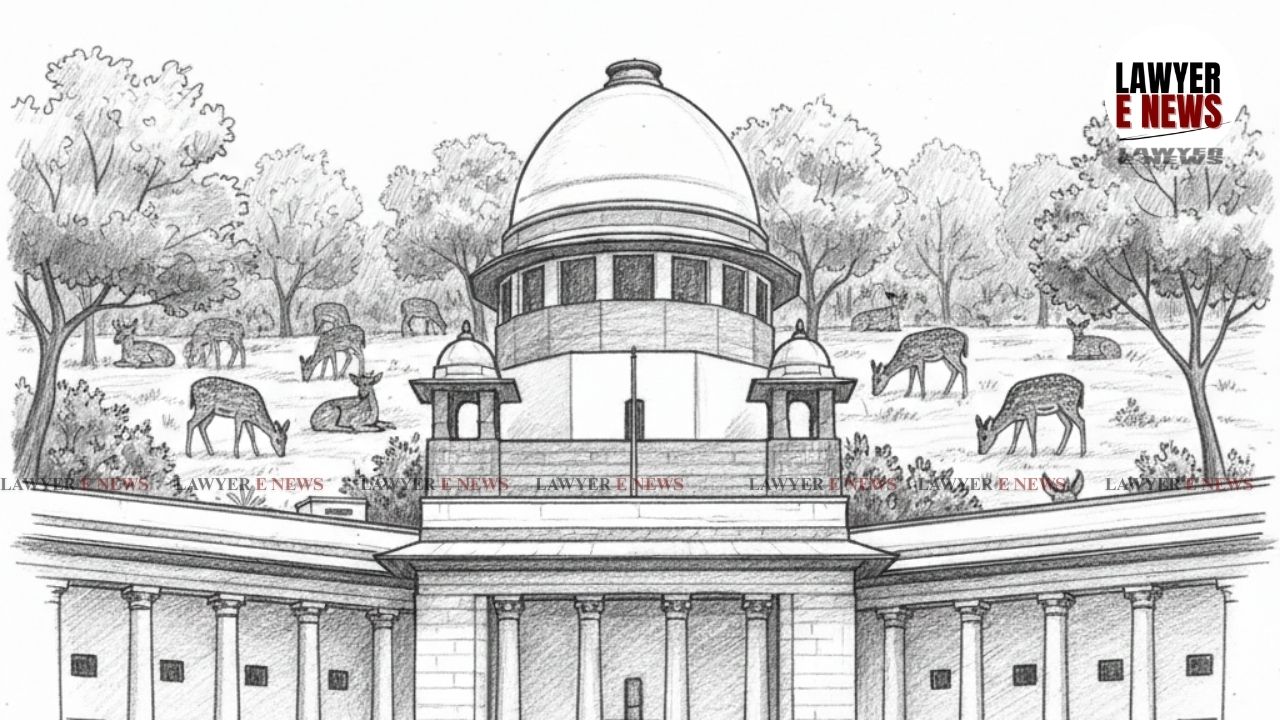
"Decisions affecting wildlife must reinforce dignity, ecological integrity, and intergenerational equity" – Supreme Court of India delivered a landmark judgment in which critically examining the controversial translocation of nearly 600 spotted deer from A.N. Jha Deer Park, Hauz Khas, Delhi, to wildlife sanctuaries in Rajasthan and Delhi. A bench comprising Justice Vikram Nath and Justice Sandeep Mehta stayed all further translocations, flagging grave violations of statutory, constitutional, and ecological mandates by the Delhi Development Authority (DDA) and other authorities.
The Court observed that while managing overpopulation in captive settings may necessitate regulated relocation, “wildlife management cannot be approached as a matter of administrative convenience.” Instead, the Court emphasized, such actions must be rooted in "scientific assessment, ecological prudence, and fidelity to constitutional values."
“Relocating Pregnant, Juvenile Deer Violates Welfare Norms and Ecological Ethics” – SC Finds Serious Breaches of IUCN and Zoo Guidelines
The case arose out of orders passed by the Delhi High Court in 2024 and 2025 permitting the DDA to proceed with deer translocation from the historic urban enclosure of A.N. Jha Deer Park. The petitioner, New Delhi Nature Society, challenged these decisions before the apex court, raising serious concerns over cruelty, ecological unsuitability, and procedural violations.
Highlighting the deficiencies, the Supreme Court noted: “It is evident from the record that the translocation protocol and best practices incorporated in the guidelines issued by the Central Zoo Authority and IUCN Guidelines were not adhered to during the translocation.” The Court found prima facie material to show that pregnant females, juveniles, and antlered deer were transported, often in overcrowded trucks, without proper veterinary supervision or habitat suitability studies.
In a scathing assessment, the Court stated that deer were allegedly loaded in groups of 40–50 without proper ventilation, padding, or segregation, and in one instance, a rope tied to a deer’s limb was recovered, suggesting gross negligence and possible cruelty.
Constitutional Commitments and Ecological Duty Undermined
At the heart of the controversy was the constitutional and statutory framework protecting wildlife. The Court reiterated that Articles 48A and 51A(g) impose a constitutional obligation on the State and citizens to protect wildlife and act with compassion towards animals, while Article 21, as interpreted by environmental jurisprudence, includes the right to a clean and ecologically balanced environment.
The Court noted that “continued retention of entirety of the remaining population of deer at the Deer Park would be contrary to the very principles of animal welfare” under domestic laws and international conservation protocols. However, it held that the past translocations were also tainted with serious procedural lapses, necessitating judicial scrutiny.
From Urban Green Zone to Mismanaged Facility
Established in 1968, A.N. Jha Deer Park has long been an urban green lung in Delhi. Originally spread over 10.26 acres (later extended to 10.97 acres), it housed a captive population of chital (Axis axis), forming a unique ecological and recreational zone. Despite repeated warnings from the Central Zoo Authority (CZA), the DDA continued to operate the park in violation of zoo management norms under the Wild Life (Protection) Act, 1972, Zoo Rules, 2009, and the National Zoo Policy, 1998.
In 2023, the CZA cancelled the recognition of the Deer Park and authorized translocation of around 600 deer to Rajasthan’s Ramgarh Vishdhari and Mukundra Hills Tiger Reserves, and Delhi’s Asola Bhatti Wildlife Sanctuary, citing overcrowding and expired licences. The petitioner society challenged this decision before the Delhi High Court, which, after an initial stay, allowed the DDA to proceed, leading to this special leave petition.
Translocation Without Scientific Study Is Impermissible
The central legal questions revolved around:
The Supreme Court found that none of the statutory preconditions – such as pre-translocation genetic screening, habitat feasibility analysis, tagging, and veterinary fitness certification – were complied with.
"Without such data, it is not possible to determine how many deer survived the journey or successfully adapted to their new environments," the Court held, further pointing out that post-release monitoring was either non-existent or severely deficient.
It also noted administrative failures by the Central Zoo Authority, which extended recognition despite repeated non-compliance, and failed to oversee adherence to norms during translocation.
CEC Assigned to Investigate, DDA Barred from Commercializing Park
The Court issued comprehensive directions to remedy the legal and ecological violations:
The Court emphasized that the wildlife relocation cannot be reduced to box-ticking exercises, and the lives of sentient animals cannot be jeopardized for administrative or logistical convenience.
Wildlife Management Is Not Bureaucracy—It Is a Constitutional Duty
In its concluding remarks, the bench underlined a foundational principle of environmental jurisprudence:
“Conservation is not merely the relocation of animals but an exercise in stewardship: preserving species, habitats, and the environmental ethos enshrined in our constitutional framework.”
The decision marks a turning point in judicial oversight of captive wildlife welfare in India. It sends a strong message that statutory mandates, scientific guidelines, and ecological principles must guide all wildlife-related decisions — not institutional convenience or vague policy justifications.
The matter is now listed for 17 March 2026, when the Court will review the CEC’s findings and DDA’s compliance report, setting the stage for further accountability and possibly systemic reform in India’s captive animal management practices.
Date of Decision: 26 November 2025





