-
by sayum
25 August 2026 8:14 AM







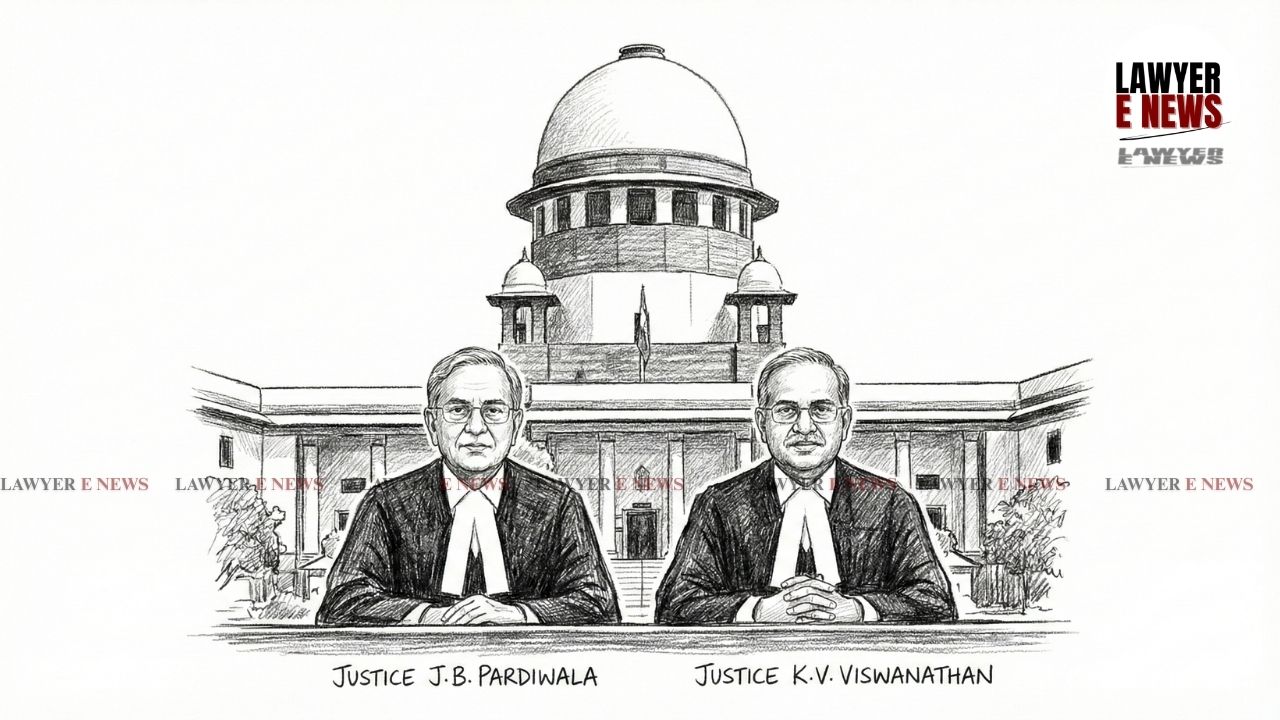
“How can a person booked for drunken driving be allowed to go scot-free simply because five years have lapsed?” — Supreme Court of India delivered a strongly worded order in the ongoing Public Interest Litigation (Writ Petition Civil No. 295 of 2012, S. Rajaseekaran v. Union of India & Ors.), raising deep constitutional and legal concerns over the Uttar Pradesh Criminal Law (Composition of Offences and Abatement of Trials) (Amendment) Act, 2023, which retroactively abates criminal trials under the Motor Vehicles Act (MV Act) pending since 1977.
Describing the implications of the UP Amendment as “drastic,” the Bench of Justice J.B. Pardiwala and Justice K.V. Viswanathan remarked in open court, “This means that the person who was booked for the offence of driving in a drunken condition or under intoxication goes scot-free. Should that by itself justify abatement of the proceedings?”
The Court’s observations came while hearing multiple interlocutory applications in a PIL that has over the years become the central judicial platform for road safety reforms in India. This latest development, however, draws into sharp focus federal legislative competence, Article 254(2) of the Constitution, and the fundamental principle of deterrence in criminal law.
“Abatement in One Shot Erodes the Sting of Deterrence”: Court Warns Against Legislative Shortcut to Manage Judicial Backlog
During the hearing, the Court questioned the State of Uttar Pradesh’s legislative intent, stating unequivocally that, “If we may not sound very harsh, this Amendment Act should not be in the form of a step to eradicate the arrears of pending cases in different courts of the State.”
The 2023 Amendment is part of a legislative pattern by Uttar Pradesh, which has enacted five laws since 1979 to periodically abate all MV Act trials for different periods—effectively wiping clean the records of lakhs of traffic violators over a span of 44 years.
Highlighting the gravity of the situation, the Court noted, “In a country like India, traffic is a big problem. Regulation of traffic is a big challenge. Citizens are not so disciplined… There has to be some deterrence so that a check remains on people indulging in offences relating to Motor Vehicles Act, more particularly, the youngsters.”
“You Cannot Use IPC as a Safety Net After Abating MV Act Charges”: Bench Rejects State’s Defence on Parallel Prosecutions
The counsel for Uttar Pradesh attempted to justify the legislation by arguing that more serious cases involving road fatalities or drunk driving could still be prosecuted under the Indian Penal Code (IPC), such as under Sections 279 or 304A. But the Court remained unconvinced.
“It would be too much to say that Section 185 proceedings would be dropped and the concerned person would be prosecuted for Section 279 or Section 304A of the IPC,” the Bench observed, noting that the legal implications of dropping MV Act charges on IPC trials remain debatable and legally tenuous.
In doing so, the Court exposed a major fault line in the State’s legislative approach: that non-compoundable offences under the MV Act—such as Section 185 (drunk driving), Section 187 (hit and run), Section 184 (dangerous driving), and Section 199A (juvenile offences)—were being nullified without trial, despite carrying mandatory punishment.
“Section 185 of the Motor Vehicles Act is just one illustration. There are so many other offences we have taken notice of which have stood abated by virtue of the Amendment Act,” the Court cautioned.
“Legislation Without Presidential Assent in a Concurrent Field Cannot Override a Central Law”: Prima Facie Violation of Article 254(2) Raised
The Court also took note of the constitutional infirmity alleged by the petitioner and the Amicus Curiae—lack of Presidential assent under Article 254(2) of the Constitution.
The Motor Vehicles Act, 1988, is a central legislation enacted under Entry 35 of the Concurrent List. Any state law inconsistent with it requires presidential assent to survive. However, the Uttar Pradesh Amendment Act, 2023, was not reserved for consideration of the President, nor did it receive presidential assent, rendering it prima facie unconstitutional.
The petitioner argued that “the systematic abatement of trials for MV Act offences incentivized traffic rule violations instead of serving as a deterrent… creating a disparity between those who have paid fines and those who have not, in clear violation of Article 14 of the Constitution.”
The Court directed the Legal and Transport Secretaries of Uttar Pradesh to file detailed affidavits justifying the section-wise abatement, remarking that, “We want the State to explain why proceedings under even non-compoundable offences were allowed to abate en masse.”
“We’re Not Looking for Lip Service—We Want Reform”: Justice A.M. Sapre Committee Asked to Examine Cashless Treatment Scheme Under Section 162 MV Act
In a related application concerning post-discharge cashless treatment for road accident victims, the Court referred the matter to the Justice A.M. Sapre Committee for detailed recommendations. The application had sought directions to operationalise Section 162(1) of the MV Act, which provides for insurance-funded treatment and reimbursement, even beyond the ‘golden hour’ covered under Section 162(2).
The Bench observed, “All relevant aspects, more particularly the reliefs prayed for, should be looked into by the Justice A.M. Sapre Committee... The suggestions that may be offered by the Committee would definitely come handy to us before we proceed to issue final directions.”
The Court directed the Committee to consult stakeholders and file a comprehensive report within six weeks, emphasizing that the scheme must include accountability, awareness campaigns, and transparent reporting on beneficiaries.
Urban Planning, Pedestrian Infrastructure, Driver Working Hours—Court Maps Out a Multi-Layered Road Safety Regime
Apart from the Uttar Pradesh amendment and cashless treatment, the Supreme Court’s order cast a wide net over systemic gaps in road safety, demanding swift institutional responses on multiple fronts:
“In the Age of High-Speed Vehicles, Enforcement Cannot Be Optional”: Supreme Court Sets the Stage for Constitutional Reckoning on Traffic Law Enforcement
This order may well mark a jurisprudential turning point in how traffic offences, road safety, and state legislative powers are viewed through the lens of constitutional rights, administrative responsibility, and criminal jurisprudence.
The Bench has fixed the next hearing on January 22, 2026, but not before leaving the legal community and policy-makers with a stark reminder:
“This is an age of highly powerful cars, and it is a matter of common experience how accidents are being caused because the drivers are unable to control these powerful cars... There has to be deterrence.”
The stage is now set for a serious constitutional confrontation, where federalism, public safety, and access to justice intersect with real-life consequences of leniency in traffic enforcement.
Date of Decision: 20 November 2025