-
by sayum
26 August 2026 6:42 AM







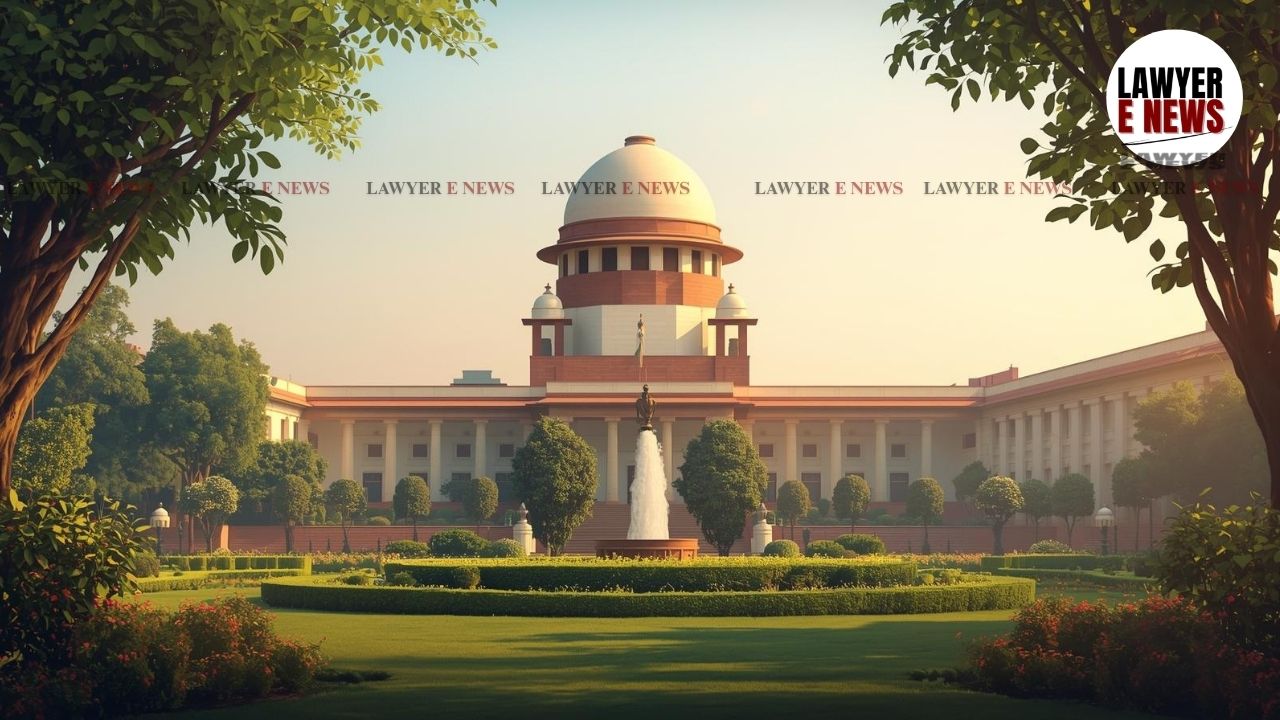
On November 7, 2025, Supreme Court of India invoked its extraordinary jurisdiction to deliver a landmark order aimed at rescuing hundreds of distressed homebuyers from a collapsed housing scheme in Greater Noida. The Court, deeply critical of the Greater Noida Industrial Development Authority (GNIDA) and the fraudulent developer, ordered the constitution of a one-Judge Independent Enquiry Committee, marking a rare judicial attempt to resurrect a housing project stalled since 2011 due to corruption, mismanagement, and administrative paralysis.
Describing the state of affairs as untenable, the Court observed:
“The original allottees who dreamt of a roof over their heads have been struggling in a losing cause for the last nearly 20 years.”
The case concerns Plot No. 7, Sector PI-2, Greater Noida, originally allotted in 2004 to Golf Course Sahkari Awas Samiti (GCSAS). What began as a cooperative housing venture turned into one of the most notorious real estate frauds in Uttar Pradesh, with the Court remarking that the “homebuyers were cheated and the builder has vanished”.
“Authority Is Not Cooperating… Buyers Are Fighting For Their Homes While Builder Has Vanished”: Supreme Court Tears Into GNIDA’s Apathy
The Court expressed open dissatisfaction with the role of GNIDA in allowing the stalemate to continue for over a decade, stating unequivocally:
“We are not happy with the fact that the Greater Noida Industrial Development Authority is not cooperating in the entire exercise of reviving a dead project… some of the homebuyers have joined together to revive the entire project in part… the Authority is not coming up with the details of the demand nor allowing them to continue with their joint venture.”
It was this institutional inertia and bureaucratic resistance that forced the Court to form an Independent Committee, headed by Justice Pankaj Naqvi (Retd.), former judge of the Allahabad High Court, to take over the task of verification, feasibility analysis, lease restoration, dues calculation, and planning for completion of the stalled project.
“This Court Has No Difficulty Permitting Construction, But The Builders Left A Mess Only Judicial Supervision Can Clean”: Court Shifts Responsibility To Retired Judge Panel
Over several hearings between 2021 and 2025, the Court meticulously recorded the formation of buyer collectives, each willing to complete their respective towers. Despite verifiable records, structural audits, and even payment readiness from allottees, GNIDA repeatedly failed to assist or restore even a proportional lease. In fact, the lease for the entire plot had remained cancelled since September 9, 2011, due to non-payment of dues exceeding Rs. 12 crores, largely caused by the builder’s embezzlement and abandonment.
Faced with GNIDA’s stand that it could not partially restore a lease, the Court directed it to explore this very possibility:
“We require the Authority to examine this aspect, as a special case, that it may restore partial lease with respect to Tower-1 and the required adjoining areas which may be necessary for its use and utility.”
“The Suffering Of These Buyers Cannot Be Compounded Further By Legal Complexity”: SC Orders Identification Of Genuine Allottees And Lease Restoration Strategy
The Court recognised that Article 136 proceedings were ill-suited to manage the sheer administrative complexity involved in identifying genuine buyers, verifying their documents, coordinating with banks, recalculating dues, and segregating construction responsibilities tower-wise. Accordingly, it directed:
“Resolution of all these issues seems unlikely if not impossible in the proceedings under Article 136 of the Constitution of India.”
In a strong policy-oriented move, the Court granted Justice Naqvi (Retd.) the authority to examine:
Restoration of full or partial lease
Proportional dues based on area of tower occupied
Auction feasibility for unclaimed flats in Towers 3 and 4
A structured plan for completion of the entire project
Verification of hundreds of allottees, including those not before the Court
“When Justice Demands Action, Not More Litigation”: A Committee With Quasi-Executive Powers To Resolve A Judicially Unmanageable Housing Crisis
The Committee, per the Supreme Court’s order, will be vested with broad investigatory and decision-making authority, including the ability to consult GNIDA, banks, financial institutions, and urban authorities. The Court explicitly permitted the possibility of auctioning unclaimed towers to recover dues and reinvest in completion of the remaining flats:
“In the eventuality that the original allottees of the flats in Towers 3 and 4 are found to be unidentifiable or unverifiable, the Committee may also examine the feasibility and viability of auctioning Towers 3 and 4… to ensure recovery of the entire expenditure… and protecting the interests of genuine allottees…”
This proactive clause is unprecedented and suggests a judicial intent to treat this case as a model for stalled project revival, where homebuyer equity replaces developer capital, and judicial supervision replaces regulatory inertia.
“From Deadlock To Blueprint”: Supreme Court Issues Timelines, Directs Public Notices To Trace Missing Buyers
The Court directed that all logistics and secretarial support be provided by the State and the homebuyers, with GNIDA and the Uttar Pradesh Government bearing 50% of all costs. The Committee is to complete its work within four months, and a public notice is to be issued in Hindi and English newspapers to alert all allottees, especially those who are yet to assert their claims.
“The State of Uttar Pradesh and GNIDA shall publish a public notice regarding the constitution and functioning of the Committee… such allottees may submit their claims before the Committee, which shall examine and verify through respondent No. 5-Commissioner.”
The final report is to be filed in a sealed cover by March 24, 2026, before the Supreme Court for final orders and project-level action.
“Justice May Be Delayed, But Cannot Be Denied Forever”: Supreme Court's Verdict Gives New Hope To Homebuyers After Two Decades Of Injustice
The ruling in Ravi Prakash Srivastava & Ors. v. State of U.P. & Ors. is a watershed moment in real estate jurisprudence, representing an extraordinary use of judicial powers to construct a hybrid legal-administrative remedy in a complex land and housing dispute. With hundreds of lives impacted, the decision aims not just to punish the guilty but resurrect a long-dead dream of home ownership for those who waited with trust and hope.
It is not merely a judgment—it is a blueprint for real estate justice.
Date of Decision: November 7, 2025





