-
by sayum
14 August 2026 8:36 AM







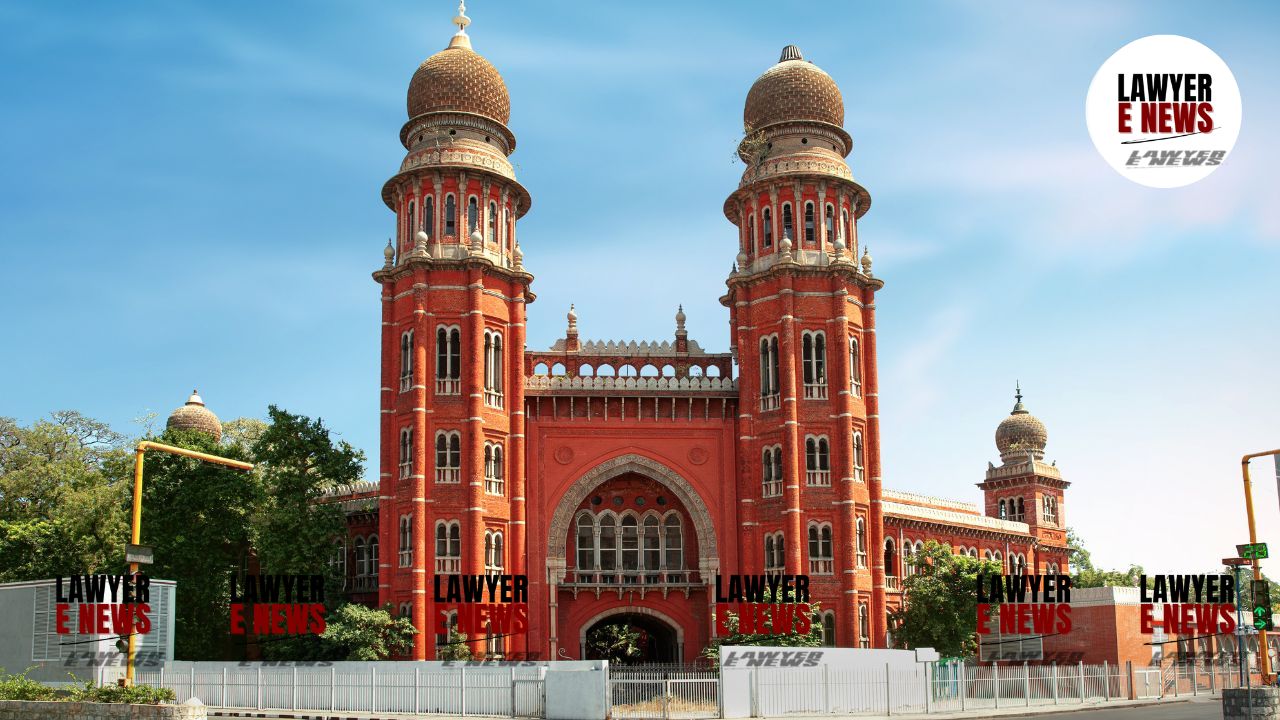
"The law does not prescribe a standard format which every testator should comply with when he or she writes a will." Madras High Court, in a significant ruling, upheld the validity of a holographic will, overturning a trial court's decision that had disbelieved the will based on perceived suspicious circumstances.
A bench of Justice N. Sathish Kumar and Justice M. Jothiraman emphasized that a testator's established character, independent decision-making, and prior gifts to heirs could provide valid reasons for unequal distribution in a will, dispelling common doubts.
The dispute arose following the demise of Dr. S.G. Rajarathinam, with his daughter (the plaintiff) seeking partition of his properties, claiming he died intestate. The fourth defendant, one of Dr. Rajarathinam's sons, contended that his father had executed a holographic will on February 10, 1993, which bequeathed properties to his legal heirs according to his choice, providing only monetary provision for the plaintiff due to substantial prior gifts. While the trial court acknowledged the will's execution, it ultimately disbelieved it, citing suspicious circumstances such as corrections, use of different inks, and non-registration, leading the fourth defendant to appeal.
The primary questions before the High Court were whether the holographic will dated February 10, 1993, was true, valid, and legally proven. The court was also called upon to determine if any suspicious circumstances attached to the will had been dispelled by the propounder and, consequently, whether the plaintiff was entitled to a share in the properties as claimed.
Holographic Will's Genuineness Admitted by Plaintiff
The High Court noted that the plaintiff, while disputing the will's validity, had unequivocally admitted in her cross-examination that the entire holographic will, including the handwriting and signature, belonged to her father, Dr. S.G. Rajarathinam. This admission formed a crucial bedrock for the appellate court's reasoning.
Prior Gifts Justify Unequal Distribution in Will
The bench observed that the testator, Dr. Rajarathinam, had clearly stated in his will that he had celebrated his daughters' marriages and already provided them with properties and presentations. Specifically, the court noted that the plaintiff had received properties through a sale deed (Ex.A.43) and a settlement deed (Ex.A.44) as early as 1979 from her father. These substantial prior provisions were considered a valid reason for the testator to exclude her from immovable property bequests in the impugned will, while providing for other daughters who had not received similar immovable properties previously.
Testator's Character Reinforces Autonomy
"Testator's Independent Nature Supports Discretionary Bequests"
The court underscored that Dr. Rajarathinam was a highly respected individual in Coimbatore, known for his independent views and decision-making, having held various prestigious positions in social clubs and professional associations. This strong, independent character lent credence to the idea that he would draft his will in his own distinctive style, making discretionary bequests based on his assessment of his children's needs and prior endowments.
Proof of Attestation Complied with Indian Evidence Act
The High Court found that the will's attestation requirements were duly met under Section 69 of the Indian Evidence Act, 1872. With both attesting witnesses deceased, their signatures were successfully identified by DW3 (daughter of Dr. T.K. Ganesan) and DW4 (son of Advocate M. Shanmugam). Both witnesses were reputable professionals and close friends of the testator. Coupled with the plaintiff's admission of the testator's handwriting and signature, the court concluded that the "twin requirements" of Section 69 were fully satisfied.
"Plaintiff's Inconsistent Stands Falsified Her Claims"
The court found the plaintiff's shifting narratives regarding the will's attestation highly improbable. While she initially claimed the will, when read, lacked attesting witnesses' signatures and that a copy provided to her was similarly unsigned, she failed to produce this unsigned copy. Her subsequent allegations of the will being fabricated in a hotel by other defendants were deemed contradictory and suspicious by the court.
Suspicious Circumstances Dispelled
"Non-Registration Not A Suspicious Circumstance"
The High Court rejected the trial court's finding that non-registration of the holographic will constituted a suspicious circumstance. It affirmed that registration is not mandatory for a will, and a testator's choice not to register, even if they had registered previous documents, cannot inherently lead to suspicion, especially when the will's execution is otherwise established.
"Minor Alterations Reflect Testator's Deliberation, Not Suspicion"
Regarding corrections, interpolations, and use of different inks in the 12-page holographic will, the court held that these minor alterations, made in the testator's own handwriting and bearing his signature, demonstrated his meticulous application of mind in detailing and bequeathing his properties. These factors, particularly in a holographic will and in the absence of any challenge to the testator's mental faculty, were seen as indicative of genuine deliberation rather than suspicious activity. The court cited Dr. Lodd Surendardas v. Lodd Narendardas (2009) and Joyce Primrose Prestor v. Vera Marie Vas (1996) to reiterate that holographic wills carry a greater presumption of genuineness, and minor overwritings or corrections often reflect the testator's age or personal style.
"Unequal Distribution Explained By Circumstances"
The court specifically addressed the unequal distribution, noting that the fourth defendant, unlike his well-settled graduate siblings, was not a graduate and had lived with his parents. This, along with the prior gifts to the plaintiff and other children, was considered a plausible reason for the testator to make greater provision for the fourth defendant. The court further noted that the other legal heirs had not disputed the will, reinforcing its genuineness.
The bench reiterated the principle from K. Sadagopan v. K. Yamunan (2002) that the law does not prescribe a standard format for wills and that the testator's intention and state of mind are paramount. While acknowledging the need to dispel genuine suspicious circumstances (citing Shashi Kumar Banerjee v. Subodh Kumar Banerjee, AIR 1964 SC 529), the court concluded that the doubts raised by the trial court were irrelevant and did not genuinely shroud the will in suspicion.
Consequently, the High Court held that the judgment and decree of the trial court, discrediting the holographic will (Ex.B.12) based on unsubstantiated doubts, could not be sustained.
The Madras High Court partly allowed the appeal. It set aside the trial court's judgment and decree that granted the plaintiff a 1/5th share in Item Nos. 1 to 7 of Schedule I and the properties in Schedule II of the plaint. However, the trial court's decree granting a 1/15th share to the plaintiff and defendants 1 to 3 in Schedule III, and allotting shares to the 5th, 7th, 8th, and 9th defendants in Schedule III and Item 8 of Schedule I, was confirmed, as other alleged wills were not proved in accordance with law.
Date of Decision: 10 August 2026