-
by sayum
28 August 2026 8:44 AM







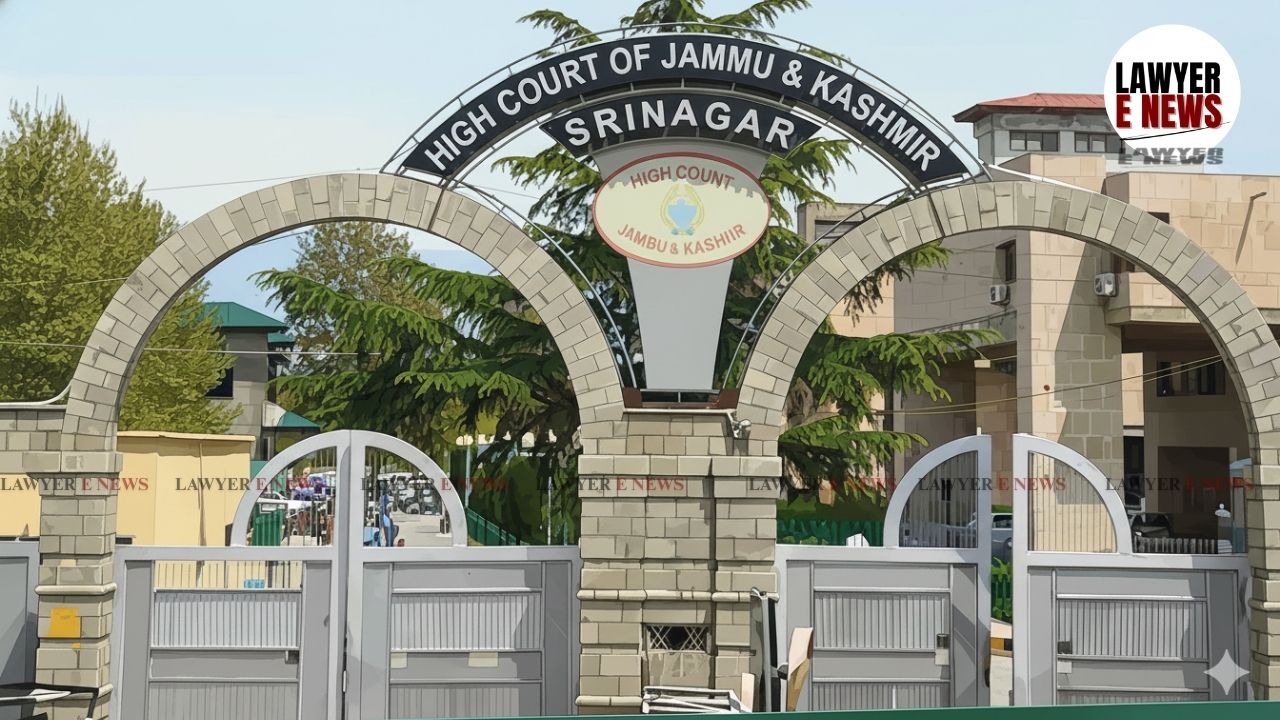
"Rejection of the plaint extinguishes the claim and forces the plaintiff to institute a fresh suit subject to limitation. Conversion preserves the suit and enables adjudication on merits." High Court of Jammu & Kashmir and Ladakh, in a significant ruling, held that a trial court cannot summarily reject a plaint under Order 7 Rule 11 of the Code of Civil Procedure (CPC) simply because a summary suit under Order 37 is found to be technically non-maintainable.
A bench of Justice Shahzad Azeem observed that if a plaint discloses a valid cause of action for a regular money recovery, the court must exercise its discretion to convert the suit into an ordinary civil suit rather than dismissing it outright.
The appellant had approached the Trial Court with a summary suit under Order 37 CPC to recover ₹4.00 lakhs, claiming it was the outstanding portion of a friendly loan. The respondent moved an application seeking leave to defend, raising disputes regarding business partnerships, counter-claims of ₹24.76 lakhs, and allegations of forgery. The Trial Court, however, rejected the plaint under Order 7 Rule 11 CPC on the grounds that the cheque in question had expired without being presented to the bank, thereby failing to establish a cause of action for a summary suit.
The primary legal question before the High Court was whether the non-presentation of a cheque in a summary suit necessitates the total rejection of the plaint, or whether the court is empowered to treat the matter as a regular recovery suit. The Court also had to determine if Order 7 Rule 11 of the CPC was the appropriate mechanism for dealing with a suit that merely failed to satisfy the specific requirements of Order 37.
Non-Maintenance Of Summary Suit Does Not Kill The Underlying Debt
The Court reaffirmed the established legal position that a suit under Order 37 CPC is only maintainable if the cheque in question has been presented and subsequently dishonored. While agreeing with the Trial Court that the suit was not maintainable in its summary form, Justice Shahzad Azeem clarified that this failure does not result in the extinction of the underlying debt. The bench noted that the plaint, when read in its entirety, clearly set out the advancement of a loan, the acknowledgement of debt through a cheque, and the respondent’s subsequent refusal to pay.
"Where a civil wrong is alleged, the court should ordinarily not leave the aggrieved party remediless, especially when the plaint discloses a cause of action for an ordinary suit. Rejection of suit under Order 7 Rule 11 of CPC in such circumstances is a drastic course and should be resorted only when no cause of action whatsoever is disclosed."
The Doctrine Of Conversion Over Rejection
The High Court emphasized that the procedural rigor of Order 37 is designed to expedite specific types of litigation, not to provide a gateway for dismissing legitimate claims. By rejecting the plaint, the Trial Court had erroneously forced the appellant to face the risk of fresh limitation periods. The bench held that when a defendant raises serious triable issues—such as the counter-claims and allegations of forgery present in this case—the court’s duty is to move the matter toward a trial on merits.
"The special procedure is available only upon fulfillment of prescribed conditions. Where the conditions are not satisfied or where defendant raised triable issues, the court is not precluded from treating the suit as an ordinary suit and proceeding accordingly."
Concluding that the Trial Court had failed to exercise its jurisdiction correctly, the High Court set aside the impugned judgment and decree dated August 12, 2025. The Court ordered the suit to be restored to its original position and directed that it be proceeded with as an ordinary suit for the recovery of money. The respondent has been granted four weeks to file a written statement, and both parties are ordered to appear before the Trial Court on September 7, 2026, to ensure the dispute is adjudicated on its actual merits.
Date of Decision: 17 August 2026