-
by sayum
28 August 2026 8:44 AM







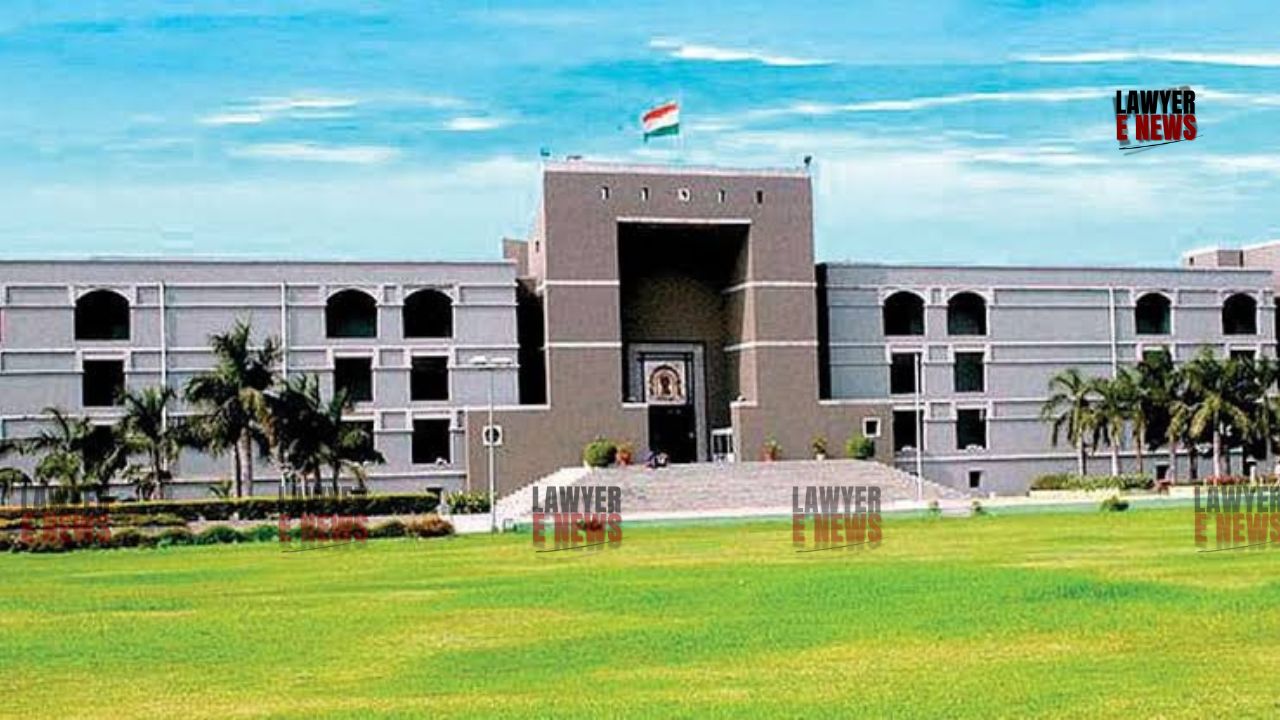
"By accepting any additional premium towards the coverage of own car damage or owner-driver of insured vehicle, the insurance company has agreed to indemnify the owner towards contractual liability which is beyond the scope of jurisdiction of the tribunal as being confined to third party damages." Gujarat High Court, in a significant ruling, held that legal heirs of a deceased owner-cum-driver who is a tortfeasor cannot maintain a claim petition under Section 166 of the Motor Vehicles Act, 1988 against their own insurer for the deceased's own wrongful acts.
A division bench comprising Justice A.Y. Kogje and Justice Nisha M. Thakore observed that while an insurance company may accept an additional premium for Personal Accident coverage of the owner-driver, such liability is strictly contractual in nature and falls squarely outside the statutory jurisdiction of the Motor Accident Claims Tribunal, which is confined purely to third-party claims.
The appeal arose from a March 10, 2017 judgment of the Motor Accident Claims Tribunal (Aux.), Gandhidham-Kachchh, which dismissed Claim Petition No. 511 of 2007 preferred by the widow and legal heirs of deceased driver Mukeshbhai Somaiyabhai. The deceased was driving his own unregistered Santro car on the Rajkot-Jamnagar Highway at night when he collided head-on with a Swaraj Mazda Matador while attempting to overtake it. Finding that the deceased was carrying 201 bottles of illegal liquor and was solely or contributorily negligent, the Tribunal dismissed the claim, prompting the appellants to approach the High Court under Section 173 of the Motor Vehicles Act.
The primary questions before the High Court were whether the Tribunal erred in relying on police investigation papers to find the deceased negligent in the absence of examined eyewitnesses, and whether a claim petition under Section 166 of the Motor Vehicles Act is maintainable at the instance of a tortfeasor's heirs against their own insurer by virtue of a comprehensive policy covering personal accidents.
Preponderance Of Probabilities Governs Motor Accident Claims
The Court underscored that in claim petitions instituted under Section 166 of the Motor Vehicles Act, the initial burden rests upon the claimants to establish rashness and negligence, but the required standard of proof is the preponderance of probabilities rather than proof beyond reasonable doubt. Relying on the Supreme Court's ruling in Anita Sharma v. The New India Assurance Co. Ltd. (2021), the bench emphasized that tribunals must evaluate the overall material on record to determine whether the claimants' narrative is more likely than not true, rather than insisting on the strict evidentiary standards of a criminal trial.
Police Panchnama And FIR Admissible Even Without Examining Panch Witnesses
Addressing the claimants' grievance that the FIR and panchnama could not have been read into evidence without examining the Investigating Officer or panch witnesses, the bench rejected the objection on the ground that these investigation papers were brought on record by the claimants themselves. The physical location of the vehicles detailed in the spot panchnama revealed that the Santro car was positioned in the middle of the road after a head-on impact, while the Matador's rear wheels had skidded off the road's left shoulder, establishing that the deceased had veered into the wrong lane while overtaking at high speed.
Section 166 Claims Compulsorily Tethered To Statutory Third-Party Risk
Evaluating the statutory architecture of Chapter XI of the Motor Vehicles Act, the bench observed that Section 166 is an enabling mechanism that operates in tandem with Sections 147 and 149 of the Act. The Court explained that Section 147 mandates compulsory insurance to indemnify owners exclusively against third-party liabilities arising from the use of motor vehicles in public places, and the statutory obligations cast on insurers cannot be enlarged to cover the owner's or tortfeasor's self-inflicted injuries under Section 166.
"Section 147(b) would get attracted in third party risk and the contractual liability incurred by the insurance company by accepting additional premium covering risk of owner of the insured vehicle cannot be dealt with by the Tribunal under provisions of Motor Vehicles Act, 1988."
MACT Cannot Exercise Writs Or Inherent Powers To Enforce Pure Contracts
The Court firmly held that the statutory powers exercised by the Claims Tribunal under Section 166 and by the High Court in appellate jurisdiction under Section 173 are strictly circumscribed by the four corners of the statute. The bench noted that tribunals are not vested with extraordinary writ jurisdiction under Article 226 of the Constitution of India or plenary powers akin to Article 142 of the Constitution, meaning any monetary direction to an insurer must be traceable strictly to statutory provisions governing third parties.
Comprehensive Policy Clauses Distinguish Statutory Risk From Contractual Indemnity
Scrutinizing the terms and conditions of the Private Car Package Policy, the Court highlighted that the contract clearly demarcated "Section II - Liability to Third Parties" from "Section III - Personal Accident Cover for Owner-Driver." The bench observed that while additional premium was paid to extend personal accident coverage up to ₹2 Lakhs, this constituted a distinct, separate contract between the insured and the insurer rather than a statutory indemnity under Section 147.
Remedy For Personal Accident Cover Lies Before Consumer Forum
Citing apex court precedents in Oriental Insurance Co. Ltd. v. Jhuma Saha (2007), National Insurance Co. Ltd. v. Laxmi Narain Dhut (2007), and New India Assurance Co. Ltd. v. Sadanand Mukhi (2009), the bench reaffirmed that disputes concerning own-damage and personal accident covers must be agitated before a Consumer Forum or a competent civil court as a contract enforcement action, and cannot be imported into MACT proceedings.
The High Court accordingly dismissed the first appeal and upheld the Tribunal's order rejecting the claim petition under Section 166 of the Motor Vehicles Act. However, the bench clarified that the dismissal will not preclude the legal heirs from agitating their claim for compensation under the Personal Accident coverage clause before the appropriate forum on its own merits.
Date of Decision: 03 August 2026