-
by sayum
13 August 2026 11:02 AM







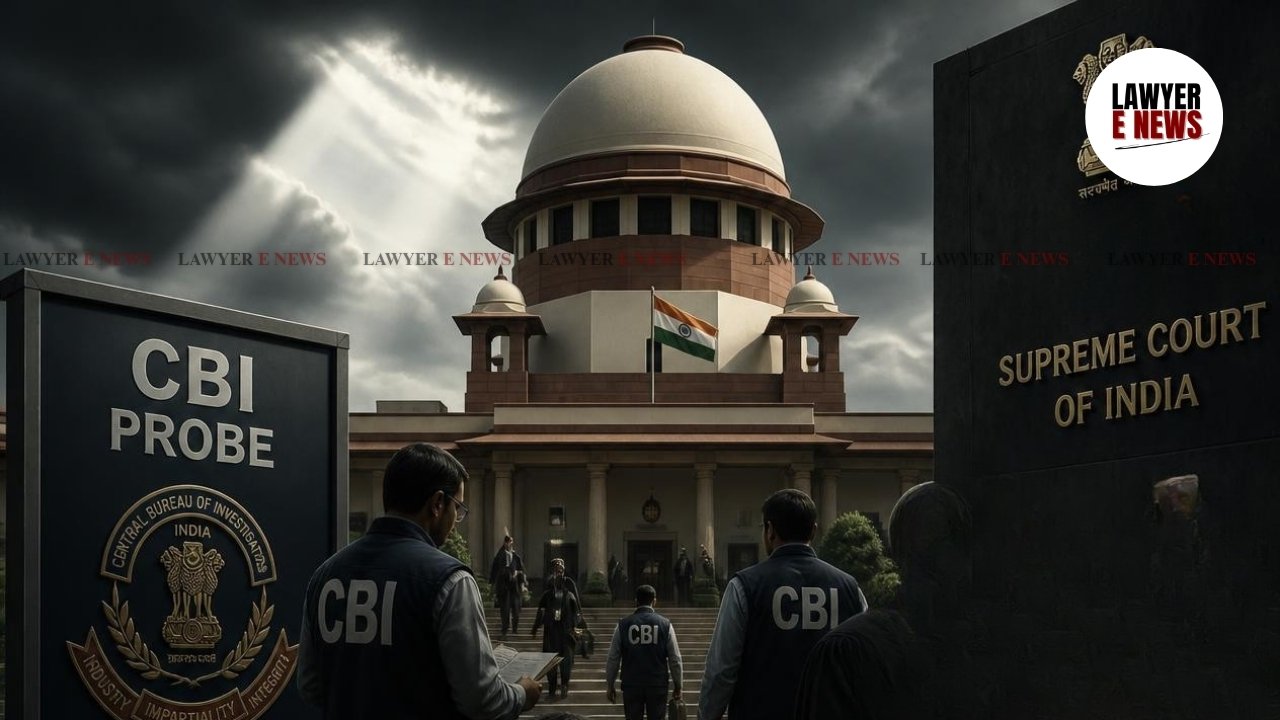
"The stance of blissful ignorance taken by the senior officers of the State of Chhattisgarh... is sacrilegious and reflects a disturbing disregard of the statutory procedure governing custodial deaths." Supreme Court, in a scathing ruling dated August 12, 2026, held that senior state bureaucracy and police leadership exhibited a "sacrilegious" disregard for statutory procedures by attempting to cover up a custodial death.
A bench comprising Justice Vikram Nath and Justice Sandeep Mehta observed that the attempts by top state officials to shield perpetrators through false submissions and withheld medical records warrant an immediate, independent investigation.
The deceased, Shri Shravan Suryavanshi, had been arrested under Section 34(2) of the Chhattisgarh Excise Act, 1915, in connection with the alleged possession of six litres of raw Mahua liquor. Following his arrest and remand to Central Jail, Bilaspur, his health deteriorated rapidly, leading to his transfer to CIMS Hospital, Bilaspur, where he passed away on January 22, 2024. A subsequent post-mortem report revealed multiple antemortem injuries, including a laceration on the occipital scalp, with the cause of death certified as cardio-respiratory arrest resulting from complications of a head injury caused by a hard and blunt object.
The primary questions before the court were whether the State and its senior functionaries can evade accountability for custodial violence through deliberate inaction, and whether the transfer of investigation to an independent agency is warranted when state authorities attempt to cover up custodial crimes. The court was also called upon to examine the adequacy of compensation granted by the High Court.
Court Slams Intransigent Stance Of Top Bureaucrats
The Supreme Court came down heavily on the Director General of Police, the Director General (Prisons), and the Principal Secretary (Home) of the State of Chhattisgarh for taking a "totally intransigent stance" during virtual proceedings. The Director General of Police had argued that because the judicial inquiry report under Section 176 of the Code of Criminal Procedure, 1973 had not been officially received by the police, there was no occasion to register a criminal case.
"Cover-Up Story" Exposed By Court Records
Rejecting this explanation as a "cover-up story and an attempt to pull the wool over the Court's eyes," the bench pointed out that the State's own pleadings before the High Court had acknowledged the pendency of the Section 176 CrPC inquiry. The judges noted that the authorities were fully conscious of the judicial inquiry, rendering the police chief's submission patently false, wholly reprehensible, and reflective of deep institutional apathy.
Deliberate Manipulation Of Medical Records
The bench uncovered a clear attempt to mislead authorities after scrutinizing the medical records prepared at the jail during the time of the death. While the initial jail medical report diagnosed the cause of death as cardiopulmonary arrest with aspiration pneumonitis due to alcoholic withdrawal and delirium tremens, it completely omitted any reference to the severe head injury later documented in the post-mortem report.
"Investigation Entrusted To Central Bureau of Investigation"
Declaring that the ends of justice require an independent probe, the Supreme Court directed the Director of the Central Bureau of Investigation to forthwith register a regular criminal case into the custodial death. The bench ordered that the investigation be entrusted to a senior CBI officer to be conducted expeditiously, and mandated that the role of state officials in failing to act upon the judicial inquiry report be thoroughly examined.
"Interim Compensation Awarded To Grieving Family"
While noting that the High Court's award of Rs. 1 lakh was a "pittance" that failed to reflect the gravity of the loss suffered by the deceased's widow and daughters, the Supreme Court directed the State of Chhattisgarh to pay an interim compensation of Rs. 25,00,000 within four weeks. The court emphasized that the final quantum of compensation would be determined subsequently, ordering that the complete case records be transmitted to the CBI via a special messenger within a week.
Date of Decision: 12 August 2026