
-
by sayum
22 August 2026 7:11 AM







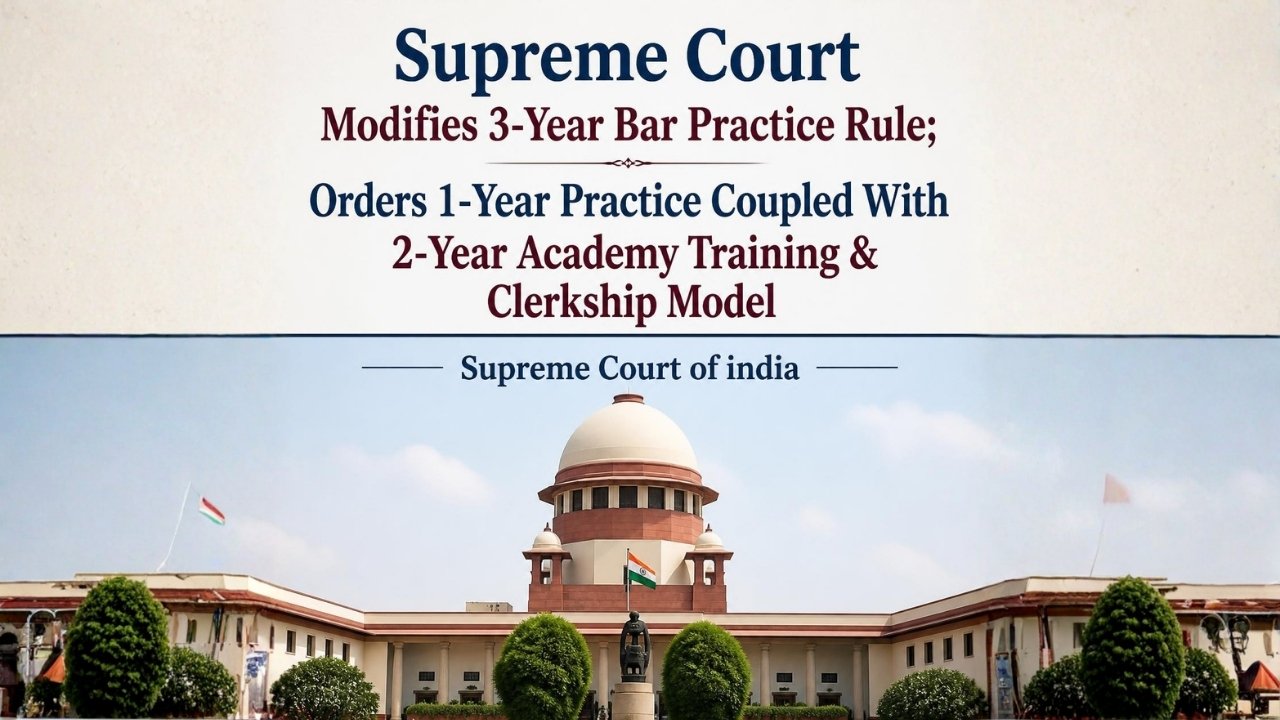
"Practical exposure and judicial training may be acquired through a combination of professional and institutional experience." Supreme Court of India, in a significant ruling delivered on August 21, 2026, substantially modified its earlier judgment that mandated a three-year practice at the Bar as an indispensable eligibility condition for appearing in the Civil Judge (Junior Division) examination.
A majority bench comprising Chief Justice of India Surya Kant and Justice Augustine George Masih held that practical courtroom competence and readiness can be more effectively achieved through a balanced scheme comprising one year of practice coupled with two years of post-selection institutional training and supervised judicial clerkship.
The proceedings arose out of review petitions and a writ petition filed by Bhumika Trust alongside law graduates challenging the Court's earlier judgment dated May 20, 2025, in the All India Judges' Association matter, which had revived the three-year Bar practice rule. The petitioners argued that the sudden revival placed an undue hardship on recent law graduates, women, and marginalized candidates, disrupting their legitimate expectations and career progression.
The primary question before the bench was whether the mandatory three-year Bar practice requirement for entry-level judicial recruitment required reconsideration or adjustment. The Court was also called upon to determine whether practical readiness could be secured through a combination of limited prior practice and enhanced post-selection training rather than a rigid pre-examination bar experience.
Passage Of Time At The Bar Not Sole Factor Behind Practical Competence
The majority observed that while practical familiarity with court procedure and litigation is an indispensable attribute for a judicial officer dealing with life, liberty, and property, conventional practice at the Bar cannot be regarded as the sole vehicle to acquire judicial temperament. The bench noted that the quality of practice in initial years varies widely and often depends on chamber access, mentorship, and socioeconomic circumstances.
"The purpose of an eligibility rule is to secure suitable candidates for judicial office. It should not, by the manner of its implementation, exclude candidates whom the judicial system would otherwise benefit from attracting," the Court observed.
Transitional Relief For Law Graduates Appearing In Exams Up To March 2027
To mitigate the hardship caused to candidates who prepared under the earlier regime established in the Third AIJA Case (2002), the Court formulated a specific transitional framework applicable to all recruitment notifications issued from the date of the review judgment up to March 31, 2027. Under this transitional window, all law graduates will be deemed to have completed one year of active practice without the need to furnish a separate certificate of practice.
The Court clarified that candidates selected during this transitional phase will not be put into regular courtrooms immediately upon recruitment. Instead, they will be inducted with the status of Trainee Judicial Officers and will undergo a comprehensive two-year post-selection curriculum before being granted independent charge of courts.
First Year Of Compulsory Intensive Institutional Training At State Judicial Academies
Under the new model, selected candidates must first complete one full year of intensive training at their respective State Judicial Academies. The majority held that this year-long academy training will be formally treated as equivalent to one year of practice at the Bar for the purpose of satisfying the experience benchmark.
The bench directed that during this training year, the Trainee Judicial Officers shall receive a fixed emolument equivalent to one-half of the remuneration payable to a regular Judicial Magistrate First Class in the concerned State, alongside accommodation and institutional facilities ordinarily provided by the academies.
Second Year Divided Into Two-Tier Structured Law Clerkship
Upon completing academy training, trainees must undergo a second full year of structured Law Clerkship, which will count as the third equivalent year of practical exposure. This clerkship will be divided into two distinct six-month phases: the first six months under a Principal District and Sessions Judge or Member of the Higher Judicial Service, and the subsequent six months attached directly to a sitting Judge of the concerned High Court.
The Court observed that working in close proximity to trial judges and High Court judges exposes trainees to the nuances of case management, evidence appreciation, order writing, and courtroom decorum. Trainees will continue to draw half-pay during this period, followed by an objective, reasoned evaluation by the supervising High Court Judge before entering regular judicial service.
> "The courtroom being the most profound of all classrooms... a lawyer’s mistake can be remedied by an experienced Presiding Officer, but a Presiding Officer’s mistake puts to peril a litigant."
Permanent Scheme From April 2027: Mandatory One-Year Verified Bar Practice
For all recruitment advertisements issued on or after April 1, 2027, the Supreme Court laid down a permanent model replacing the three-year requirement with a mandatory one-year actual practice requirement in District Courts. Candidates must produce a verified Certificate of Practice evidencing genuine participation in court proceedings or assistance to a senior advocate having ten years of standing.
Once selected through the competitive exam after fulfilling this one-year practice criterion, the candidates will still be required to undergo the same two-year training model, comprising one year at the State Judicial Academy and one year of two-tier judicial clerkship before assuming judicial office.
Justice K. Vinod Chandran Dissents, Calls Bar Practice Indispensable
Dissenting from the majority view, Justice K. Vinod Chandran dismissed the review petitions, holding that no ground for review was established and warning against reducing the three-year threshold. He emphasized that the forensic and analytical skills of an adjudicator cannot be substituted by clerkships or academy courses, noting that sending raw graduates directly into judicial service risks creating careerists rather than seasoned jurists.
Justice Chandran also cautioned that keeping selected candidates on half-pay for two years without reckoning the period as regular service would cause financial strain, multiply judicial vacancies, and create arbitrary classes among recruits.
The majority concluded that the newly formulated scheme shall operate for an initial duration of five years, after which the Court will assess empirical data on recruitment quality and trainee performance to determine if further adjustments are required. State Governments and High Courts have been directed to amend their respective judicial service rules within three months to reflect these directions.
Date of Decision: 21 August 2026