-
by sayum
25 August 2026 11:12 PM







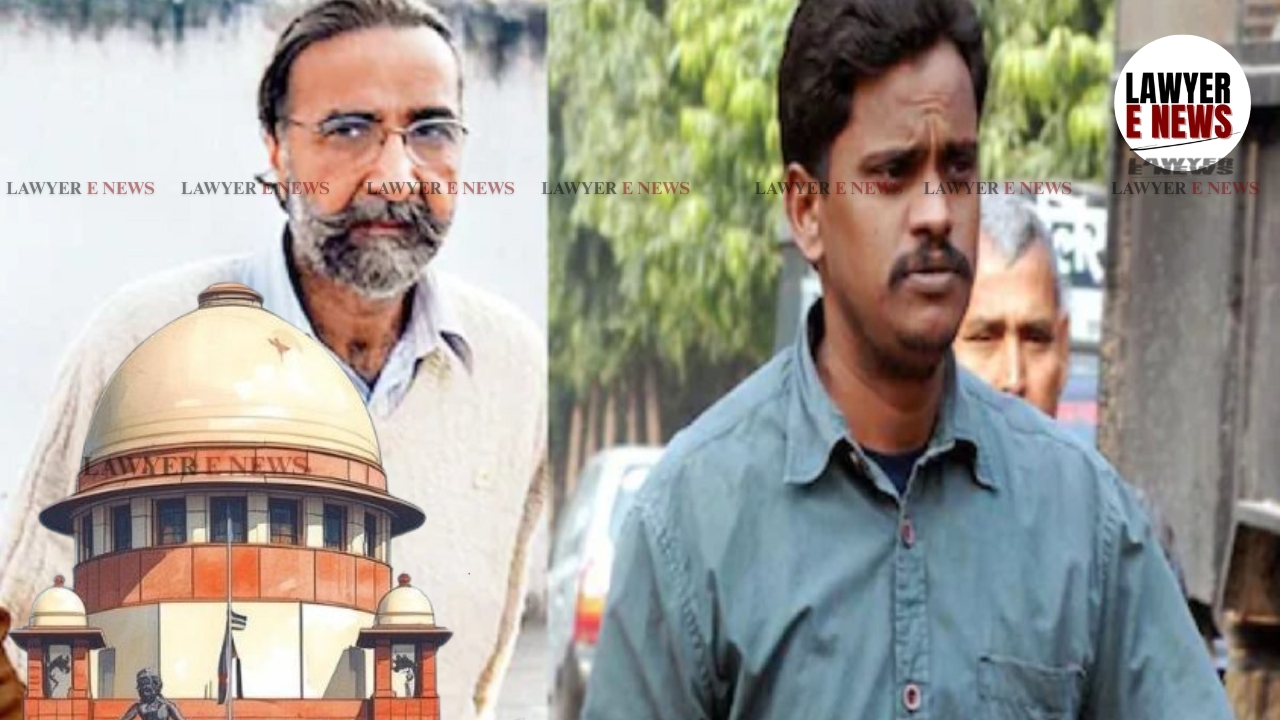
“Two Final Judgments Cannot Speak in Contradictions on Identical Evidence ….Suspicion, However Grave, Cannot Replace Proof Beyond Reasonable Doubt” – Supreme Court Declares Conviction Unsustainable, Calls It a Manifest Miscarriage of Justice. In an unprecedented legal volte-face grounded in the preservation of judicial integrity, the Supreme Court of India set aside the conviction and sentence of Surendra Koli, previously sentenced to death in the Rimpa Haldar murder case, part of the notorious Nithari serial killings. The three-judge bench led by Chief Justice Bhushan Ramkrishna Gavai, along with Justice Surya Kant and Justice Vikram Nath, invoked the curative jurisdiction of the Court to overturn a final verdict that had upheld Koli’s guilt in 2011.
Delivering a landmark judgment in Curative Petition (Crl.) No. … of 2025 @ Diary No. 49297 of 2025, the Court held that two diametrically opposite outcomes arising from identical facts and evidence — the first upholding Koli’s conviction in 2011 and the second acquitting him in 12 similar cases by 2025 — could not stand simultaneously.
“It is a fundamental defect that impeaches the integrity of the adjudicatory process,” the Court stated, emphasizing that “intervention ex debito justitiae is not an act of discretion but a constitutional duty when two sets of outcomes resting on the same evidentiary foundation cannot lawfully coexist.”
“Same Confession, Same Recoveries, Different Outcomes—A Judicial Incongruity That Offends Article 14 and Article 21” – Court Rules That Equality Before Law Demands Consistency
The core of the Court’s reasoning lay in the striking contradiction between its own final judgment in 2011, which had affirmed Koli’s death sentence, and its more recent ruling in July 2025, wherein it upheld twelve separate acquittals of the same man on identical charges and identical evidence.
The Court observed: “Outcomes of this Court that cannot be reconciled on the same evidentiary substratum engage the guarantees of equality and due process under Article 14 and Article 21 of the Constitution.”
In all thirteen cases, including the Rimpa Haldar case, the prosecution relied on two primary pillars: a confession recorded under Section 164 of the CrPC and alleged recoveries made under Section 27 of the Indian Evidence Act. Yet, while those very foundations were found inadmissible and unreliable in twelve other cases, they were curiously upheld in this lone conviction.
Such judicial inconsistency, the Court held, “undermines public confidence in the administration of justice” and “cannot be allowed to harden into precedent.”
“A Confession Extracted After 60 Days in Custody, Without Legal Aid, Cannot Be Called Voluntary” – Apex Court Rejects Section 164 Confession as Tainted
Turning to the confession that formed the lynchpin of Koli’s conviction, the Court found it to be “legally inadmissible and factually unreliable.” Koli was in continuous police custody for nearly two months before he allegedly confessed to murdering Rimpa Haldar. The recording magistrate failed to note unqualified satisfaction about the voluntariness of the confession, and the presence of the investigating officer in the room further compromised its credibility.
Significantly, the Court noted that “the text of the statement itself contains repeated references to coercion and tutoring.”
Referring to these glaring procedural flaws, the Bench ruled, “These features attracted the bar under Section 24 of the Evidence Act and rendered the confession inadmissible as a matter of law.”
It questioned the rationality of upholding this very statement in one case after judicially rejecting it in all others: “We find no principled basis on which the same statement can be treated as voluntary and reliable in this case when it has been judicially discredited in all others.”
“Section 27 Cannot Justify a Discovery Already Known to Public and Police” – Supreme Court Rejects Recovery Evidence as Legally Unsound
On the issue of alleged discoveries and recoveries made at Koli’s instance — such as human remains and murder weapons — the Court ruled that these were neither spontaneous nor exclusive, and hence could not be protected under Section 27.
“Excavation had already begun before the petitioner arrived. Public and police had prior knowledge. The area was not under his exclusive domain. The essential element of discovery was absent.”
The Court found contradictions between remand papers and recovery memos, including references to joint disclosures with co-accused Moninder Singh Pandher, further damaging the prosecution’s case.
“The narrative in the later-prepared seizure memorandum conflicted with the remand papers. Once contradictions infect the record, Section 27 ceases to operate.”
These exact findings had formed the basis of the High Court’s acquittal orders in 2023, and were affirmed by the Supreme Court in July 2025. The present case, the Court held, could not be decided differently.
“DNA May Identify a Body, But It Cannot Prove Guilt” – Apex Court Slams Prosecution’s Forensic Lapses
The judgment sharply criticised the lack of forensic integrity in the investigation. Despite the prosecution’s claim that multiple murders and dismemberments occurred inside D-5, no human bloodstains or DNA evidence were found inside the premises.
The DNA evidence, the Court clarified, only established identification of victims, not culpability of the accused. The knives and axe allegedly recovered were not linked forensically to the injuries or bodies. “There was no expert testimony establishing that a domestic help with no medical training could perform the precise dismemberment described.”
The Court held that the circumstantial chain had been irreparably broken: “Once those keystones are removed, the circumstantial chain no longer holds.”
“The Investigation Was Neither Fair Nor Professional—It Closed Doors to Truth” – Court Blasts Police For “Negligence and Delay”
One of the most damning aspects of the ruling was the Supreme Court’s sharp indictment of the investigation, calling it “botched,” “shifting,” and riddled with systemic failures.
It found that:
“Each lapse weakened the provenance and reliability of the evidence and narrowed the path to the truth.”
The Court observed that despite horrific crimes, “negligence and delay corroded the fact-finding process and foreclosed avenues that might have identified the true offender.”
“The Rule of Law Does Not Yield to Outrage—Courts Cannot Prefer Expediency Over Legality” – Presumption of Innocence Reaffirmed
Recognizing the gravity of the offences and the public anger surrounding the Nithari killings, the Court nonetheless stressed that no one could be punished based on suspicion.
“Suspicion, however grave, cannot replace proof beyond reasonable doubt. Criminal law does not permit conviction on conjecture or on a hunch.”
Quoting settled legal principle, the Court held: “The presumption of innocence endures until guilt is proved through admissible and reliable evidence… when the proof fails, the only lawful outcome is to set aside the conviction, even in a case involving horrific crimes.”
Conviction Quashed, Koli Acquitted, Ordered to Be Released
After detailed analysis, the Court ruled that the 2011 conviction could not stand, and that the curative petition deserved to be allowed under the narrow but powerful doctrine laid down in Rupa Ashok Hurra v. Ashok Hurra.
The Court set aside:
It acquitted Koli of all charges under Sections 302, 364, 376, and 201 IPC, ordered that he be released forthwith, and disposed of all pending related proceedings as infructuous.
“Finality must give way to fairness when the foundations of justice are compromised.”
The Nithari saga, marked by horror, tragedy, and mystery, has now taken a definitive turn—not by rewriting facts, but by reaffirming the primacy of law, fairness, and constitutional fidelity.
Date of Decision: 11 November 2025