-
by sayum
27 July 2026 3:39 PM







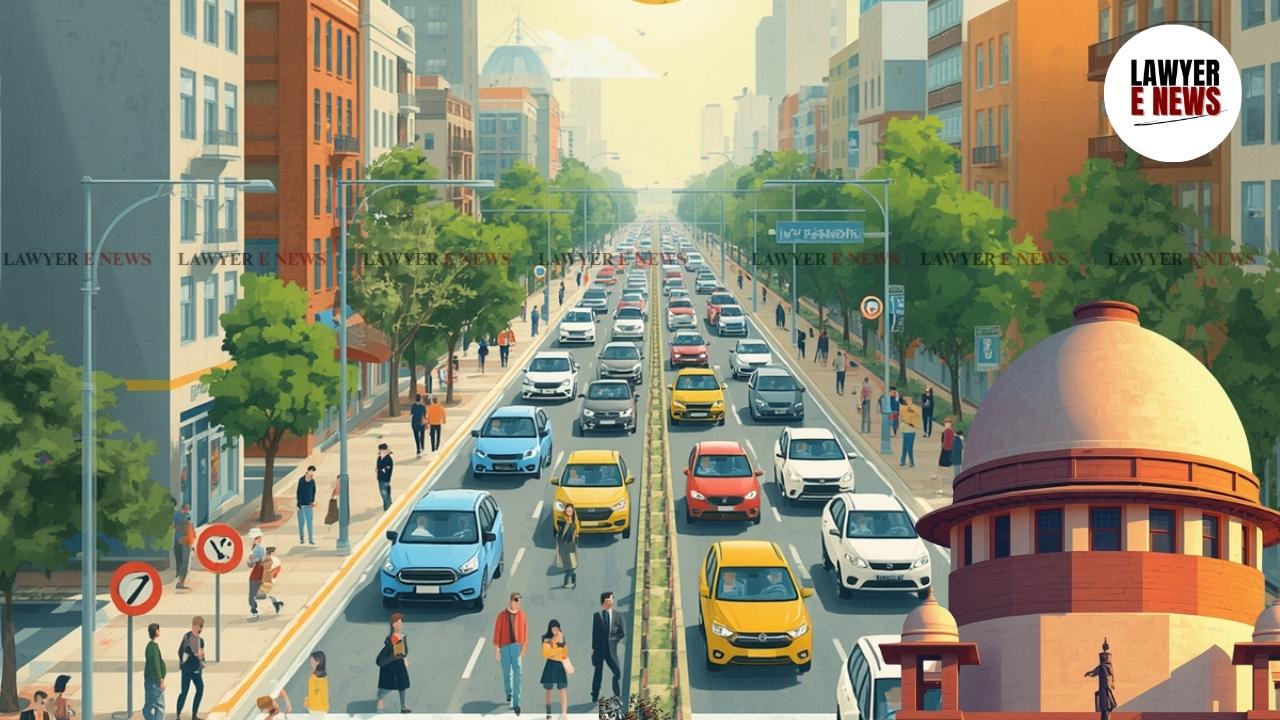
"A stationary vehicle occupying the road in the dead of night without any warning indication poses an evident hazard to road users," Supreme Court, in a significant ruling dated June 23, 2026, held that leaving a vehicle unattended on the road at night without adequate precautionary measures constitutes negligence.
A bench of Justice Prashant Kumar Mishra and Justice N.V. Anjaria observed that the mere fact of a rear-end collision does not automatically imply negligence on the part of the following driver when the lead vehicle is stationary and invisible. The Court emphasized the principle of "just compensation" while dealing with the death of a young professional student.
The matter arose from a 2013 motor accident where a car collided with a truck parked in the middle of the road at 3:00 a.m. on Delhi's BRT Corridor. The deceased, a 20-year-old CA Final student, succumbed to fatal injuries, leading his parents to seek compensation under the Motor Vehicles Act. While the insurer claimed contributory negligence by the car driver, the Tribunal and High Court concurrently held the truck driver liable for failing to use indicators or reflectors.
The primary question before the Court was whether the concurrent finding of negligence against the driver of the stationary truck was sustainable in the absence of warning signs. The Court was also called upon to determine if the compensation awarded to the parents of a professional student was excessive and whether they were entitled to filial consortium.
Stationary Vehicle At Night Without Indicators Poses Hazard
The Court upheld the findings of the lower forums, noting that the truck had been stationed on the road without parking lights, reflectors, or cautionary signs. The bench remarked that the absence of such measures at 3:00 a.m. assumes significant legal weight. It held that the proximate cause of the accident was the negligent act of leaving the vehicle unattended on the road, creating an "evident hazard" for other commuters.
Adverse Inference Against Driver For Not Testifying
The bench highlighted that while the driver and owner of the truck claimed the vehicle was parked due to a tyre puncture, neither entered the witness box to substantiate this plea. The Court ruled that in the absence of evidence from the defense, the Tribunal was justified in drawing an adverse inference against them. It noted that the testimony of the eyewitness, who was also injured in the crash, remained materially unshaken.
"No Evidence To Establish Contributory Negligence"
Regarding the insurer's plea of contributory negligence, the Court held that such a finding cannot be based on mere conjecture. It observed that save for the written statement, no cogent material was adduced to prove that the car driver was rash or negligent. The bench clarified that the mere occurrence of a rear-end collision with a stationary vehicle at night does not inherently shift the blame to the driver who rammed the vehicle.
Compensation For Student At The Threshold Of Career
Turning to the quantum of compensation, the Court noted that the deceased was a CA Final student undergoing articleship. While his actual stipend was low, the Tribunal had assessed his monthly income at Rs. 55,500 based on the likely earnings of an entry-level Group-A officer. The bench approved this forward-looking assessment, stating that the determination of "just compensation" cannot be viewed in sterile mathematical terms detached from the human element.
"Technical Overlap In Methodology Does Not Warrant Reduction"
The Court addressed the insurer's argument that the Tribunal committed a technical error by adding 50% for future prospects on an already enhanced benchmark income. However, the bench refused to interfere, stating that reducing the award at this stage would not advance substantive justice. It observed that the loss of a young life with promising professional potential cannot be measured with arithmetical precision or exactitude.
"The adjudication of compensation in the present matter cannot be viewed in sterile mathematical terms alone detached from human element underlying such claims."
Mandatory Entitlement To Filial Consortium
The Supreme Court found that the lower courts had omitted compensation under the head of 'filial consortium.' Relying on the precedents set in National Insurance Company Limited vs. Pranay Sethi and Magma General Insurance Co. Ltd. vs. Nanu Ram, the bench held that parents are entitled to this award in the case of the death of an unmarried son. The Court emphasized that it is the duty of the judiciary to ensure all legitimate conventional heads are covered.
Final Directions and Enhancement of Award
In its final order, the Supreme Court dismissed the insurer’s appeal and partly allowed the claimants' cross-appeal. It enhanced the total compensation by adding Rs. 40,000 each for both parents towards filial consortium, totaling Rs. 80,000. The final compensation was modified to Rs. 82,01,900 along with interest as originally awarded by the Tribunal. The insurer was directed to deposit the enhanced amount within four weeksThe Supreme Court reaffirmed that a stationary vehicle without warning signs is a primary source of negligence in night-time accidents. By upholding a substantial award for a CA student’s death, the Court underscored that compensation must reflect the future professional trajectory of a deceased student rather than being limited to their current earnings or stipend.
Date of Decision: June 23, 2026