-
by sayum
27 August 2026 3:32 PM







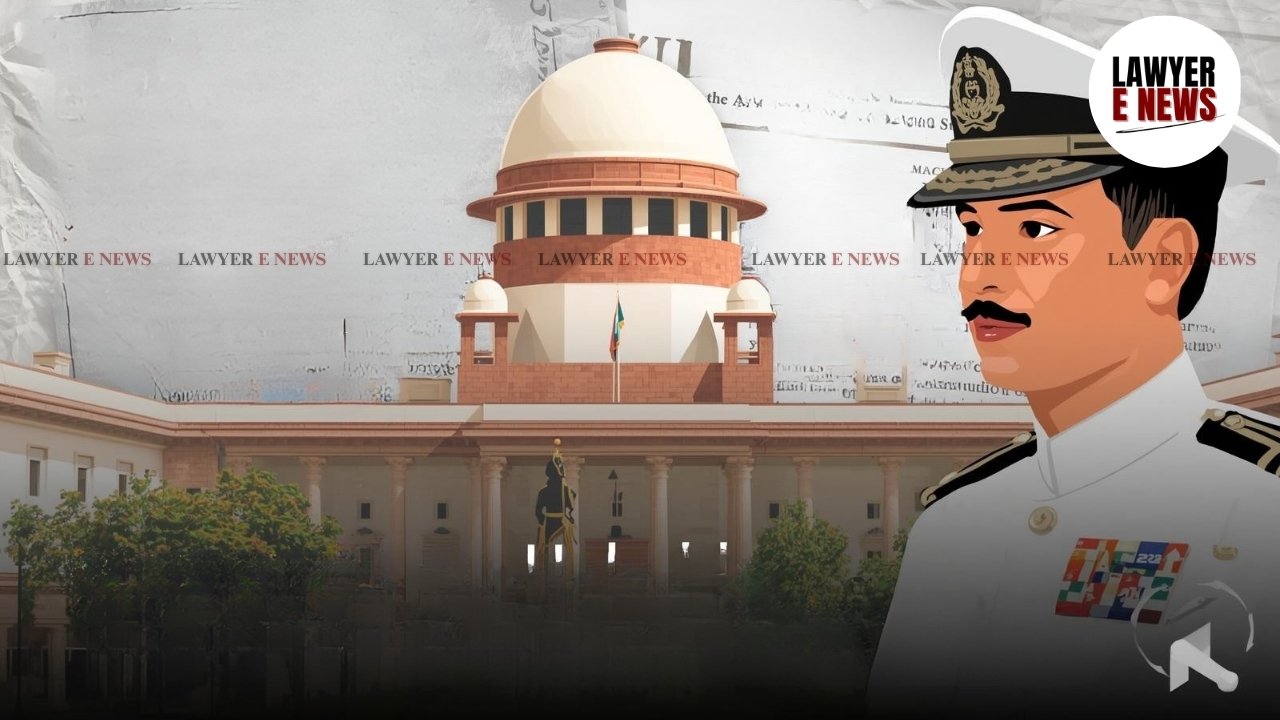
“The Right of Appeal Under Section 18 of the POSH Act Is Immediate and Judicially Enforceable”— In a judgment with far-reaching implications for service personnel and the enforcement of workplace gender justice, the Supreme Court of India decisively held that a member of the Armed Forces has the statutory right to appeal against an ICC report under the POSH Act and that such a challenge cannot be thwarted on the ground that only a Show Cause Notice has been issued. The Court categorically declared that when a Show Cause Notice is founded on the findings of an Internal Complaints Committee, it cannot be treated as a standalone or preliminary action divorced from the ICC report.
The case concerned Commander Yogesh Mahla, who was served a Show Cause Notice dated 05.03.2025 under Regulation 216 of the Navy Regulations, recommending termination from service. This followed an adverse report by the ICC, which was constituted under the POSH Act, 2013 after a female officer aboard INS Shakti alleged sexual harassment.
Challenging both the ICC report and the Show Cause Notice, Commander Mahla had approached the Armed Forces Tribunal (AFT) under Section 14 of the AFT Act read with Section 18 of the POSH Act, but the Tribunal dismissed his challenge as premature. The Delhi High Court upheld this view and further observed that no statutory right of appeal lay under the POSH Act in such a scenario.
Reversing both decisions, the Supreme Court firmly held, “The Tribunal has not adjudicated the appeal filed by the appellant in terms of Section 18 of the POSH Act read with Section 14 of the AFT Act, 2007 but has primarily proceeded on the basis that what was in issue was essentially the Show Cause Notice... whereas the appeal under Section 18 of POSH Act was the subject matter of OA No.1024 of 2025.”
“Regulation 216 Is General—POSH Act Is Special. Special Law Must Prevail”—Court Rejects Technical Objections of Navy
The Court drew a sharp distinction between general disciplinary provisions under Navy Act and Regulations, and the specific right to appeal against ICC findings under the POSH Act. Justice Nagarathna, writing for the Bench, observed, “Regulation 216 is general in nature vis-à-vis any complaint that could be made against a naval officer... whereas Section 18 is specific inasmuch as it is under a special enactment which enables a person to assail the report and recommendations of the ICC.”
The Court found that Commander Mahla had rightly invoked the appellate jurisdiction of the Tribunal, and the AFT was bound to adjudicate the correctness of the ICC report and its recommendations, which formed the very foundation of the Show Cause Notice.
It held that the Show Cause Notice was “not simply a preliminary notice as such—it was a notice relatable directly to the report and the recommendations of the ICC”, and therefore, the challenge could not be dismissed as premature.
“Right Under Section 18 of the POSH Act Exists—and Must Be Respected”—Supreme Court Rebukes High Court’s Reasoning
Criticising the Delhi High Court’s conclusion that the appellant had no statutory right to appeal, the Supreme Court made it clear that Section 18 of the POSH Act does apply to service personnel, and the AFT is the competent forum for such appeals.
In unambiguous terms, the judgment stated, “We find that the High Court was not right in holding that the appellant had no right under Section 18 of the POSH Act.”
The Court reminded the High Court and the Tribunal that Section 18 confers an immediate and actionable right of appeal, and the appellant was not required to await final termination before seeking redress.
Supreme Court Restores Appeal Before Tribunal—Directs No Action on Show Cause Notice Until Final Decision
Setting aside the orders of the High Court and Tribunal, the Supreme Court restored Original Application No.1024/2025 before the Armed Forces Tribunal and directed that the Show Cause Notice shall remain inoperative until the matter is decided.
It ordered, “Pending consideration of the appeal being O.A. No.1024/2025, the Show Cause Notice dated 05.03.2025 shall not be acted upon.”
The Court made it clear that it had not expressed any opinion on the merits of the sexual harassment allegations, and its judgment was confined to the question of legal maintainability and procedural propriety.
In a significant conclusion, the Bench held, “Section 14 of the AFT Act, 2007 when read in juxtaposition with Section 18 of the POSH Act, we find that the appellant herein had rightly approached the Tribunal so as to assail the report as well as the recommendations of the ICC.”
This ruling is expected to strengthen the procedural safeguards available to military personnel facing disciplinary proceedings based on ICC findings and clarify the enforceability of appeal rights under the POSH Act across service branches.
Date of Decision: 20 January 2026