-
by sayum
23 August 2026 2:56 PM







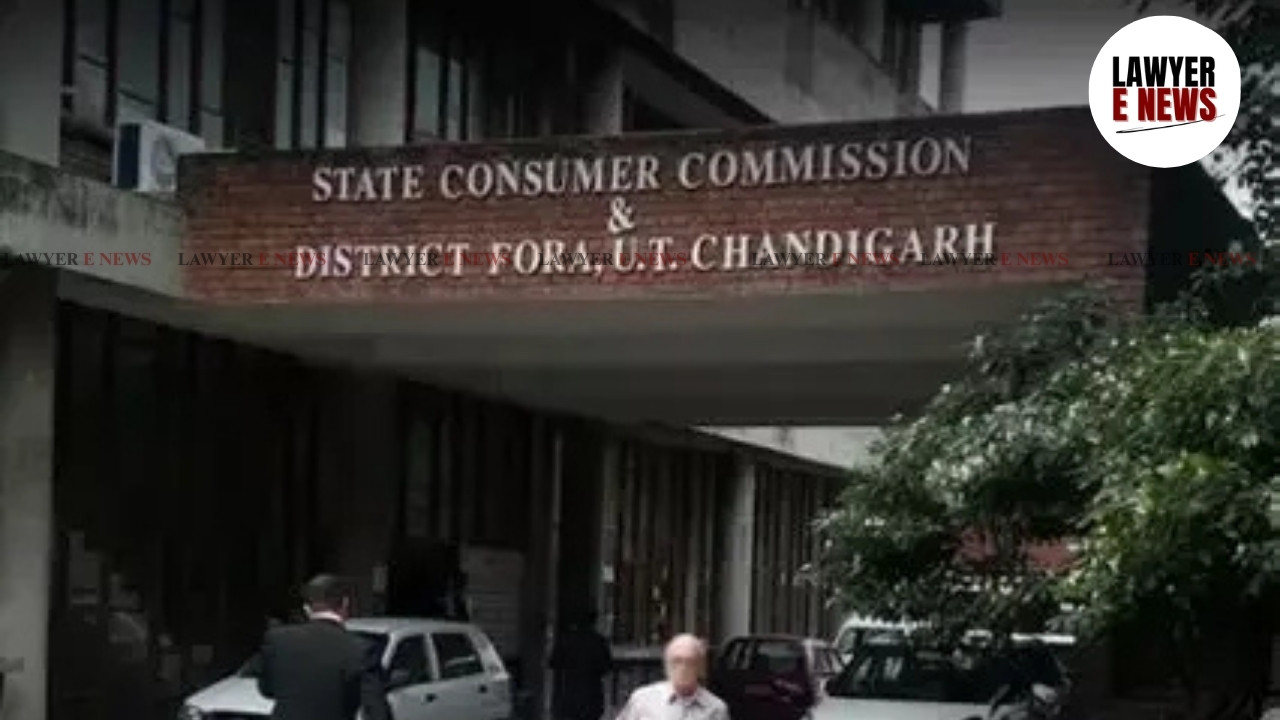
“No Prudent Senior Citizen Would Opt for 12-Year Policy on Fixed Deposit Assurance – Signatures on Blank Forms Don’t Prove Informed Consent”, In a strongly worded decision reinforcing consumer protections against financial mis-selling, the State Consumer Disputes Redressal Commission, U.T. Chandigarh upheld a District Forum order directing Reliance Nippon Life Insurance Co. Ltd. to refund entire premium amounts with interest and compensation to a senior citizen complainant, Mrs. Neelam Sobti, who was lured into purchasing long-term life insurance policies on the false assurance that they were short-term investments like fixed deposits.
Dismissing six connected appeals (Nos. 30–35 of 2025) filed by the insurer, the Bench comprising Presiding Member Mrs. Padma Pandey and Member Mr. Preetinder Singh held that:
“No prudent senior citizen would voluntarily opt for a policy with a 7-year premium paying term and a 12-year duration, especially on the assurance of a 3-year fixed deposit-type investment. Mere signatures on printed proposal forms do not ipso facto establish free volition.”
The Commission held the insurer vicariously liable for the acts and misrepresentations of its agents, and found mis-selling, deficiency in service, and unfair trade practice clearly established, warranting full restitution.
“Mis-selling to Senior Citizens Is a Continuing Wrong—Limitation Starts Only Upon Discovery”
Rejecting the insurer’s argument that the complaint filed in 2024 was time-barred, given that the policy was issued in 2019, the Commission held:
“In mis-selling cases, the cause of action arises when the complainant discovers the deceit or is denied the expected return—not on the date of policy issuance. The complaint is well within limitation as the denial occurred only after three years when refund was sought.”
The Court invoked Section 24A of the Consumer Protection Act, 1986 and clarified that misrepresentation is a continuing wrong, and the limitation begins only when the wrong becomes apparent to the consumer.
“Absence of Proof of Policy Delivery Defeats Free Look Defence”
The insurer argued that the complainant had the opportunity to cancel the policy during the 15-day free look period as per Regulation 6(2) of the IRDA (Protection of Policyholders’ Interests) Regulations, 2002, and was thus estopped from later complaints.
However, the Commission found:
“The appellants failed to prove delivery of policy documents. No proof of dispatch or acknowledgment was furnished. In the absence of such evidence, the free look clause cannot be enforced against the consumer.”
The Bench observed that the free look clause cannot be weaponized to validate fraud or misrepresentation, especially when the policy itself was never properly explained or disclosed.
“Vicarious Liability of Insurer Cannot Be Evaded by Disowning Agents”
The insurer contended that the complainant's policy was not solicited through a corporate agent like PNB Bank, implying no liability for acts of field agents. This was flatly rejected:
“It is irrelevant where the inducement took place—within the bank premises or elsewhere. The fact remains that agents of the insurer misrepresented the product, and the insurer never denied their authority or took action against them. They cannot now claim disconnection.”
The Commission affirmed that insurers are vicariously liable for their agents’ actions while soliciting insurance, especially when there is no rebuttal of allegations of blank signatures or false assurances.
“When Contract Is Vitiated by Misrepresentation, Surrender Clause Is Inapplicable”
In one of the cases, the insurer had already credited a surrender value of ₹14.03 lakhs to the complainant’s account. The insurer argued that this extinguished any further liability.
The Bench disagreed:
“Once the contract itself is found to be vitiated by misrepresentation and unfair trade practice, reliance on surrender clauses or partial payouts is misplaced. Retaining premiums under such circumstances amounts to unjust enrichment.”
Reliance on National Commission Judgment in Rattan Chauhan Case Strengthens Consumer's Case
The Commission cited with approval the recent judgment of the National Consumer Disputes Redressal Commission (NCDRC) in Reliance Nippon Life Insurance Co. Ltd. v. Rattan Chauhan (Second Appeal No. 75 of 2025), where the National Commission upheld refund of premiums to a senior citizen duped by similar mis-selling.
“No doubt, an insurance contract binds both parties. But when it is established that the policy was sold under misrepresentation, without explanation of terms, the insured cannot be bound by the contract.”
By referring to this authoritative precedent, the State Commission validated its decision as fully in line with settled consumer jurisprudence.
The Commission concluded that no illegality, perversity or jurisdictional error existed in the District Commission’s detailed findings, and that all the insurer’s grounds were without merit.
Upholding the original order in full, the Commission directed:
The ruling is a strong message to insurers against mis-selling to vulnerable consumers, especially senior citizens, and a reaffirmation that consumer protection law looks beyond mere documentation to the substance of consent and fairness.
Date of Decision: 05 January 2026