
-
by sayum
26 August 2026 6:42 AM







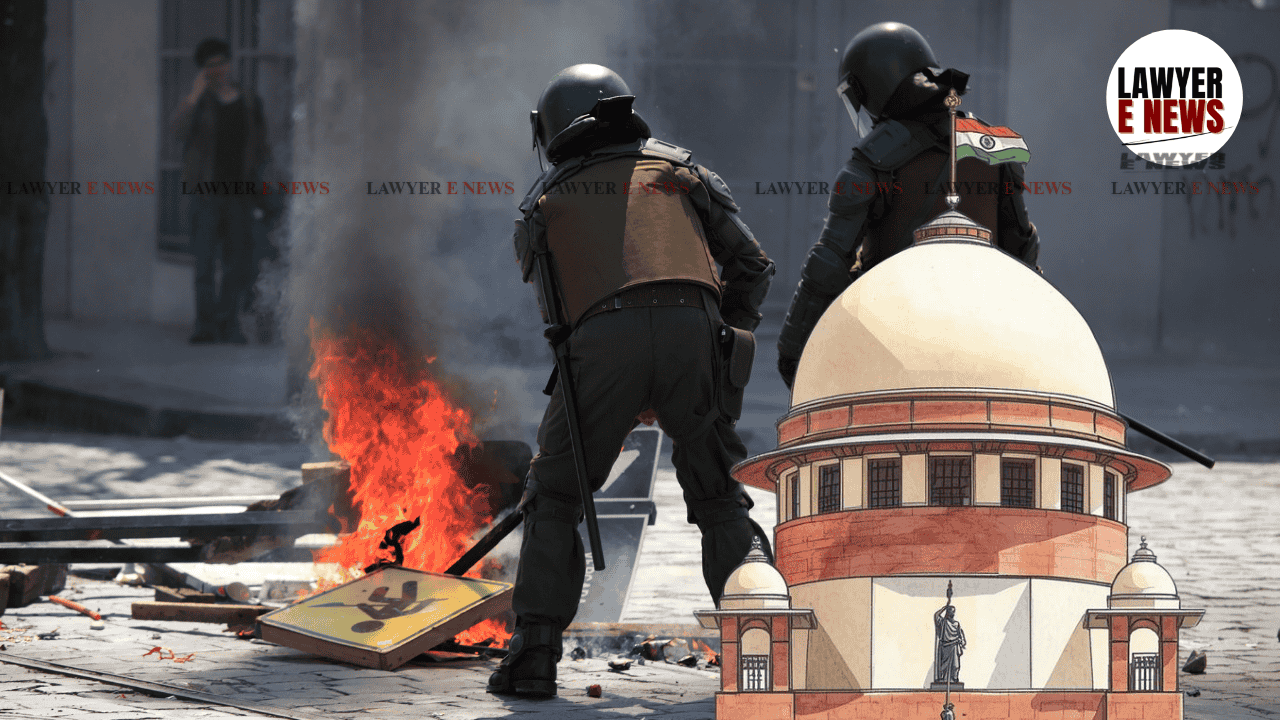
“Secularism needs to be actuated in practice and reality, rather than be left on paper to be enshrined as a constitutional principle” — On 7 November 2025, the Supreme Court of India dismissed a Review Petition filed by the State of Maharashtra, challenging a key direction in its earlier judgment dated 11 September 2025 in Criminal Appeal No. 3976 of 2025, which had mandated that a Special Investigation Team (SIT) constituted to probe communal riots should include senior police officers from both Hindu and Muslim communities. The Court reiterated that in cases involving communal overtones, transparency and fairness in investigation must not only exist but must be seen to exist, and the direction for inclusive representation in the SIT was a measured and necessary step, not a violation of secularism.
Rejecting arguments that the order undermined institutional secularism, the Court held that secularism is not a passive constitutional abstraction, but one that must be enforced through action, especially where the conduct of public officials during communal tensions is under scrutiny.
“When the Case Bears the Hue of Religious Bias, Investigation Must Be Beyond Suspicion”
Court Defends Direction for Diverse SIT to Probe Police Inaction in Communal Riot
The original judgment under review had arisen from an appeal challenging police inaction during communal riots, where the police allegedly failed to register an FIR despite clear information about the commission of cognizable offences.
The Court had found that both the local police officers and the Superintendent of Police had abjectly failed in their duty, either by deliberate omission or gross negligence, and accordingly directed the constitution of an SIT to ensure a fair probe.
In doing so, it specifically ordered that the SIT must comprise senior officers from both the Hindu and Muslim communities, noting that such representation would “maintain transparency and fairness in the investigation” and reassure the communities involved.
The State, in its review petition, had argued that this direction impinged on the principle of institutional secularism and improperly introduced religious identity into police functioning, thereby requiring correction under Article 137 of the Constitution.
But the Supreme Court dismissed this objection, stating:
"The review petition merely reproduces and seeks to appropriate what was stated by this Court... but the same was not borne out by the action of the police officers in this case."
It stressed that the communal character of the case demanded heightened sensitivity, and the composition of the SIT was intended not to divide, but to restore public confidence.
“Police Cannot Appear Partial in Communal Riots: Diversity Ensures Transparency”
Court Observes Dereliction of Duty and Failure to Register FIR by Police in Riot-Affected Areas
Reiterating its earlier findings, the Court noted that:
“Despite information being given as to the commission of a cognizable offence, neither the officers of the police station concerned nor the Superintendent of Police took necessary action by at least registering an FIR, clearly manifesting total dereliction of duty.”
This observation laid the foundation for the Court’s insistence on a balanced composition in the investigative team, to counter the possibility — or even the perception — of religious bias.
The Court further explained:
“As the case related to communal riots... and the hues of this case prima facie hinted at a religious bias, it was necessary to direct constitution of an investigation team comprising senior police officers of both communities.”
This, it said, was not to undermine the secular fabric but to ensure it is upheld in practice, particularly where the actions of public authorities had already betrayed that ideal.
“Idealism Must Be Matched by Institutional Conduct”: Secularism Not Merely a Constitutional Slogan
Court Cites Balram Singh Judgment on Indian Secularism as Applied, Not Abstract
In support of its conclusion, the Court referred to its earlier decision in Balram Singh v. Union of India, 2024 SCC OnLine SC 3433, where it had clarified the nature of secularism in India.
Quoting from that judgment, the Bench held:
“India has developed its own interpretation of secularism, wherein the State neither supports any religion nor penalizes the profession and practice of any faith. This being the ideal, the State machinery must tailor its actions accordingly.”
The Court emphasized that transparency and fairness must be "manifest in matters even remotely touching upon secularism and religious oppression", and insisted that investigative processes, especially in riot cases, must reflect that commitment.
The judgment decisively stated:
“Constitution of an investigation team comprising members of the communities involved in the communal riot would go a long way in ensuring and safeguarding the transparency and fairness of the investigation to be carried out.”
It concluded with a powerful reminder:
“Secularism needs to be actuated in practice and reality, rather than be left on paper to be enshrined as a constitutional principle.”
“Attempts to Mislead the Court About Bench Mentioning Practices Are Unacceptable”
Court Condemns Procedural Misconduct by State in Simultaneous Mentions Before Judges
In a strongly worded censure, the Court also addressed procedural improprieties by the State of Maharashtra’s counsel in the course of review proceedings.
The Court noted:
“The dubious and unprecedented practice of making separate mentions for seeking such hearing before both the Judges on the Bench simultaneously, without disclosing the fact that the other was also being approached, requires to be condemned in no uncertain terms.”
It thus rejected the Criminal M.P. No. 242074 of 2025, which had sought an open court hearing of the review petition, deeming that no procedural irregularity would be countenanced, especially in matters involving such serious constitutional principles.
Fairness Must Be Seen, Not Just Assumed — Review Petition Dismissed
Finding no error apparent on the face of the record, the Supreme Court dismissed the review petition and refused to recall or modify the direction requiring communal representation in the SIT. It held that the direction was not only constitutional but necessary, given the failure of the police and the sensitive nature of the case.
The Court concluded:
“No grounds are, therefore, made out to review the directions of this Court.”
The review petition filed by the State of Maharashtra was dismissed, and the original direction for forming a communal-representative SIT was upheld in full.
Date of Decision: 7 November 2025





