-
by sayum
01 November 2026 1:51 PM







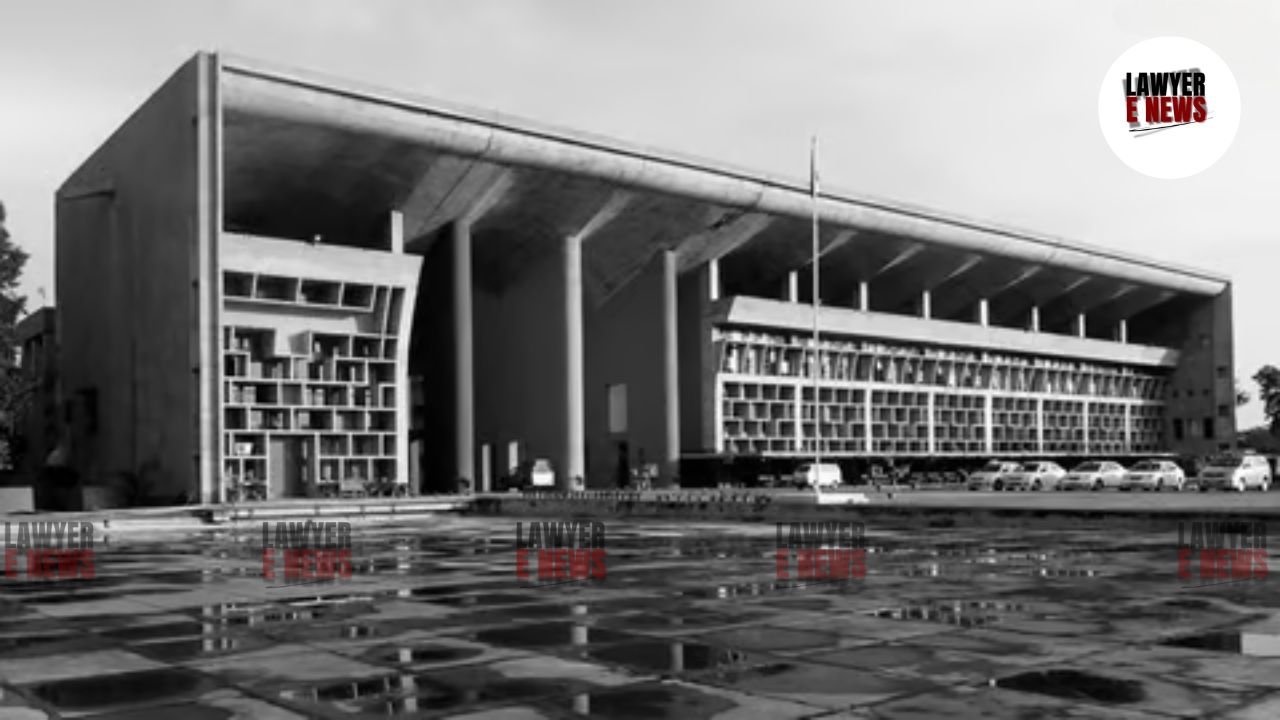
"The submission proceeds on the assumption that a person carrying a weapon would necessarily try to throw it away or offer resistance on finding himself surrounded by the police. Such conduct cannot be said to be the only natural reaction in such a situation. The conduct of a person depends upon how he reacts to the particular situation in which he finds himself." Punjab and Haryana High Court, in a significant ruling delivered on September 24, 2026, held that the absence of violent resistance by armed accused persons upon being surrounded by the police cannot be treated as an unnatural circumstance to discard the prosecution version under Sections 399 and 402 of the Indian Penal Code (IPC).
A single-judge bench of Justice Mandeep Pannu observed that when the testimony of an investigating officer overhearing the allocation of specific roles for committing dacoity remains unchallenged during cross-examination, and is corroborated by the recovery of firearms, the charge of making preparation to commit dacoity stands fully established.
The appeal arose out of a judgment of conviction and order of sentence passed by the Sessions Judge, Jind, in January 2008, arising from FIR No. 152 of 2006 registered at Police Station Nirwana under Sections 399 and 402 IPC along with Section 25 of the Arms Act. The prosecution alleged that acting on secret information, a police raiding party surrounded five individuals assembled inside an abandoned octroi kotha who were actively planning to loot a Haryana Roadways bus, subsequently arresting them and recovering loaded country-made pistols, an air gun, and wooden sticks. The appellant, Ramesh, approached the High Court challenging his conviction and substantive three-year rigorous imprisonment sentence.
The primary questions before the High Court were whether the failure to offer resistance or discard weapons when surrounded by police renders the prosecution story inherently improbable, and whether the unchallenged testimony of an officer overhearing planning, combined with recoveries from an abandoned building, satisfies the legal threshold of "preparation" under Section 399 IPC. The Court was also called upon to determine whether the non-joining of independent witnesses and non-compliance with Section 100(4) of the Code of Criminal Procedure (CrPC) vitiated the personal search and recovery.
Distinction Between Mere Intention And Preparation Under Section 399 IPC
The High Court began by delineating the statutory ingredients necessary to sustain a conviction for preparation to commit dacoity under Section 399 IPC. The bench underscored that the prosecution is obligated to show an overt step advancing beyond the mental stage of committing a crime.
The Court observed that mere intention to commit dacoity was not sufficient and there had to be some act or acts amounting to preparation towards the commission of dacoity. Justice Pannu, however, clarified that such preparation need not necessarily extend to the stage of an actual attempt.
Failure To Cross-Examine Investigating Officer On Overheard Conversation Proves Fatal To Defence
Examining the evidentiary weight of the conversation overheard by the investigating officer outside the window of the octroi post, the Court highlighted that the witness had specifically recounted the allocation of roles, including who would board from the front door, who would cover the driver, and who would execute the looting.
The bench stressed that this critical testimony remained completely unshaken because the defence failed to put even a single question or suggestion disputing the conversation during cross-examination. Justice Pannu noted that the defence cannot subsequently argue that the conversation was improbable based on conjectures when the officer was never confronted on that assertion at trial.
"The cross-examination of PW-5 is directed towards other aspects of the prosecution case, including the manner of apprehension of the accused, the place of occurrence and the recovery of weapons. Thus, the material assertion of PW-5 regarding the conversation remained unchallenged."
Absence Of Armed Resistance When Surrounded Does Not Vitiate Prosecution Story
Addressing the appellant's primary contention that armed criminals would naturally resist the police or discard weapons rather than quietly surrender, the bench refused to endorse rigid presumptions regarding criminal conduct.
The Court held that human reactions vary widely when individuals suddenly realise they are trapped by law enforcement. The bench distinguished the Supreme Court ruling in Jasbir Singh @ Javri @ Jabbar Singh v. State of Haryana, clarifying that the judgment turned on its own peculiar facts and does not lay down a blanket precedent that lack of resistance discredits an arrest.
"Some persons may choose to resist, whereas others may choose not to resist and surrender themselves to the police. Therefore, merely because the accused did not offer resistance before being apprehended cannot, by itself, be made a ground to doubt the prosecution version."
Non-Joining Of Independent Witnesses At Night Near Isolated Structures Not Fatal
The Court dismissed the defence plea that the absence of independent public witnesses proved fatal to the case, noting that the raid occurred at around 10:00 p.m. at an abandoned octroi post.
Justice Pannu ruled that the mere proximity of a school or police station does not establish that independent civilians were readily available to join the raid late at night. The testimony of official police witnesses carries intrinsic legal value and cannot be rejected mechanically in the absence of any established motive for false implication.
Section 100(4) CrPC Inapplicable To Personal Search Effected Outside Premises
The bench also rejected the appellant's argument that the search was invalidated due to non-compliance with Section 100(4) CrPC, which mandates independent witnesses during searches of closed places.
The High Court clarified that the accused persons had stepped out of the structure upon being commanded by the police, and the recoveries of loaded firearms were made from their personal search outside the building. Consequently, Section 100(4) CrPC could not be invoked to impugn recoveries that did not emanate from a search of the building itself.
Minor Discrepancies In Writing Work Or Cartridge Markings Do Not Dent Case
Evaluating minor discrepancies raised by the defence regarding whether writing work was done on chairs or on the ground with a torch, and minor variations in cartridge markings between police witnesses, the Court deemed them peripheral.
The bench held that such minor inconsistencies naturally occur with the passage of time and do not shake the core prosecution narrative regarding the presence of five persons, their common objective, and the recovery of illicit firearms proved by ballistic and armourer reports.
Sentence Reduced Considering Two-Decade Pendency And Medical Ailments
While upholding the conviction under Sections 399 and 402 IPC alongside Section 25 of the Arms Act, the High Court took a lenient view on the quantum of punishment.
Taking into consideration that the occurrence dated back to 2006, the proceedings had spanned two decades, and the appellant suffered from chronic liver cirrhosis, the bench reduced the substantive sentence of imprisonment under Sections 399 and 402 IPC from three years to two years.
The High Court partly allowed the appeal by confirming the appellant's conviction under Sections 399 and 402 IPC as well as Section 25 of the Arms Act, while reducing the substantive sentence to two years rigorous imprisonment. The ruling clarifies the evidentiary standards in dacoity preparation cases, reiterating that unchallenged overhearings of criminal planning coupled with weapon recoveries constitute an unassailable basis for conviction.
Date of Decision: 24 September 2026