-
by sayum
24 October 2026 1:11 PM







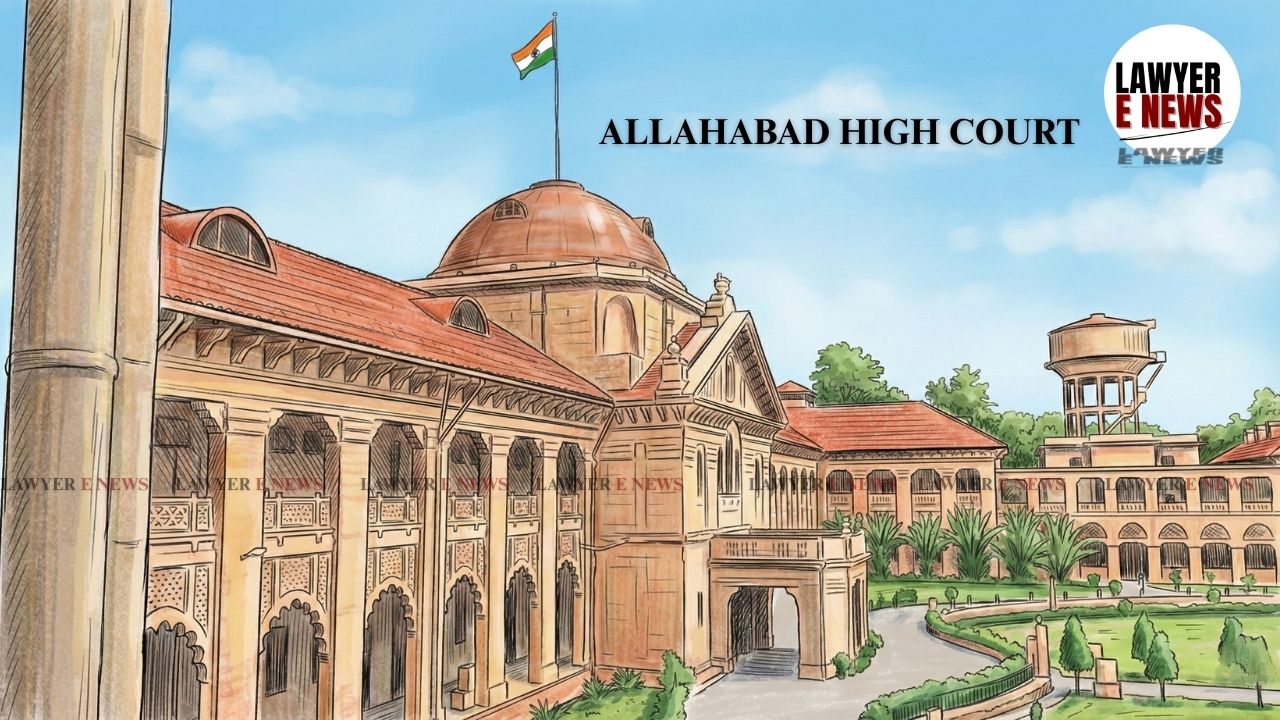
"The core substratum of the prosecution case across all declarations, that appellant Krishna Kumar @ Kumbh Karan inflicted the fatal dagger/gupti blow into the abdomen of deceased Bhim Singh, remains unwavering. The minor variance regarding the mode of conveyance does not destroy the consistent attribution of the fatal assault to the appellant." Allahabad High Court has held that when dealing with multiple dying declarations under Section 32(1) of the Indian Evidence Act, 1872 (now Section 26 of the Bharatiya Sakshya Adhiniyam, 2023), credibility is shaken only by material inconsistencies and not trivial peripheral variations.
A division bench comprising Justice Siddhartha Varma and Justice Jai Krishna Upadhyay observed that minor discrepancies regarding the transit of the deceased to the hospital do not vitiate a dying declaration where the core substratum consistently establishes the fatal overt act attributed to the accused.
The prosecution arose out of a fatal incident on February 24, 1987, where the deceased, Bhim Singh, was assaulted and stabbed in the stomach with a dagger following an ongoing land dispute. Bhim Singh succumbed to his injuries the following morning at the District Hospital, Bareilly, after his dying declaration was formally recorded by an Executive Magistrate. The Additional Sessions Judge-9th, Bareilly, convicted appellant Krishna Kumar alias Kumbh Karan under Section 302 IPC and sentenced him to life imprisonment, prompting this appeal before the High Court.
The primary question before the court was whether minor discrepancies between the FIR, medical register, and the written dying declaration regarding the deceased's transit to the hospital rendered multiple dying declarations contradictory under Section 32(1) of the Evidence Act. The court was also called upon to determine whether an unexplained delay in recording a witness statement under Section 161 CrPC and the presence of defence wounds on the deceased vitiated the prosecution's case.
Jurisprudential Basis Of Dying Declarations Under Section 32(1) Evidence Act
The bench commenced its analysis by underscoring the legal foundations governing dying declarations, historically enshrined under Section 32(1) of the Indian Evidence Act, 1872, and now embodied in Section 26 of the Bharatiya Sakshya Adhiniyam, 2023. The Court observed that written or verbal statements by a deceased person regarding the cause of death or transactions resulting in death enjoy unique evidentiary sanctity.
The Court highlighted that the evidentiary rule is rooted in the venerable legal maxim nemo moriturus praesumitur mentiri, presuming that a person will not meet their Maker with a lie in their mouth. The bench reiterated that when declarations are made in extremity, when every hope of this world is gone and every motive to falsehood is silenced, they create an obligation equal to that imposed by a positive oath.
"A dying declaration, if voluntary, truthful, and unprompted, can form the sole basis of conviction without requiring corroboration."
Parameters Governing Multiple Dying Declarations
Addressing the evidentiary treatment of multiple dying declarations, the Court examined the principles laid down by the Supreme Court in Mohan Lal Gangaram Gehani v. State of Maharashtra and the recent codification in Abhishek Sharma v. State (Govt. of NCT of Delhi). The bench noted that while a plurality of dying declarations requires close judicial scrutiny, the law mandates consistency primarily on the core substratum of the crime.
The bench stressed that under settled Supreme Court jurisprudence, inconsistencies between statements must be material rather than inconsequential to shake their credibility. Where a dying declaration is recorded by an Executive Magistrate following proper medical certification, it carries high probative value if shown to be voluntary, truthful, and free from tutoring.
Medical Certification Guarantees Veracity And Mental Fitness
Examining the record, the High Court observed that the written dying declaration (Ex. Ka-7B) recorded by Executive Magistrate Leeladhar Nainwal (PW-7) was backed by meticulous medical scrutiny. Attending Medical Officer Dr. D.K. Saxena (PW-3) had examined the victim prior to the declaration, explicitly certifying his conscious and fit mental state, and re-certified his mental stability immediately upon completion.
The bench held that a harmonious reading of the testimonies of the Executive Magistrate and the treating doctor fully established that the dying declaration was recorded under rigorous medical oversight. The Court held that the declaration remained completely free from any coaching, prompting, or fabrication.
"In the presence of inconsistencies, the medical fitness of the person making such declaration, at the relevant time, assumes importance along with other factors such as the possibility of tutoring..."
Peripheral Variations in Conveyance Do Not Vitiate Ocular and Dying Accounts
The Court firmly rejected the appellant's contention that discrepancies between the FIR and the dying declaration regarding whether the deceased was transported to the hospital by a rickshaw or a traffic constable destroyed the prosecution's version. The bench ruled that minor variations concerning the mode of transit or the assisting individual are trivial details that do not compromise the foundational narrative.
The bench observed that across all iterations—including the initial FIR, the medical entries, and the formal statement before the Magistrate—the specific overt act of thrusting a dagger into the deceased's abdomen was steadfastly assigned to the appellant. Such consistent attribution of the fatal assault left no room for reasonable doubt.
Defence Wounds On Victim Negate Plea Of Accidental Injury
The Court further held that the ocular testimony of eyewitness PW-1 Sohan Lal stood fully fortified by the post-mortem report proved by Dr. F.A. Khan (PW-8). The autopsy revealed not only the fatal abdominal puncture cutting through the omentum and intestines, but also multiple incised wounds across the fingers and palm of the deceased's left hand.
The bench noted that these injuries constituted classic incised defence wounds sustained by an unarmed victim attempting to ward off a lethal attack. This definitive forensic finding completely demolished the uncorroborated defence plea under Section 313 CrPC that the deceased had initiated the assault and was accidentally injured during a scuffle over the weapon.
"Significantly, Injuries No. 2, 3, 4, and 5 on the left hand of the deceased are classic incised defence wounds, establishing that an unarmed victim attempted to ward off a lethal attack."
Short Delay In Section 161 CrPC Examination Not Fatal Per Se
Turning to the challenge regarding the three-day delay in recording PW-1's statement under Section 161 CrPC, the Court noted that the delay had been satisfactorily explained by Station Officer Rajbala Vishnoi (PW-5), who took over the investigation mid-way. Relying on Supreme Court precedents in Goutam Joardar v. State of W.B., Sunil Kumar v. State of Rajasthan, and V.K. Mishra v. State of Uttarakhand, the Court reiterated that an investigational delay in examining witnesses is not fatal per se when adequately explained and the underlying substantive evidence remains trustworthy.
Concluding that the prosecution had proved the charge under Section 302 IPC beyond reasonable doubt, the High Court affirmed the judgment and sentence of life imprisonment passed by the trial court. The Court directed the appellant to surrender before the trial court to serve out the remaining sentence.
The Allahabad High Court dismissed the criminal appeal and upheld the conviction under Section 302 IPC, affirming that trivial inconsistencies in multiple dying declarations concerning transit or ancillary facts do not impair prosecution evidence where the attribution of the fatal act remains coherent and unshakeable. The ruling reinforces that medical certification and corresponding defence wounds provide decisive corroboration to a Magistrate-recorded dying declaration.
Date of Decision: October 16, 2026