-
by kapil
15 October 2026 3:54 PM







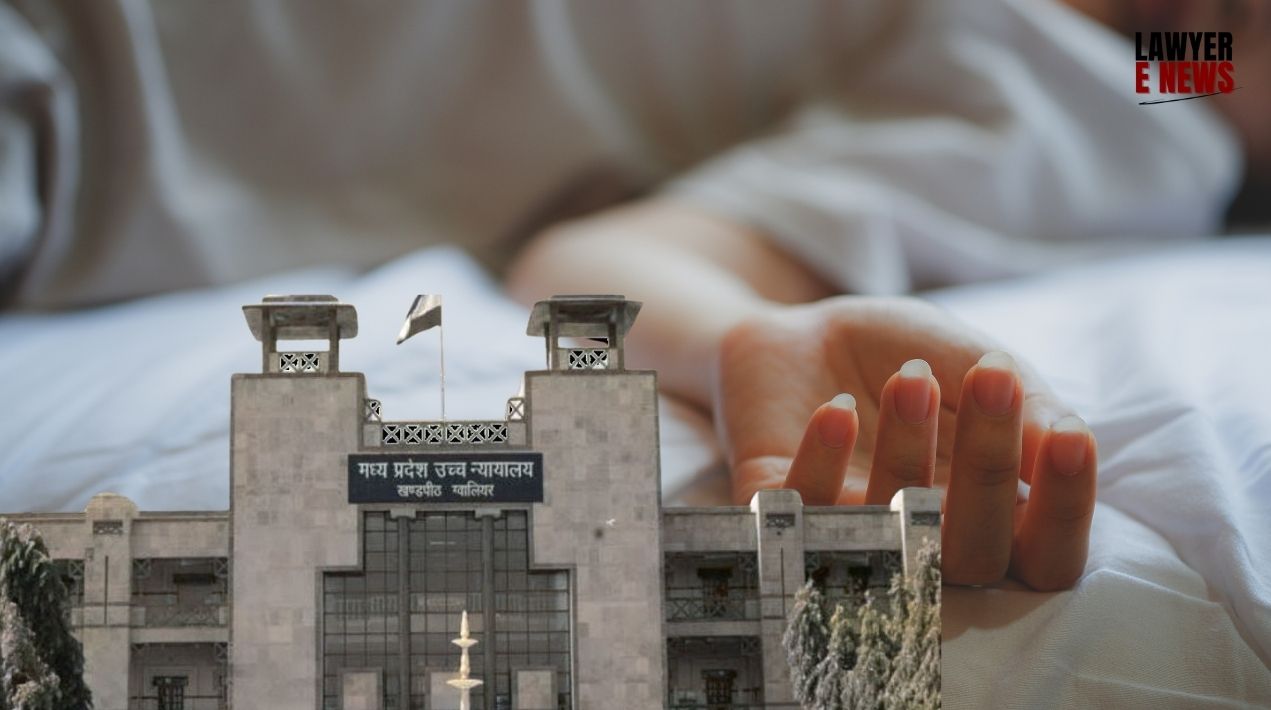
"Mere absence of a suicide note, by itself, cannot justify discharge where the material on record otherwise raises a grave suspicion that the deceased committed suicide, prima facie, due to the aforesaid conduct of the petitioner, which was capable of provoking, urging or encouraging the deceased to do so." High Court of Madhya Pradesh at Gwalior, in a significant ruling delivered on October 13, 2026, held that the absence of a suicide note cannot by itself justify the discharge of an accused under Section 306 of the Indian Penal Code if the material on record prima facie demonstrates a continued course of harassment leaving the victim with no option but to take her own life.
A single bench of Justice Pushpendra Yadav observed that "instigation may be inferred from the conduct of the accused when the material is capable of disclosing the requisite intention to provoke, urge or encourage the deceased to commit suicide," while refusing to interfere with the trial court's order framing charges under Sections 306, 376, 354-D, and 354-A of the IPC.
The petitioner, a Community Health Officer, approached the High Court challenging the order of the III Additional District and Sessions Judge, Vidisha, rejecting his discharge plea and framing charges against him in a suicide case. The prosecution alleged that the deceased committed suicide by hanging in January 2023 following continuous harassment, stalking, and threats by the petitioner, with subsequent forensic and DNA profiling establishing the presence of his biological material. The revision was preferred invoking Sections 397 and 401 of the Code of Criminal Procedure, 1973 (corresponding to Sections 438 and 442 of the Bharatiya Nagarik Suraksha Sanhita).
The primary question before the court was whether an accused can claim discharge under Section 306 IPC solely due to the absence of a suicide note or direct instigation immediately proximate to the incident. The court was also called upon to determine whether a defence of a consensual relationship can be adjudicated at the stage of framing charges under Sections 227 and 228 CrPC to discharge an accused of rape under Section 376 IPC.
Threshold Scope Of Sections 227 And 228 CrPC At Stage Of Framing Charge
Examining the statutory scheme governing discharge and the framing of charge under Sections 227 and 228 CrPC, the Court noted that the trial court is solely tasked with assessing whether the material on record creates a ground for presuming that the accused has committed an offence. The bench held that while the court may sift the evidence for the limited purpose of satisfying itself, it cannot hold a full-blown enquiry or evaluate whether the evidence is sufficient to secure a conviction.
Citing the Supreme Court’s landmark ruling in State of Maharashtra v. Som Nath Thapa, the Court emphasized that if the material indicates that the commission of the offence is a probable consequence, a prima facie case exists. The bench reiterated that at the stage of framing charges, the court is only required to form a tentative opinion based on grave suspicion, whereas a definite opinion is required under Section 227 CrPC before discharging an accused.
Legal Ingredients Of Instigation Under Section 107 Read With Section 306 IPC
Delving into the essential components of abetment under Section 107 IPC, the High Court analyzed the legal meaning of the word "instigate" by adverting to the Supreme Court judgments in Ramesh Kumar v. State of Chhattisgarh and Chitresh Kumar Chopra v. State (Govt of NCT of Delhi). The bench observed that instigation does not require the explicit use of words, but rather encompasses a course of conduct calculated to goad, urge forward, or provoke a consequence.
"Where the accused had, by his acts or omissions or by a continued course of conduct, created such circumstances that the deceased was left with no other option except to commit suicide, in which case, an instigation may have to be inferred."
Addressing the petitioner's argument that there was no suicide note or direct proximate instigation, the Court held that the continuous harassment demonstrated by the prosecution could not be discarded as a mere ordinary dispute. The record revealed that the petitioner had stalked the deceased, barged into her room in an intoxicated state, assaulted her, issued death threats, and continuously called her from different numbers even after being blocked.
"Whether the physical relationship was consensual or against the will of the deceased, and whether the ingredients of Sections 375 and 376 of IPC are ultimately established, are matters requiring appreciation of evidence at trial. To conclusively determine these disputed questions at this stage would amount to conducting a premature 'mini-trial'..."
Plea Of Consensual Relationship In Section 376 IPC Cannot Be Examined In Mini-Trial
Turning to the petitioner's argument that the sexual relationship was entirely consensual and that forensic matching does not automatically prove rape under Section 376 IPC, the bench held that such disputed defences cannot be decided without a trial. The Court ruled that where vaginal slides reveal human sperm and the Regional Forensic Science Laboratory reports confirm a positive DNA profile match with the accused, a grave suspicion is plainly raised.
The Court distinguished the Supreme Court ruling in State of Himachal Pradesh v. Sanjay Kumar, clarifying that determining whether the intercourse was against the will or without the consent of the deceased requires full appreciation of evidence. Undertaking such an inquiry at the inception stage would impermissibly reduce the proceedings to a mini-trial, which the law strictly forbids.
Previous Acquittal And Pending Cyber Cell Report No Ground For Discharge
The Court further rejected the argument that an earlier acquittal of the petitioner in Crime No. 325/2022 under Sections 452 and 354-A IPC barred subsequent prosecution under Sections 354-D and 354-A IPC. The bench noted that the allegations in the present case pertained to continued stalking and extortionate threats made after the earlier compromise, prompting the deceased to seek an administrative transfer for protection.
Dismissing the grievance regarding the non-receipt of the Cyber Cell report concerning WhatsApp chats and seized mobile data, the Court held that the absence of a single technical document cannot stall the trial when ocular statements, medical evidence, call detail records, and DNA reports collectively raise sufficient suspicion regarding complicity.
Upholding the order of the Sessions Court, the High Court dismissed the revision petition, directing the trial court to proceed uninfluenced by observations made on the threshold evidence. The ruling affirms that persistent harassment leading to suicide permits a legal inference of instigation under Section 306 IPC, and defences of consent in sexual offences remain matters strictly for trial.
Date of Decision: 13 October 2026