-
by sayum
12 October 2026 7:53 AM







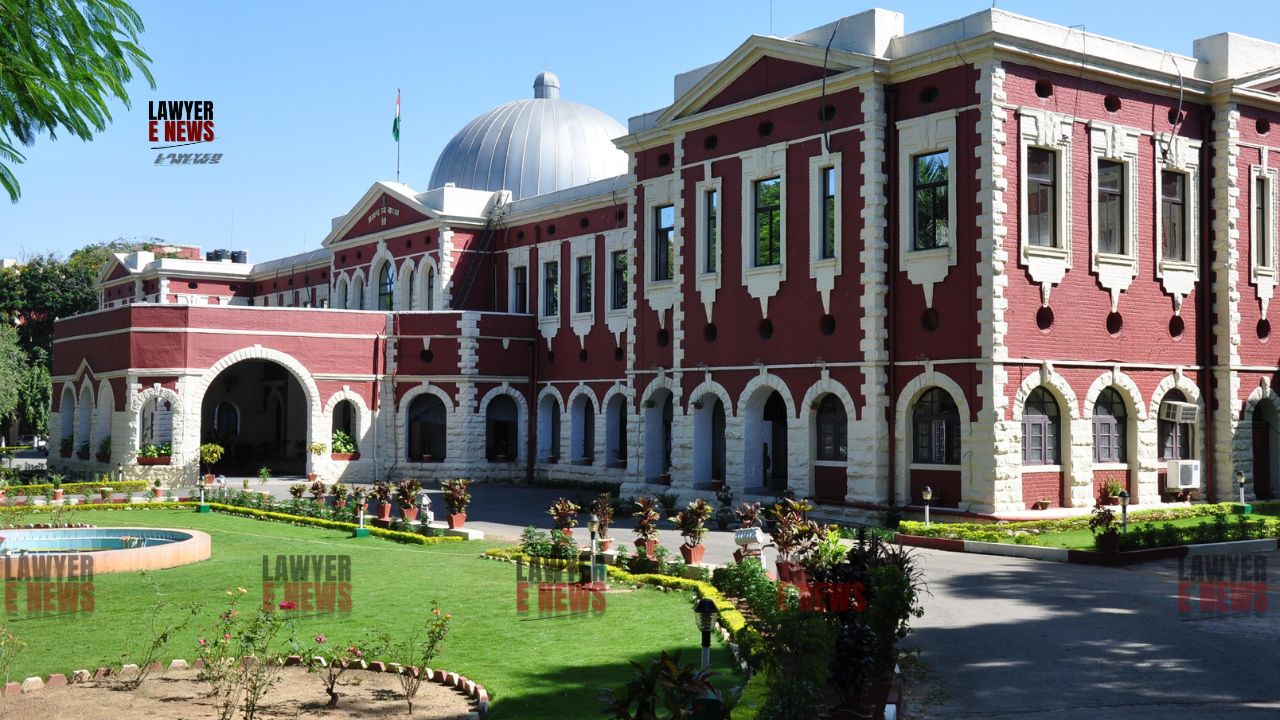
"The objective of granting interim/permanent alimony is to ensure that the dependent spouse is not reduced to destitution or vagrancy on account of the failure of the marriage, and not as a punishment to the other spouse." Jharkhand High Court, in a ruling dated 09 October 2026, held that while there is no rigid mathematical formula for determining permanent alimony under Section 25 of the Hindu Marriage Act, 1955, the court must balance the husband's financial capacity with the necessity of ensuring that the wife maintains a standard of living consistent with her matrimonial life.
A bench of Justice Sujit Narayan Prasad and Justice Sanjay Prasad observed that the maintenance amount should be neither so extravagant as to be oppressive for the husband nor so meagre that it drives the wife to penury.
The appellant-wife challenged a 2016 decree of divorce granted to the respondent-husband on the grounds of cruelty under Section 13(1)(i-a) of the Hindu Marriage Act, 1955. During the appellate proceedings, the parties acknowledged that a re-union was impossible as the husband had solemnized a second marriage. Consequently, the proceedings shifted focus exclusively toward the determination of permanent alimony, with the court directing both parties to file affidavits regarding their assets and income in accordance with the Supreme Court’s mandate in Rajnesh v. Neha.
The primary question before the court was the quantum of permanent alimony to be awarded to the appellant-wife considering the husband’s current income, his existing liabilities, and the appellant's lack of independent financial means. The court was further tasked with determining whether the previous maintenance awarded by the Family Court was legally sustainable in light of the husband's documented salary at Tata Motors.
Court Emphasizes Duty To Maintain
The bench reiterated that the obligation to maintain a spouse flows from the marital relationship itself and is a continuous obligation. The court noted that the wife’s lack of employment or the potential for her to work does not negate the husband's primary duty to provide sustenance. It emphasized that a wife should not be forced to rely on her parents for her basic needs, as the purpose of Section 25 is to grant her autonomy and dignity post-separation.
No Straitjacket Formula For Alimony
The court underscored that assessment of income is the first and most crucial step in matrimonial litigation. Relying on Vinny Parmvir Parmar v. Parmvir Parmar and Kalyan Dey Chowdhury v. Rita Dey Chowdhury, the bench noted that while 25 percent of a husband's net salary is often used as a reasonable benchmark, this is not an absolute rule. The court must look at "free income" after statutory deductions, excluding voluntary expenses like loan EMIs or insurance premiums.
Financial Reality Of The Parties
The respondent-husband disclosed a gross monthly salary of approximately ₹47,498, with a net take-home pay of ₹34,372. The court observed that the husband has a constant source of income and a moral obligation to ensure the appellant-wife does not face destitution. The bench considered the wife's age of 47 years and her life expectancy to calculate a lump sum that would provide long-term financial stability.
"Maintenance, after all, is not a matter of charity but of right – a continuing obligation flowing from the marital relationship, which the husband cannot evade merely by pointing to the wife’s limited earning capacity."
Court Awards Lump Sum Alimony
Finding the Family Court’s initial maintenance award of ₹3,000 per month to be "wholly inadequate and meagre," the High Court exercised its power under Section 25 to enhance the alimony. The bench determined that a lump sum payment of ₹20,00,000 would be just, fair, and reasonable, taking into account the husband's salary and the wife's need to survive on interest-accruing funds amidst rising inflation.
Final Directions and Payment Schedule
The court directed the respondent-husband to pay the total sum of ₹20,00,000 in four equal installments over a period of 12 months. The first installment is to be paid within two months of the judgment. The bench clarified that should the respondent fail to comply, the appellant is at liberty to approach the court for enforcement, though it expressed a "hope and trust" that the husband would abide by the directive without further litigation.
The High Court affirmed the decree of divorce while modifying the financial component to ensure the appellant-wife's future sustenance. By grounding the award in the husband's actual earning capacity and the standard of living expected of the parties, the court reaffirmed the protective nature of Section 25 of the Hindu Marriage Act, 1955.
Date of Decision: 09 October 2026