-
by kapil
16 October 2026 4:47 PM







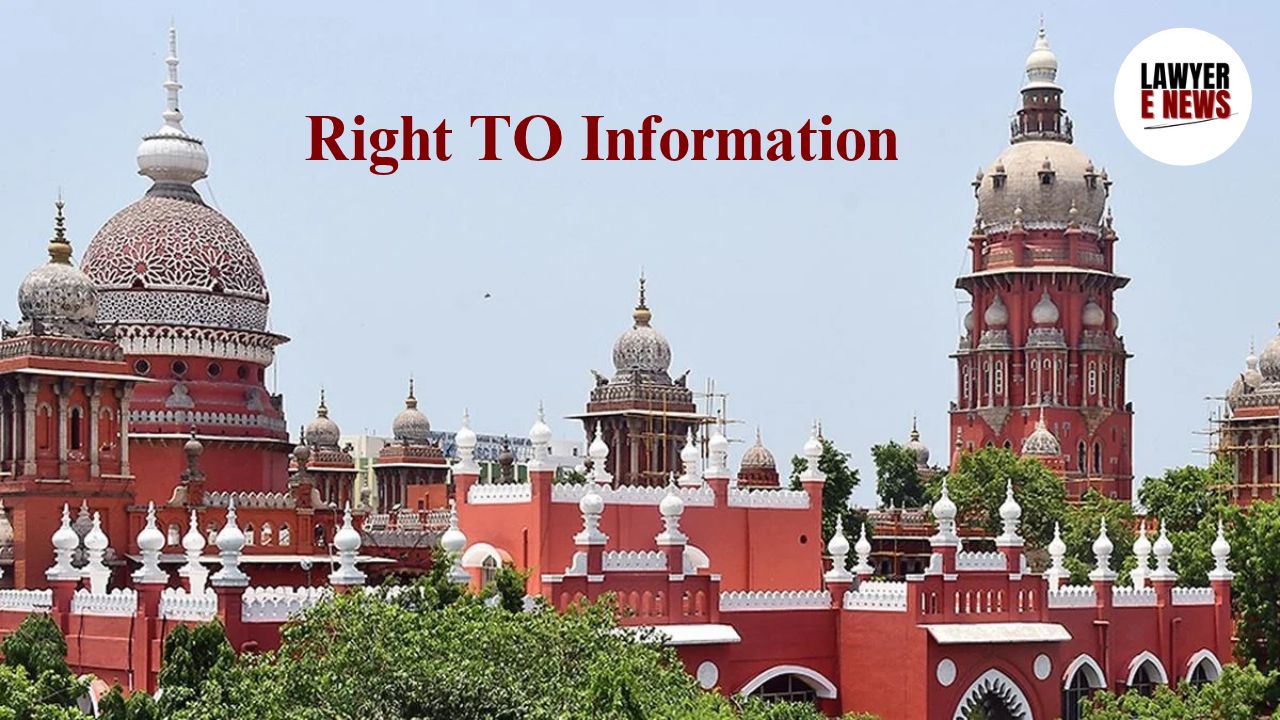
"The effort involved in applying the statutory requirement of severability cannot convert otherwise disclosable information into exempt information." Madras High Court has ruled that the Directorate of Vigilance and Anti-Corruption (DVAC) cannot claim a blanket exemption under Section 24(4) of the Right to Information Act, 2005 (RTI Act) when requested information pertains to allegations of corruption, and an officer who was the subject of an enquiry is entitled to access the records once the proceedings are closed in his favour.
Justice Hemant Chandangoudar upheld an order of the Tamil Nadu State Information Commission directing the disclosure of Detailed Enquiry records to retired Director General of Police (DGP) S.R. Jangid after masking the personal particulars of other officers, observing that "a general assertion that disclosure may affect the safety of witnesses or third parties is not sufficient to attract Section 8(1)(g)."
The second respondent, retired DGP S.R. Jangid, filed an application under Section 6(1) of the RTI Act seeking enquiry reports, witness statements, and collected materials relating to a Detailed Enquiry conducted against him by the DVAC that had culminated in closure in his favour. The Public Information Officer and the first appellate authority rejected the request by invoking Section 8(1)(g) of the RTI Act, prompting the retired officer to approach the State Information Commission under Section 19(3). The Commission allowed the second appeal and directed the DVAC to furnish the records within 45 days after masking third-party names, which the State of Tamil Nadu challenged under Article 226 of the Constitution.
The primary question before the court was whether the DVAC is barred from claiming immunity under Section 24(4) of the RTI Act when an enquiry relates to corruption allegations. The court was also called upon to determine whether the requested records were exempt under Section 8(1)(g) or Section 8(1)(j), and whether administrative inconvenience or internal manual provisions could override statutory disclosure obligations.
Section 24(4) Proviso Strips Exemption For Corruption Inquiries
The court commenced its analysis by addressing the State's reliance on G.O.Ms.No.158, dated August 26, 2008, which exempted the DVAC from the operation of the RTI Act under Section 24(4). The bench noted that the statutory proviso to Section 24(4) categorically carves out an exception for information relating to allegations of corruption and human rights violations.
Holding that the statutory carve-out squarely applied to the present proceedings, the bench clarified that the agency could not hide behind a blanket jurisdictional immunity. The court recorded:
"In the present case, the Detailed Enquiry relates to allegations of corruption investigated by the DVAC. Therefore, Section 24(4) cannot be relied upon as a complete bar to the information sought by the second respondent. The request has to be considered with reference to the exemptions specifically provided under Section 8 of the RTI Act."
Vague Safety Apprehensions Cannot Sustain Section 8(1)(g) Exemption
Turning to the exemption claimed under Section 8(1)(g) of the RTI Act regarding the endangerment of life or physical safety, the High Court observed that the State had failed to present any concrete material demonstrating an actual or imminent threat to witnesses or sources. The court observed that general apprehensions expressed by the department cannot meet the high threshold required by the statute to withhold public records.
Addressing the second limb of Section 8(1)(g), which shields information supplied in confidence for law-enforcement purposes, the bench ruled that the mere appearance of a name in an official file does not automatically cloth an individual with the status of a protected informant. The bench observed:
"The mere presence of a person’s name in an enquiry file does not, by itself, establish that the person was a confidential source. The exemption must be based on the nature of the information and the circumstances in which it was supplied."
Delinquent Officer Entitled To Closed Proceedings Under Section 8(1)(j)
The State relied heavily on Supreme Court rulings in Girish Ramchandra Deshpande v. Central Information Commissioner (2013) and Canara Bank v. C.S. Shyam (2018) to argue that disciplinary and service records are exempt as personal information under Section 8(1)(j). The High Court distinguished these precedents, highlighting that the applicant was not an inquisitive stranger seeking the private disciplinary profile of an unrelated employee.
Because the retired DGP was the central subject of the scrutiny and the enquiry had terminated in his exoneration, the court held that the ratio governing third-party privacy could not be stretched to withhold the entirety of the file from him. The bench emphasized:
"The second respondent is not seeking the service records of an unrelated third party. He himself was the subject of the Detailed Enquiry and the enquiry was ultimately closed in his favour. The information sought substantially concerns the proceedings conducted against him. Therefore, the above decisions do not justify withholding the entire enquiry record from him."
"An internal administrative instruction requiring information collected during an enquiry to be treated as confidential cannot create an exemption which is not contained in the RTI Act."
Statutory Severability Under Section 10 Overrides Administrative Inconvenience
The High Court dismissed the State's submission that redaction was impossible due to the voluminous nature of the files, pointing out that Section 10 of the RTI Act explicitly mandates the severability of non-exempt material from exempt portions. The bench laid down that bureaucratic burden or logistical hardship cannot transform disclosable public documents into immune state secrets.
The court reiterated that genuine personal data of third parties contained within the file could easily be protected through redaction, holding:
"The effort involved in applying the statutory requirement of severability cannot convert otherwise disclosable information into exempt information."
Internal DVAC Manual And Civil Court Privilege Cannot Defeat RTI Mandate
Evaluating the State's reliance on Rule 29 of the DVAC Manual and claims of privilege under Section 124 of the Indian Evidence Act in a pending civil suit (O.S.No.13833 of 2010), the bench firmly ruled that executive manuals cannot override parliamentary legislation. The court held that the question whether a document is privileged from production in judicial proceedings is entirely distinct from statutory disclosure under the RTI regime.
Clarifying the operational scope of third-party notice procedures, the bench emphasized that Section 11 of the RTI Act is merely a procedural safeguard rather than a substantive ground of exemption:
"The provision does not create an independent exemption from disclosure. Where the information proposed to be disclosed is otherwise not exempt under Section 8, the procedure under Section 11 has to be followed wherever the statutory conditions are satisfied."
Final Directions And Procedural Safeguards
Affirming the order of the Tamil Nadu State Information Commission, the court directed the Public Information Officer to release the requested enquiry files to the retired DGP within the stipulated timeline. The bench added a rider that if any specific document falls within the procedural ambit of Section 11, the officer must follow that protocol without using it as a pretext to hold back the remainder of the records.
Dismissing the writ petition, the High Court held that an officer exonerated in a vigilance probe has a legitimate legal right under the RTI Act to inspect the records of the proceedings instituted against him. The ruling firmly establishes that state vigilance agencies cannot cite administrative difficulty, internal manuals, or vague safety claims to override the statutory presumption in favour of transparency in corruption-related inquiries.
Date of Decision: 09 October 2026