-
by kapil
15 October 2026 3:54 PM







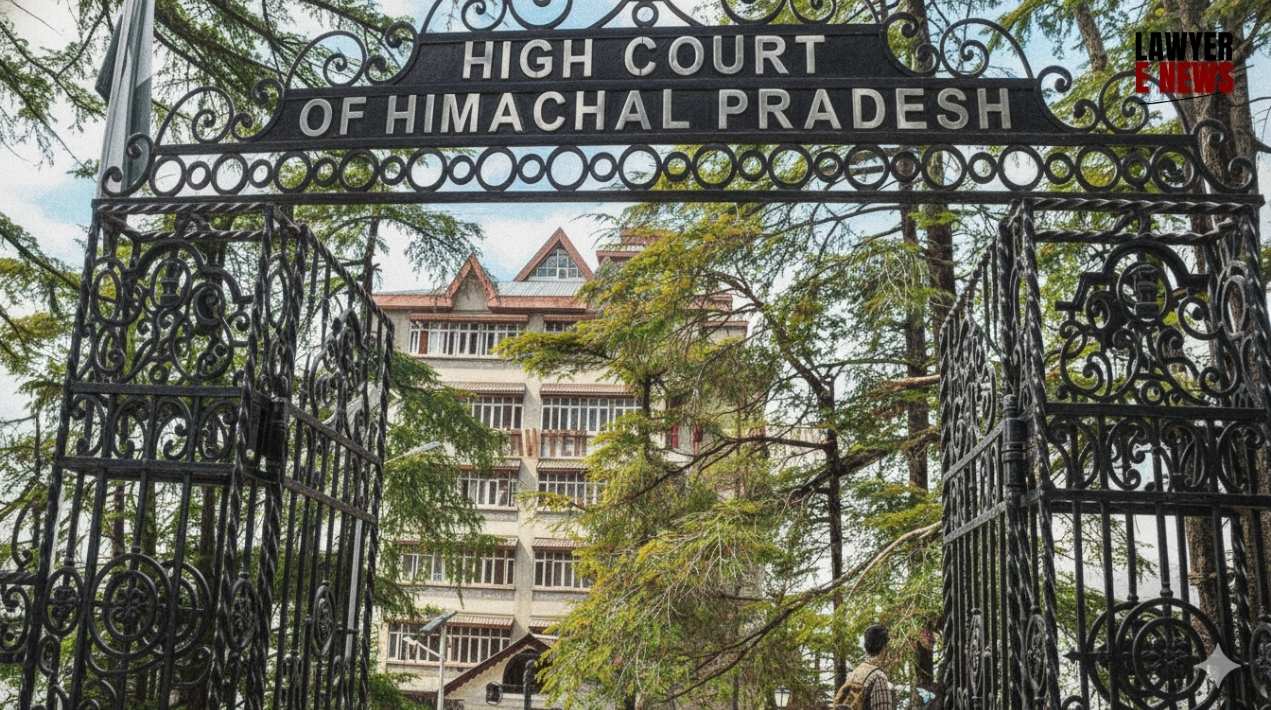
"Therefore, in view of the binding precedents of the Hon'ble Supreme Court, the prosecution of the company was essential before prosecuting its Managing Director/official. The learned appellate Court had rightly held that the complaint was not maintainable in the absence of the company." High Court of Himachal Pradesh, in a notable ruling delivered on October 6, 2026, held that a complaint for cheque dishonour under Section 138 of the Negotiable Instruments Act, 1881 is not maintainable against an authorized signatory or Managing Director without arraigning the company as an accused.
A single bench of Justice Rakesh Kainthla reaffirmed that the commission of the offence by the company is an express condition precedent to fasten vicarious liability under Section 141 of the NI Act, observing that "for maintaining the prosecution under Section 141 of the Act, arraigning of a company as an accused is imperative."
The complainant filed a criminal complaint under Section 138 of the NI Act against the respondent, claiming she had deposited money with his office and was subsequently issued a cheque of ₹2,22,270/- towards part repayment, which was returned dishonoured due to "funds insufficient". While the Judicial Magistrate First Class, Kangra convicted the respondent and sentenced him to two months' simple imprisonment with ₹1,25,000/- compensation, the Sessions Judge, Kangra at Dharamshala overturned the conviction on appeal on the ground that the drawer of the cheque was a corporate entity, B.M. Nidhi Ltd., which had not been impleaded as an accused. Aggrieved by the acquittal, the complainant approached the High Court in appeal.
The primary question before the court was whether a complaint under Section 138 read with Section 141 of the NI Act is maintainable against a Managing Director or signatory in the absence of the company being impleaded as a principal accused. The court was also called upon to determine whether the appellate court's acquittal warranted interference.
Company As Drawer Triggers Section 141 NI Act
Justice Kainthla examined the record and noted that the complainant herself admitted to depositing money in the company and that the cheque in question explicitly identified "B.M. Nidhi Ltd." as the drawer. The court observed that the use of the word "Limited" unequivocally established that the drawer was an incorporated company, and the respondent was only arrayed in his capacity as its Managing Director-cum-Proprietor.
The bench stressed that statutory demand notices and subsequent complaints must be addressed in conformity with company law and statutory requirements under the NI Act. In the present case, the statutory notice of demand had been issued solely to the individual respondent rather than the company on whose account the cheque had been drawn.
Arraigning Company As Principal Accused Is An Inflexible Condition Precedent
Addressing the statutory scheme of vicarious liability, the High Court relied extensively on the locus classicus three-judge bench ruling of the Supreme Court in Aneeta Hada v. Godfather Travels & Tours (P) Ltd. (2012), emphasizing that individuals cannot be prosecuted vicariously without indicting the juristic entity itself.
The court reiterated that applying the doctrine of strict construction, the commission of the offence by the corporate entity constitutes an indispensable foundation. Quoting Aneeta Hada, the bench noted that "the words 'as well as the company' appearing in the section make it unmistakably clear that when the company can be prosecuted, then only the persons mentioned in the other categories could be vicariously liable for the offence."
Reiterated Precedents On Vicarious Liability Under Section 141
The High Court referenced subsequent apex court authorities to underline that the legal position remains strictly settled. Citing Charanjit Pal Jindal v. L.N. Metalics (2015), the court recalled that proceedings under Section 138 read with Section 141 of the NI Act cannot survive against an individual director where the complainant omits the corporate entity.
The bench also drew support from the Supreme Court's decisions in Himanshu v. B. Shivamurthy (2019) and Pawan Kumar Goel v. State of U.P. (2022), which held that Section 141 imposes vicarious liability by a legal fiction presupposing the commission of the offence by the company as a principal accused. Without specific averments and prosecution directed against the company, directors cannot be convicted by relying on general principles of criminal jurisprudence.
Scope Of Appellate Interference In Acquittals
The High Court affirmed that the first appellate court took a legally unassailable and reasonable view in acquitting the respondent, precluding any justification for interference in an appeal against acquittal. The court rejected the appellant's plea that interim part-payments made during trial could cure the fatal defect of failing to arraign the corporate drawer.
Consequently, the High Court dismissed the appeal and affirmed the judgment of acquittal passed by the Sessions Judge. In compliance with Section 437-A CrPC (corresponding to Section 481 of the Bharatiya Nagarik Suraksha Sanhita, 2023), the respondent was directed to furnish personal bail bonds with one surety of ₹25,000/- to the satisfaction of the trial court to ensure appearance before the Supreme Court in the event of further proceedings.
The High Court affirmed that vicarious liability under Section 141 of the NI Act cannot be invoked against an authorized signatory or corporate official unless the company itself is arraigned as an accused. The ruling reinforces that strict procedural compliance and statutory impleadment are mandatory prerequisites for maintaining criminal complaints for corporate cheque dishonour.
Date of Decision: 06 October 2026