-
by sayum
24 August 2026 6:22 AM







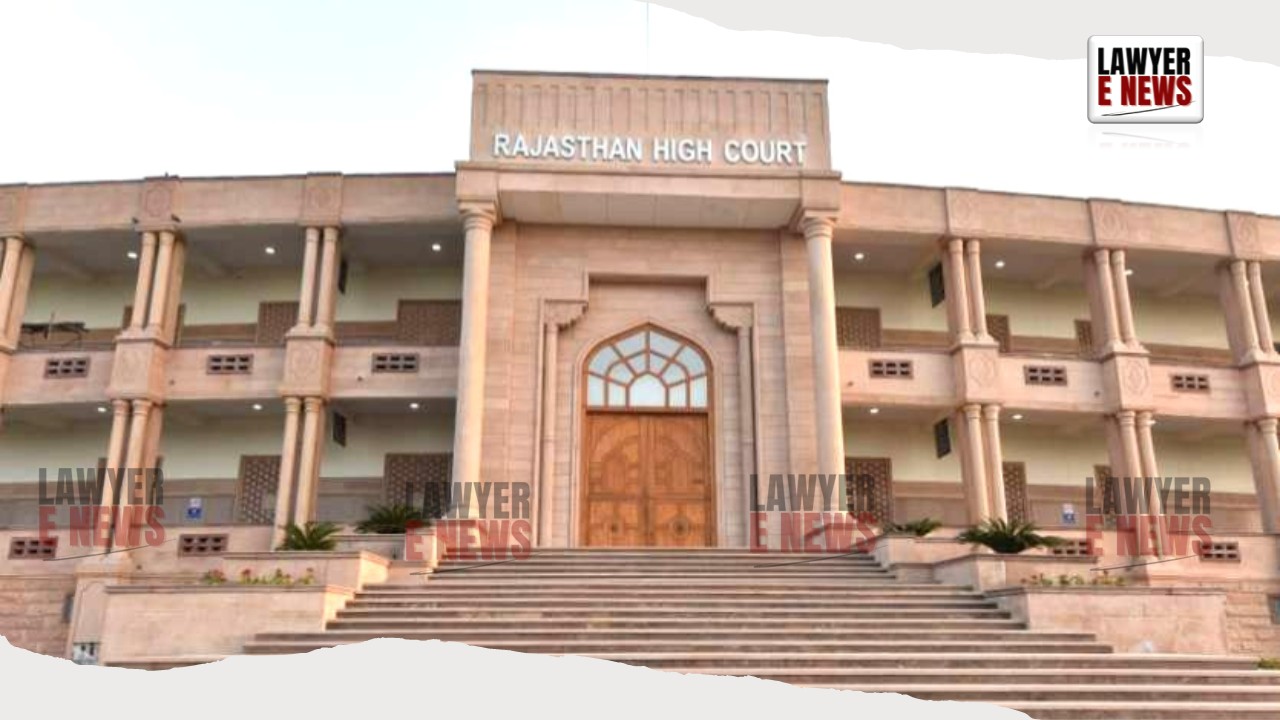
“Municipalisation Does Not Denotify a Scheduled Area — Urban Governance Must Co-Exist with Tribal Constitutional Protections”, In a landmark constitutional ruling with wide-ranging implications for tribal governance and urban expansion, the Rajasthan High Court at Jodhpur on January 5, 2026, upheld the State Government’s decision to include several Scheduled Areas within municipal limits under the Rajasthan Municipalities Act, 2009. The Division Bench comprising Justice Dr. Pushpendra Singh Bhati and Justice Sanjeet Purohit, while deciding a batch of 14 writ petitions led by Ankit Kumar Meena & Ors. v. State of Rajasthan & Ors., delivered a detailed and nuanced interpretation of the Fifth Schedule, Article 244(1), and Article 243-ZC of the Constitution.
The petitioners had challenged multiple government notifications issued between 2018 and 2025 that sought to municipalise various Scheduled Area villages across districts like Udaipur, Dungarpur, and Pratapgarh. It was argued that such inclusion was unconstitutional as it violated the protective framework for tribal areas under Article 244(1) and the Fifth Schedule, particularly in the absence of any Parliamentary law under Article 243-ZC(3).
However, the Court ruled that “Scheduled Areas are not immune to all State legislation—unless the Governor expressly excludes or modifies the application of law under Paragraph 5(1) of the Fifth Schedule, State laws continue to operate.”
“The Constitution Guards Scheduled Areas, But It Does Not Fossilise Them”
At the heart of the petitioners’ arguments was the claim that once an area is declared a Scheduled Area, it is automatically shielded from municipal governance under Article 243-ZC, which bars the application of Part IX-A (Municipalities) of the Constitution to Scheduled Areas. The petitioners contended that without a law enacted by Parliament under Article 243-ZC(3) — such as the long-pending Municipalities (Extension to Scheduled Areas) Bill (MESA) — or a Governor's notification under Paragraph 5(1) excluding application of the Rajasthan Municipalities Act, 2009, the inclusion of such areas within municipal limits was ultra vires the Constitution.
Rejecting this interpretation, the Court made a significant constitutional clarification: “Paragraph 5(1) of the Fifth Schedule is not a condition precedent to the operation of a statute. It is an exclusionary and modificatory power. In the absence of any such exclusion, the State law continues to apply by default.”
Citing the binding ratio of South Eastern Coalfields Ltd. v. State of M.P. and Adivasis for Social & Human Rights Action v. Union of India, the Court emphasized that the burden is on the State — or more specifically, the Governor — to act and restrict the application of laws when necessary, and not for the courts to presume exclusion where none exists.
“Municipal Inclusion Does Not Extinguish Scheduled Area Status — Constitutional Protections Flow With the Land, Not Its Classification”
The Court categorically ruled that inclusion within a municipality does not ‘denotify’ or erode a region’s status as a Scheduled Area, which continues to enjoy the full force of constitutional protections under Article 244(1), the Fifth Schedule, and Articles 46 and 275(1). The Bench observed:
“All safeguards under the Fifth Schedule, the role of the Tribes Advisory Council, and the protective mandates continue to operate unabated. Territorial reclassification cannot extinguish constitutional safeguards.”
Further, the Court addressed the interplay between PESA (Panchayats Extension to Scheduled Areas Act, 1996) and municipal inclusion. Once an area becomes part of a municipality, it ceases to be a “village” or “Panchayat area”, and thus PESA’s full framework cannot operate. However, the Court mandated that tribal consultative institutions continue in advisory capacity, especially in matters concerning land, cultural integrity, and community resources — until Parliament enacts MESA under Article 243-ZC(3).
“In the Absence of MESA, Municipalised Scheduled Areas Must Be Governed Through a Hybrid Framework”
Noting with concern the two-decade delay in enacting MESA, the Court referred to a 2025 official communication from the Ministry of Tribal Affairs acknowledging the legislative vacuum. The Bench observed:
“This prolonged legislative inaction has resulted in a constitutional vacuum, wherein Scheduled Areas are being subjected to municipal structures without statutory safeguards. This places the burden of protecting tribal rights on ad hoc executive action rather than coherent legislation.”
In this context, the Court devised a constitutionally harmonised hybrid framework for governance in municipalised Scheduled Areas:
– Municipal functions such as infrastructure, taxation, sanitation, land use, public health, and construction shall be governed by the Rajasthan Municipalities Act, 2009.
– Tribal welfare, land security, forest and resource protection, and social safeguards under the Fifth Schedule shall remain paramount and inform all governance decisions.
– Tribal institutions from the PESA regime shall continue in an advisory capacity to ensure continued cultural and economic protections.
This framework, the Court clarified, seeks to balance effective urban governance with tribal autonomy, affirming that “integration must not mean assimilation, and development must not mean dispossession.”
“Absence of a Governor’s Notification Does Not Create a Constitutional Bar — It Is the Default Applicability of Law That Must Be Rebutted”
Addressing a critical constitutional question, the Court held that Article 243-ZC merely excludes the automatic application of Part IX-A to Scheduled Areas. It does not create a blanket prohibition against the application of municipal laws enacted by the State legislature. The Bench explained:
“The true effect of Article 243-ZC is not prohibition but protection — protection from unmediated constitutional municipalisation, not from legitimate legislative governance.”
Thus, so long as the Governor has not excluded or modified the municipal law, the State remains competent to include Scheduled Areas within municipal limits under its existing statute, in this case, the Rajasthan Municipalities Act, 2009.
“Constitutional Adjudication in Scheduled Areas Must Ensure Development Without Dispossession”
The Court concluded by reaffirming that urbanisation and tribal protection are not mutually exclusive, and that judicial review must be sensitive to the dual constitutional mandates of inclusive development and affirmative protection. In this regard, the Court emphasized the importance of continued constitutional supervision and directed the State to place the judgment before the Union Government for appropriate legislative action.
In closing, the Court issued the following key declarations: The impugned notifications including Scheduled Areas within municipal limits are valid and do not violate the Constitution.
Scheduled Areas retain their constitutional character despite urban inclusion.
A hybrid governance model must operate until Parliament enacts a statutory framework like MESA under Article 243-ZC(3).
Tribal advisory institutions must remain functional for consultative purposes, particularly on land, resources, and culture.
The State and Governor are duty-bound to ensure that all developmental and governance actions in these areas strictly conform to Fifth Schedule protections.
“The Constitution Protects, But Does Not Prohibit Governance in Scheduled Areas — It Requires Sensitivity, Not Stagnation”
This decision affirms that Scheduled Areas are not islands of exclusion but territories of special care, and that the constitutional framework is capable of evolving solutions where governance meets tradition, and development meets dignity.
Date of Decision: January 5, 2026