-
by sayum
28 August 2026 2:11 PM







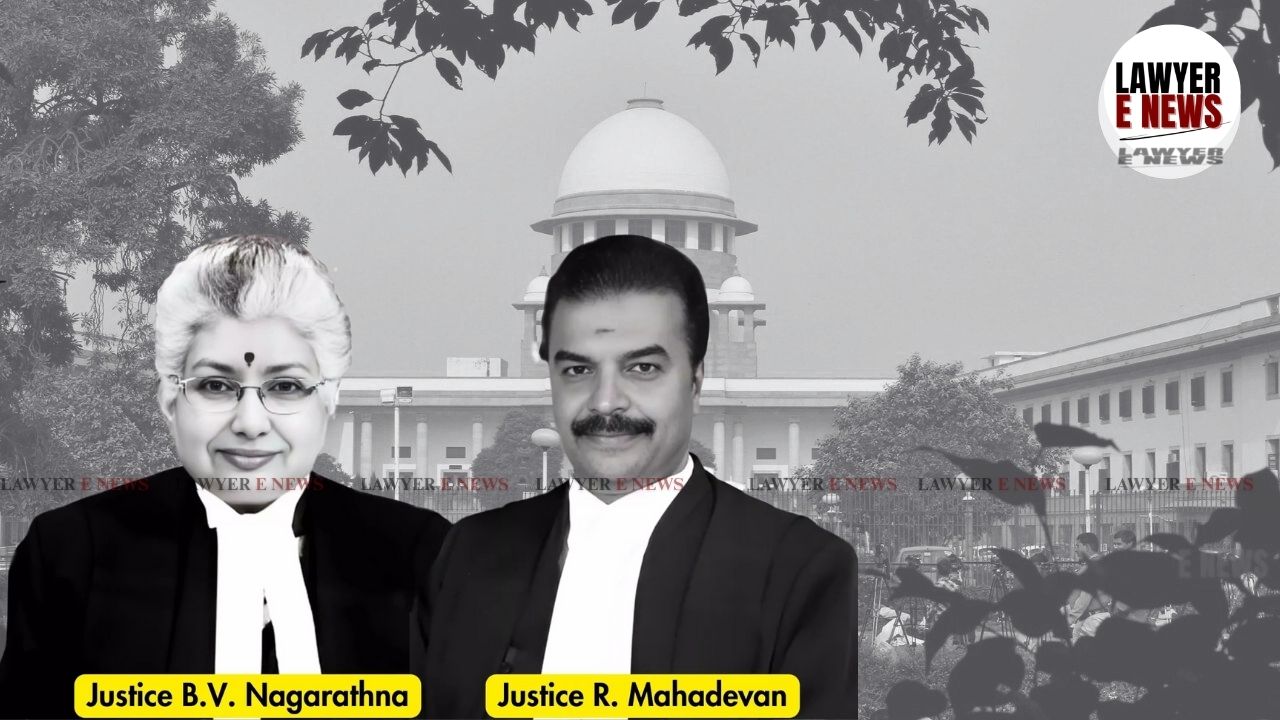
“To Brand A Failed Relationship As Rape Is A Distortion Of Criminal Law”, In a vital reaffirmation of the principles governing sexual consent and criminal culpability, the Supreme Court of India held that “every sour relationship cannot be coloured with the brush of rape”, especially when there is “no material to show that the consent was obtained by deception or force.”
The bench comprising Justice B.V. Nagarathna and Justice R. Mahadevan, while quashing FIR No. 294 of 2024 and Chargesheet No. 143 of 2024, held that the complaint filed by a woman against her former intimate partner, an advocate, alleging repeated rape under the false promise of marriage, was an abuse of the legal process. The Court ruled:
“The relationship continued for a period of three long years… physical intimacy that occurred during the course of a functioning relationship cannot be retrospectively branded as instances of rape merely because the relationship failed to culminate in marriage.”
“False Promise Of Marriage Must Exist From The Outset To Vitiate Consent”: Supreme Court Applies Mahesh Damu and Deepak Gulati Principles
The case arose from a romantic relationship between the appellant, a practising advocate, and the complainant, a married woman pursuing alimony proceedings. The two became close after meeting in 2022 and shared a physical relationship that lasted for over two years. The complainant alleged that the physical intimacy occurred on a false promise of marriage and filed an FIR only in August 2024, after the appellant refused to pay her ₹1.5 lakhs.
The Court, while examining the ingredients of Sections 376 and 376(2)(n) IPC, held that “there is no pattern of sexual assault or coercion as contemplated under Section 376(2)(n)”. Instead, the relationship was one of mutual affection, regular contact, and voluntary meetings.
Justice Nagarathna, writing for the Bench, relied heavily on Mahesh Damu Khare vs. State of Maharashtra (2024) 11 SCC 398, observing:
“Physical relationship must be traceable directly to the false promise made and not qualified by other circumstances or considerations. A woman may have reasons to have physical relationship other than the promise of marriage.”
The Court emphasised that there must be a clear proximate link between the alleged promise and the act of consent. Without that, Section 90 IPC on “misconception of fact” cannot be invoked.
“A Belated FIR After Monetary Dispute Weakens The Entire Prosecution Case”: Supreme Court Applies Bhajan Lal Guidelines
The complaint was lodged three months after the last alleged act of intimacy and only after the appellant refused to fulfil a financial demand. The Court found this delay significant, stating:
“The FIR is conspicuously silent as to any specific allegation that the appellant had either forcibly taken or compelled the complainant to accompany him to the hotel… respondent No.2, of her own volition, visited and met the appellant on each occasion.”
The Court applied the classic test from State of Haryana vs. Bhajan Lal, 1992 Supp (1) SCC 335, holding that even if the allegations in the FIR were taken at face value, they “do not prima facie constitute any offence”. Therefore, continuing the prosecution would be “an abuse of court machinery.”
The Court warned that misuse of rape laws to settle personal vendettas or disappointments in intimate relationships undermines genuine victims and overloads the criminal justice system. As observed in Prashant v. State of NCT of Delhi (2025) 5 SCC 764:
“What was a consensual relationship between the parties at the initial stages cannot be given a colour of criminality when the said relationship does not fructify into a marital relationship.”
“Consent Must Be Understood In Its Legal And Factual Context, Not Moral Expectations”: Supreme Court Reiterates That Law Cannot Become A Tool For Emotional Retribution
The Court acknowledged the social realities where promises of marriage may influence consent but clarified that each case must be assessed based on credible facts and not presumptive victimhood. Citing Rajnish Singh vs. State of U.P. (2025) 4 SCC 197, the Bench reiterated:
“The man cannot be held guilty of rape if the woman has wilfully engaged in a long-term sexual relationship, fully aware of its nature, without any cogent evidence to show that it was induced by misconception of fact.”
In this case, not only did the complainant not allege coercion during the relationship, but her own statements in the FIR revealed emotional involvement and mutual engagement without pressure. The High Court’s refusal to quash the case was found to be misplaced, as it failed to assess the factual context revealed by the FIR and accompanying material.
FIR and Chargesheet Quashed, Criminal Proceedings Stopped
The Supreme Court allowed the appeal and quashed:
Concluding with a note of caution, the Court underscored:
“The acts complained of in the present case occurred within the contours of a relationship that was, at the time, voluntary and willing. The continuation of the prosecution in such facts would be nothing short of an abuse of the court machinery.”
The Court also recorded its appreciation for Ms. Radhika Gowtam, the learned Amicus Curiae, and directed that an honorarium of ₹15,000 be paid to her.
Date of Decision: 24 November 2025