-
by sayum
16 August 2026 12:05 PM







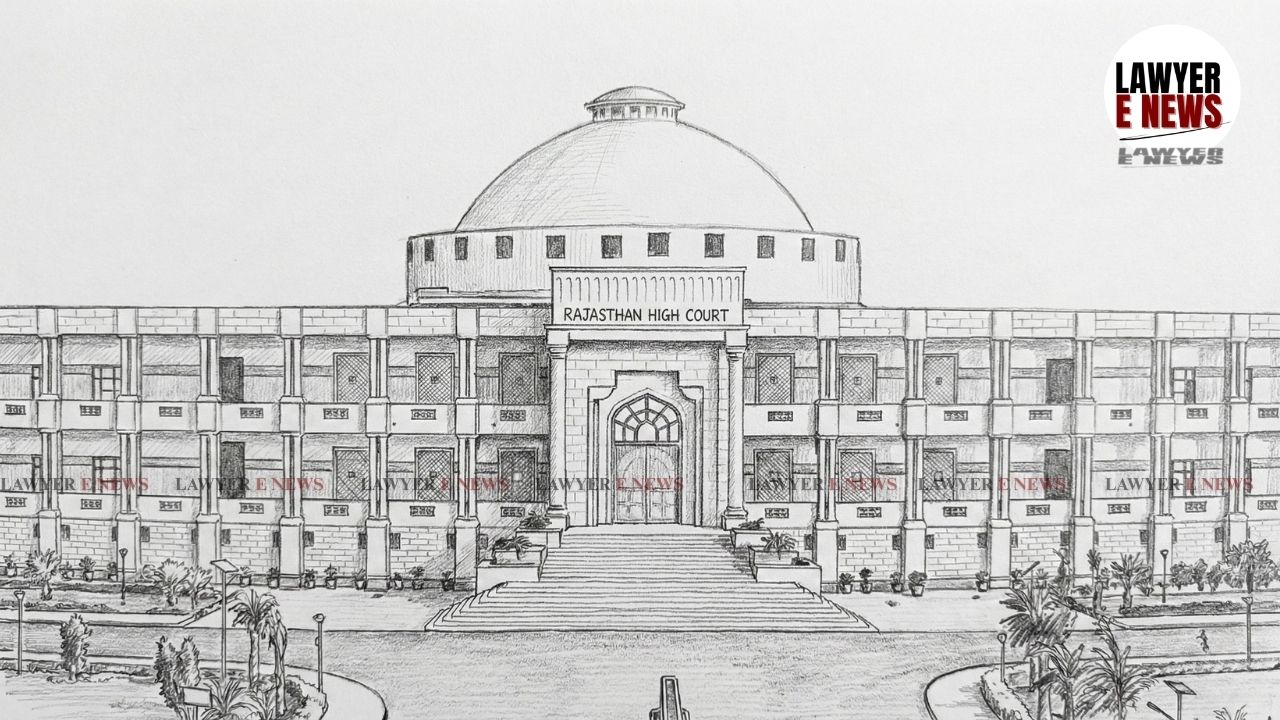
"An officer who is capable of such brazen defiance of his superiors' orders is an officer who... is a threat to civil society. He is a threat to the constitutional order. He is a threat to the very idea that government is accountable to the governed," Rajasthan High Court at Jodhpur, in a stinging rebuke of executive high-handedness, has held that the continued detention of a person despite a judicial order suspending their sentence is a "diabolical" violation of fundamental rights.
A vacation bench comprising Justice Farjand Ali and Justice Sunil Beniwal, in its judgment dated June 12, 2026, observed that personal liberty is not a luxury for the powerful but a guarantee for every citizen regardless of their social or economic status. The court emphasized that the rule of law collapses when State functionaries become law-breakers.
The matter originated from proceedings under Section 91 of the Rajasthan Land Revenue Act, 1956, where the petitioner’s husband, Shri Ghamandnath, was sentenced to three months' civil imprisonment for alleged encroachment. On April 15, 2026, the Additional Divisional Commissioner, Ajmer, acting as the Appellate Authority, passed an order suspending the sentence of imprisonment. Despite this, the respondent Tehsildar failed to release the detenue for 53 days, prompting the petitioner—a cancer patient—to file a Habeas Corpus petition for her husband, who is HIV positive.
The primary question before the court was whether the continued confinement of the detenue after the suspension of his sentence by a competent authority constituted illegal detention. The court also examined the accountability of a public servant who willfully defies a superior's judicial order and the appropriate measure of compensation for the violation of Article 21.
The Inviolability Of Personal Liberty Under Article 21
The Court began by tracing the lineage of the writ of habeas corpus from the Magna Carta to the Constitution of India, noting that it is the most celebrated safeguard of human freedom. The bench observed that the deprivation of personal liberty without lawful authority or in violation of established procedure constitutes a wrong of the gravest order.
Invoking the "immortal dissent" of Justice H.R. Khanna in ADM Jabalpur v. Shivakant Shukla, the Court stated that no arm of the State, however powerful or entrenched in bureaucratic inertia, can deprive a person of liberty save in strict accordance with the law. The bench noted that while the initial detention was lawful, it assumed the character of illegal detention the moment the suspension order was passed and ignored.
"The rule of law meets with its Waterloo when the State's minions become law-breakers and so the court, as the sentinel of the nation, runs down the violators with its writ."
Rejection Of The Tehsildar’s Plea Of Ignorance
The respondent Tehsildar (Respondent No. 4) argued that he was unaware of the suspension order passed on April 15. However, the Court found this plea "difficult to accept," citing the legal maxim omnia praesumuntur rite esse acta—that all official acts are presumed to have been done regularly. The bench noted that in the ordinary course of revenue practice, appellate orders are communicated to subordinate authorities through official channels.
Furthermore, the Court pointed out that the Tehsildar admitted to having actual knowledge of the order by June 1, 2026, yet he continued to keep the detenue in custody until the High Court’s specific intervention on June 8. This seven-day period of admitted illegal confinement was described by the bench as a "conscious, deliberate, and wilful deprivation of personal liberty."
The Principle Of 'Obey First, Appeal Later'
The bench emphasized the foundational pillar of the rule of law: that a judicial or quasi-judicial order must be obeyed and complied with unless it is stayed or set aside by a competent authority. Citing Atma Ram Properties (P) Ltd. v. Federal Motors (P) Ltd. and Daudayal v. State of Rajasthan, the Court held that the mere filing of an appeal does not operate as a stay.
The Court observed that Respondent No. 4, as a subordinate authority, was bound to give effect to the order of his hierarchical superior the moment it was brought to his notice. The failure to do so was categorized as a "dereliction of duty of the gravest kind," especially since no higher court had stayed the release order.
"Once the detenue has been ordered to be released, the same has to be followed no matter what."
Aggravating Circumstances: Medical Vulnerability Of The Family
The Court expressed shock at the "callous indifference" shown to the detenue and his wife. Shri Ghamandnath is a person living with HIV who required continuous medical treatment, which he was deprived of during the 53 days of illegal confinement. His wife, the petitioner, was simultaneously battling cancer while desperately approaching authorities for her husband’s release.
The bench remarked that the prolonged continuation of custody in the face of a subsisting order, despite its impact on two medically fragile individuals, assumed a character that was "nothing short of diabolical." The injury to the family, the Court noted, was immeasurable and extended into the realm of human suffering and familial distress.
Award Of Compensation And Personal Liability
Turning to the jurisprudence of compensatory public law remedies, the Court cited Rudul Shah v. State of Bihar and Nilabati Behera v. State of Orissa. It held that a bare declaration of illegality would be a "hollow formality" that does little to alleviate the actual injury. Compensation serves as a tangible acknowledgment of the grave wrong committed by the State.
Significantly, the High Court directed that the compensation of ₹2,00,000 (Rupees Two Lakhs) must be borne and paid personally by the Tehsildar from his own income or property. The bench held that the purpose of public law compensation would be subverted if the taxpayer always absorbed the financial burden while the officer responsible for willful misconduct walked away without personal consequence.
"The liability arising from his unlawful actions is strictly and exclusively personal in nature."
Final Directions and Institutional Accountability
The Court issued a series of stringent directions to ensure accountability. It declared the detention after the suspension order as illegal and unconstitutional. Beyond the monetary compensation, the bench directed the Additional Chief Secretary (Revenue) to initiate a detailed, time-bound departmental inquiry against the Tehsildar to determine the exact extent of his defiance.
As an interim measure, the Court ordered that the Tehsildar be immediately relieved of his field posting and attached to the Revenue Headquarters. He has been strictly prohibited from entering the premises of the Tehsil office or accessing any revenue records pending the inquiry. This was deemed necessary to prevent any influence over subordinate staff or interference with the evidence during the disciplinary proceedings.
The High Court concluded that the matter necessitated intervention not merely to redress an individual wrong but to preserve public confidence in the rule of law. By imposing personal liability on the erring official, the bench sent a clear message that executive impunity will not be tolerated. The petition was disposed of with a direction to complete the inquiry within ninety days and submit a compliance report to the Court.
Date of Decision: 12 June 2026