-
by sayum
27 August 2026 7:40 AM







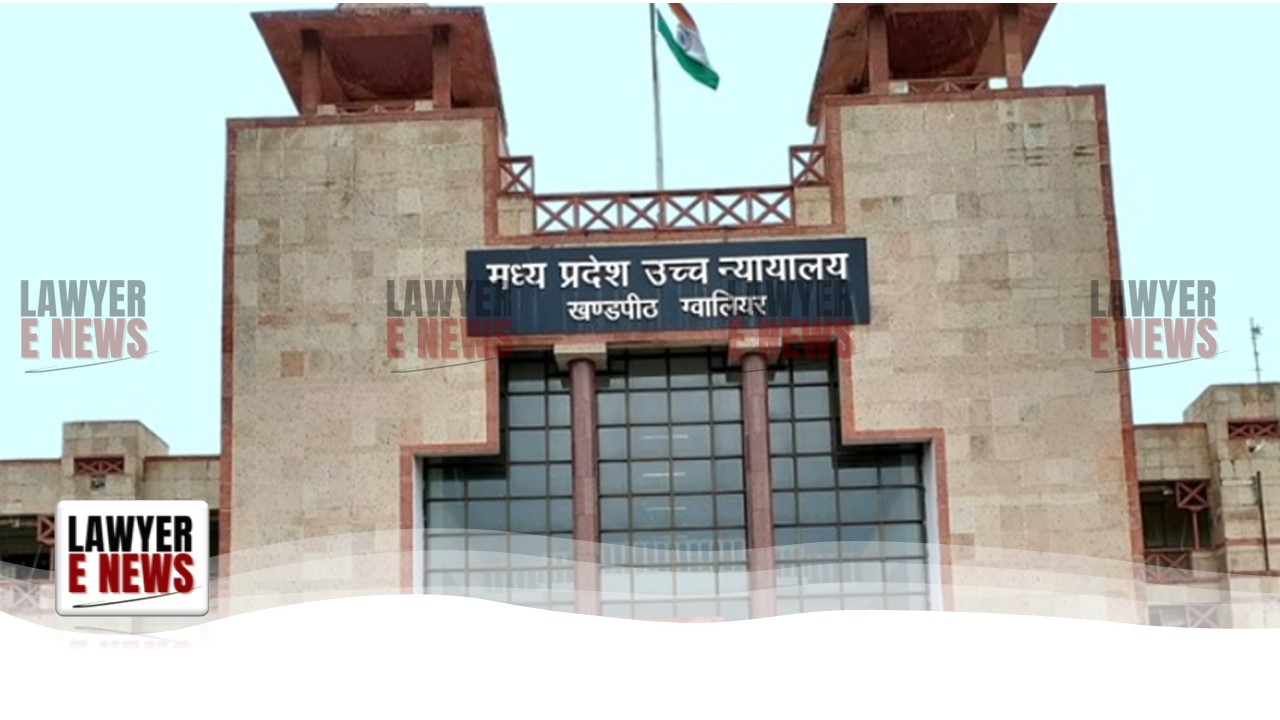
"Commission Becomes Functus Officio After Cut-off Date – No Equity Can Override Clear Recruitment Conditions", On January 21, 2026, the Madhya Pradesh High Court delivered a strong reaffirmation of procedural discipline in public employment recruitment, dismissing the writ petition of Smt. Aaradhna Buj, who sought relaxation in the document submission timeline for the post of Assistant Professor (Botany) under Advertisement No. 17/2022 issued by the Madhya Pradesh Public Service Commission (MPPSC).
Justice Jai Kumar Pillai, presiding over the matter in Writ Petition No. 39107 of 2024, held that non-compliance with the prescribed cut-off date—even on alleged medical grounds—could not be condoned, since the terms of the advertisement were binding and mandatory. The Court emphasized that the Commission becomes functus officio (having exhausted its powers) once the final date expires, and no equitable consideration or interim relief can override such finality.
“No Relaxation Without Enabling Provision – Illness or Sympathy Cannot Rewrite Recruitment Rules”: Court Rejects Petitioner’s Plea
The petitioner, Smt. Aaradhna Buj, a Scheduled Tribe candidate, had cleared the written examination conducted on June 9, 2024 and was placed at Serial No. 353 in the provisional result declared on October 4, 2024. She was required to submit her qualification documents for verification on or before October 25, 2024, a date which was twice extended, first with a late fee of ₹3,000, and then up to November 11, 2024 with a late fee of ₹25,000.
Despite these extensions, the petitioner failed to submit her documents, claiming that she was suffering from Mixed Connective Tissue Disease. Only on November 25, 2024, she submitted a representation citing illness but without any contemporaneous medical records for the relevant period.
Rejecting her claim, the Court held: “The petitioner admittedly failed to submit her documents within the prescribed time period. Even after extensions were granted with late fees, the petitioner did not comply with the timeline. Once the final date expired, the Commission became functus officio...” [Para 16]
“Responsibility to Monitor Official Website Lies Solely on Candidate”: Vigilance Is a Legal Duty, Not a Favour
A key contention of the petitioner was that she had been unaware of the result and the deadlines due to illness. The Court found this argument untenable, citing the clear instructions in the Advertisement and Appendix-1, which imposed a categorical duty on candidates to monitor the Commission’s website regularly for all updates.
Quoting the advertisement, the Court pointed out: “All candidates are required to regularly check the Commission’s website for updates. The Commission bears no responsibility for any individual email, postal communication or SMS.” [Para 11]
Relying on the Supreme Court’s decision in Thahira P. v. Administrator, UT of Lakshadweep, (2018) 6 SCC 446, the Court observed:
“Adherence to such timelines, if not strictly followed, can again lead to uncertainties... The process of selection would get bogged down and unduly prolonged, which would neither serve the institution nor public administration.” [Para 13]
“No Vested Right Through Interim Relief – Participation in Interview Does Not Confer Entitlement”: Interim Orders Do Not Create Rights
The petitioner had been permitted to appear in the interview by way of an interim order dated December 16, 2024, subject to depositing ₹25,000 and with the result kept in a sealed cover. However, the Court clarified that participation under interim protection does not give rise to any enforceable right.
Relying on State of Rajasthan v. Hitendra Kumar Bhatt, (1997) 6 SCC 574, the Court ruled:
“A cut-off date by which all the requirements relating to qualifications have to be met cannot be ignored in an individual case... Relaxing the prescribed requirements in the case of one individual may cause injustice to others.” [Para 19]
The interim order, therefore, stood vacated upon dismissal of the petition, with the Court noting: “The interim order conferred no vested right upon the petitioner and, upon dismissal of the petition on merits, stands merged with and disposed of in terms of the present Order.” [Para 25]
“Public Employment Cannot Be Governed by Sympathy – Recruitment Conditions Must Be Applied Uniformly”
Dealing with the plea of illness and equitable relief, the Court held that sympathetic considerations cannot justify deviation from strict recruitment rules, especially in absence of any enabling clause for relaxation. The Court cited the binding precedent in Bedanga Talukdar v. Saifudaullah Khan, (2011) 12 SCC 85: “Selection process has to be conducted strictly in accordance with the stipulated procedure... Relaxation of any condition in advertisement without due publication would be contrary to the mandate of equality under Articles 14 and 16.” [Para 18]
In the present case, the Commission had neither statutory nor advertised power to grant exceptions on personal grounds. The Court further clarified that accepting such excuses would violate the principle of equal opportunity: “Granting relaxation to one candidate on personal grounds would necessarily result in discrimination against other candidates who complied with the schedule despite their own difficulties.” [Para 17]
“Court Cannot Reopen Concluded Selection Process Without Showing Illegality” – Final Recommendations Already Sent to Government
Justice Pillai also noted that the selection process had concluded in July 2025, and the Commission had forwarded recommendations to the State Government for appointment. There was no illegality, arbitrariness, or violation of law shown by the petitioner to justify judicial interference at such a belated stage.
“Once a selection process has attained finality... it ought not to be unsettled at the instance of a petitioner who participated only by virtue of an interim order. Any direction to reopen the process would prejudice the rights of duly selected candidates.” [Para 21]
No Room for Individual Exceptions in Public Recruitment
Ultimately, the High Court concluded that the petitioner's failure was entirely attributable to her own inaction, despite the clear conditions of the advertisement, the multiple extensions granted, and the absence of any legal basis for relaxation.
“Public employment must be regulated by certainty, uniformity and adherence to prescribed timelines. Granting individual relaxation on equitable or sympathetic considerations would set an unhealthy precedent.” [Para 24]
Accordingly, the Court dismissed the writ petition, vacated the interim protection, and upheld the Commission's action as legally sound and procedurally fair.
Date of Decision: January 21, 2026
Case Title: Smt. Aaradhna Buj v. State of Madhya Pradesh & Others