-
by sayum
29 August 2026 9:28 AM







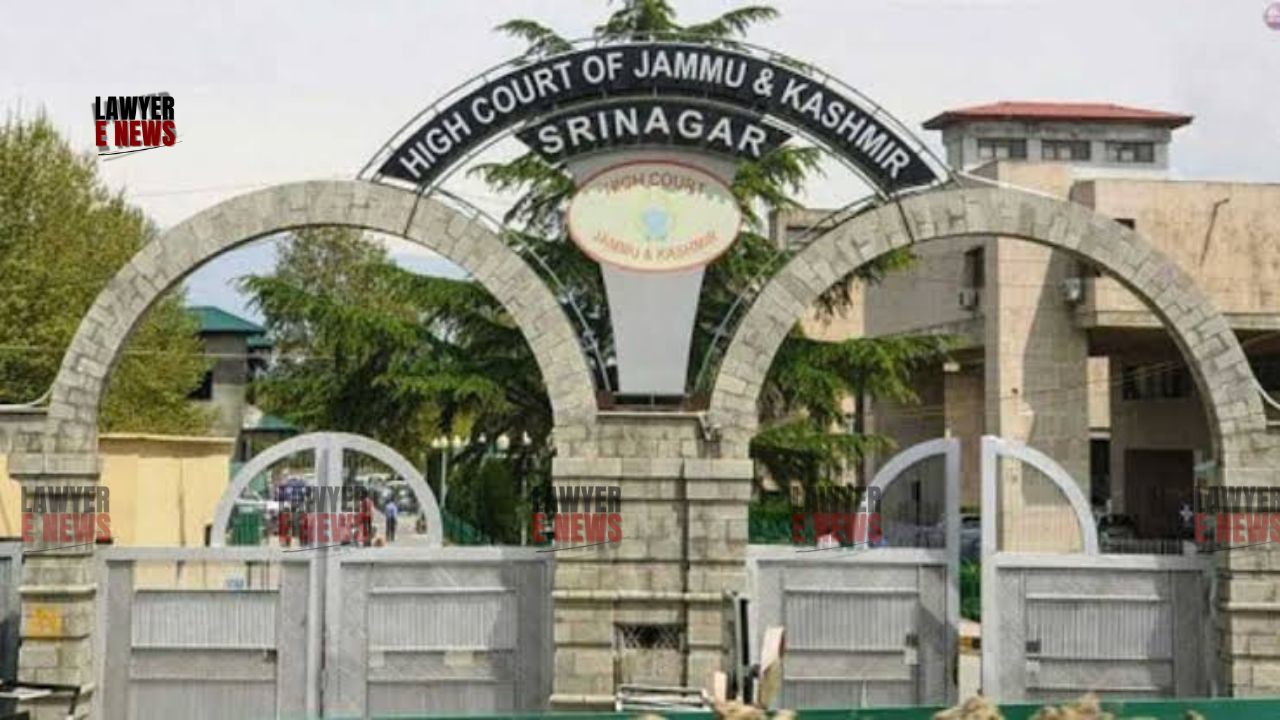
“Delay In Granting Absolute License Cannot Be Used Against Advocate Who Later Joined Government Service” – High Court of Jammu & Kashmir and Ladakh at Srinagar delivered a landmark judgment in John Mohammad Wani v. Bar Council of Jammu & Kashmir & Others, WP (C) No. 959/2025, where it quashed the cancellation of an Advocate’s provisional license by the Bar Council after his appointment as a Prosecuting Officer, terming the decision “unreasonable” and contrary to the Advocates Act, 1961.
A Division Bench of Justice Moksha Khajuria Kazmi and Justice Javed Iqbal Wani ruled that once the petitioner had applied for permanent enrolment, the Bar Council was bound to decide the same before taking coercive action, and non-communication of appointment in government service alone could not justify such a drastic penalty.
“The Petitioner’s Right To Be Treated As An Advocate From 2019 To 2023 Must Be Recognized” – Court Orders Restoration Of Enrolment
The petitioner, John Mohammad Wani, had been granted a provisional license to practice as an Advocate on 31.12.2019, after graduating from the Central University of Kashmir. His license was renewed multiple times up to 31.03.2024, pending submission and verification of his final LL.B. degree.
On 12.10.2022, Wani applied for an absolute license, submitting the final degree and necessary verification. However, no action was taken for over five months. Meanwhile, he qualified for appointment as a Prosecuting Officer, joining government service on 31.03.2023.
Despite this sequence of events, the Bar Council cancelled his provisional license on 05.08.2024 under Rule 49 of the Bar Council of India Rules, citing his government employment and alleged failure to inform the Council.
“Respondent Sat On Absolute License Application For 5 Months, Yet Penalized Petitioner Without Just Cause”
The Court scrutinized the entire factual matrix and found that the Bar Council had acted hastily and punitively. The judgment reads:
“The issuance of the Absolute/Final License has been delayed by the respondent no. 1, as such petitioner cannot be held accountable/responsible for it.”
It further observed that: “The application of the petitioner for issuance of Absolute/Final License, was… lying with the respondent no. 1 for a period of at least five months, without any progress.”
The Court held that had the Council processed his application in time, Wani would have received the absolute license before entering government service, avoiding the bar under Rule 49. Hence, the Council's inaction cannot be used to deprive him of years of practice and experience.
Rule 49: Suspension From Practice, Not Retrospective Cancellation
The Bar Council relied on Rule 49 of the Bar Council of India Rules, which prohibits an advocate from practicing law while being a full-time salaried employee. However, the Court noted:
“Rule 49... envisages only that a salaried person should not practice as a full-time Advocate... the respondent no. 1 could have treated the petitioner to have lost his right of practice from the date of his appointment i.e. 27.03.2023.”
The Court emphasized that this rule does not authorize retrospective cancellation of a valid license, especially when the person had not concealed facts but was acting on a pending application.
“Punitive Action Without Disciplinary Proceedings Violates Procedure Under Advocates Act”
The Court also criticized the failure of the Bar Council to invoke Section 35 of the Advocates Act, 1961, which provides for disciplinary proceedings against advocates.
“The respondent no. 1 did not take recourse to Section 35… even if it had, it was obligatory to refer the case to the disciplinary committee.”
It was held that Section 26, relating to refusal of enrolment, could not apply to Wani who had already been enrolled since 2019. The impugned order was thus found ultra vires, arbitrary, and lacking jurisdiction.
License Restored, Experience Recognized
Allowing the petition, the Court directed:
“The impugned order dated 05.08.2024 read with Notification No. 1677 of 2024 RG/LP dated 05.08.2024… are quashed.”
The respondent was further directed:
“To treat the petitioner to be on the rolls of the State Bar Council of Union Territory of Jammu and Kashmir from the date of his enrolment dated 31.12.2019 till his date of appointment i.e. 27.03.2023.”
This effectively means that Wani’s legal practice of over three years stands restored, which may prove crucial for future employment eligibility, bar experience, and professional record.
This ruling affirms that regulatory authorities like State Bar Councils must act reasonably and in compliance with statutory procedure, particularly when an individual’s career and livelihood are at stake. The judgment underscores that:
Delays by administrative authorities cannot be weaponized against applicants;
Punitive actions like cancellation of license must be preceded by due process under Section 35;
Rule 49 merely prohibits parallel full-time employment and advocacy but does not justify retrospective erasure of practice years.
This judgment is likely to serve as a guardrail against arbitrary use of Bar Council powers, particularly in transitional cases involving advocates entering government service.
Date of Decision: 01 September 2025