-
by sayum
26 August 2026 4:44 AM







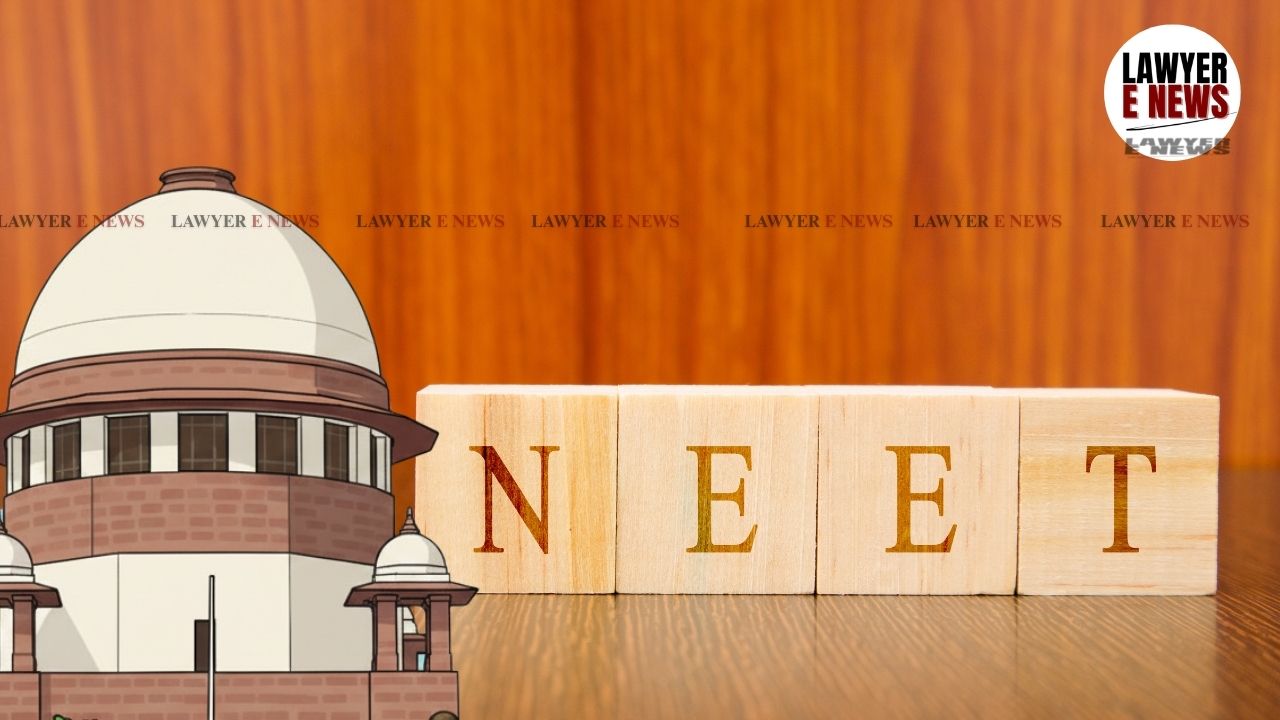
Supreme Court Strikes Down Rajasthan’s BDS Relaxation, Yet Saves Degrees in Extraordinary Relief, On 18 December 2025, the Supreme Court of India, in a far-reaching judgment, settled a decade-long controversy surrounding BDS admissions in Rajasthan for the Academic Year 2016–17.
A Bench comprising Justice J.K. Maheshwari and Justice Vijay Bishnoi, while deciding Siddhant Mahajan & Others v. State of Rajasthan & Others, held that the State Government had no authority to lower the NEET qualifying percentile, even during exigency caused by vacant seats. Declaring the State’s action illegal and contrary to the Dentists Act and BDS Regulations, the Court simultaneously exercised its extraordinary powers under Article 142 to protect students who had already completed their BDS course and obtained degrees.
The judgment is a powerful reaffirmation of NEET’s supremacy, statutory discipline in medical education, and the limited space for equity against illegality.
“‘Necessary Action as Deemed Fit’ Is Not Delegation of Statutory Power”
The core issue before the Court was whether the State of Rajasthan could reduce the NEET qualifying percentile for BDS admissions by relying on a Central Government letter dated 29.09.2016, which merely forwarded a representation from private colleges for “necessary action as deemed fit”.
The Supreme Court categorically rejected the interpretation adopted by the Rajasthan High Court that such wording amounted to delegation of power. The Bench held:
“There is no such provision which permits delegation of this power within the Act or the 2007 Regulations, and the words ‘necessary action as deemed fit’ can under no circumstances be stretched to confer such authority upon the State.”
Referring to Regulation II(5) of the Revised BDS Course Regulations, 2007, the Court made it clear that only the Central Government, in consultation with the Dental Council of India, can lower the minimum NEET percentile, and even that only when sufficient qualified candidates are unavailable.
The State’s decision to reduce the cut-off first by 10 percentile and then by an additional 5 percentile was thus held to be “manifestly illegal”.
“‘NEET Is the Sole Gateway’: Merit Cannot Be Diluted to Fill Seats”
Reaffirming the constitutional and statutory primacy of NEET, the Court relied extensively on Sankalp Charitable Trust and Christian Medical College Vellore, reiterating that:
“Admissions to MBBS and BDS courses must strictly conform to NEET merit, which ensures a level playing field and protects national standards of medical education.”
The Bench rejected arguments that vacant seats justified dilution, holding that administrative convenience cannot trump statutory command. Any lowering of eligibility outside the regulatory framework was held to be destructive of uniform standards and public interest.
“‘A Mockery of Medical Education’: Colleges Admit Zero and Negative Percentile Students”
The judgment records scathing findings against private dental colleges in Rajasthan, noting that even after the State’s illegal relaxation of 15 percentile, colleges went further and admitted students beyond any permissible relaxation, solely on the basis of 10+2 marks.
The Court observed:
“Driven by greed to fill every last seat, the colleges undertook admissions that resulted in students with even zero and negative NEET percentiles entering the BDS course.”
Such conduct was described as “a mockery of the statutory framework” and a direct assault on the integrity of professional education.
“‘No Estoppel Against Statute’: Colleges Can’t Hide Behind State’s Illegality”
Rejecting the plea of promissory estoppel, the Supreme Court held that no equity can arise from actions taken in violation of statute. Relying on Maharishi Dayanand University v. Surjeet Kaur, the Court declared that:
“Promissory estoppel cannot be invoked to sustain an action taken in contravention of a statutory mandate.”
Thus, colleges could not seek protection merely because the State had acted unlawfully.
“‘Students Are the Only Victims’: Court’s Compassion Under Article 142”
While firmly declaring the admissions illegal, the Court acknowledged the human cost of the regulatory failure. Noting that many students had completed the course under interim court orders, paid heavy fees, and spent nearly a decade in litigation, the Bench observed:
“In all this, the only victims are the students.”
Invoking Article 142, the Court regularised the degrees of students who had completed the BDS course and obtained degrees, but imposed a unique condition rooted in public service.
The Court directed that such students must file an undertaking to render pro bono dental services for up to a cumulative period of two years during public emergencies such as pandemics, natural disasters or health crises, if called upon by the State.
“‘No Relief Beyond Nine Years’: Statutory Time Limits Upheld”
The Court, however, drew a firm line by denying relief to students who failed to complete the BDS course within the prescribed outer limit of nine years under the 2007 Regulations. Such students were held not entitled to any protection, and their discharge was upheld.
“‘Strict Punishment Is Necessary’: Heavy Costs Imposed”
Expressing strong disapproval of the conduct of authorities, the Supreme Court imposed exemplary costs:
The private dental colleges were directed to deposit ₹10 crores each, and the State of Rajasthan was directed to deposit ₹10 lakhs with the Rajasthan State Legal Services Authority.
The Court further directed that the funds be invested and the interest utilised for social welfare institutions, including One Stop Centres, Nari Niketans, Old Age Homes and Child Care Institutions, under the supervision of a committee of judges of the Rajasthan High Court.
The judgment strikes a careful balance between constitutional discipline and humane justice. While the Supreme Court left no doubt that States cannot tinker with NEET eligibility, it also ensured that students are not crushed under the weight of institutional and governmental failure.
As the Court cautioned:
“This relief is confined to the peculiar facts of the case and shall not be treated as a precedent.”
The ruling sends an unmistakable message: merit is non-negotiable, statutes are supreme, and any deviation will attract severe consequences.
Date of Decision: 18 December 2025