-
by sayum
27 August 2026 7:40 AM







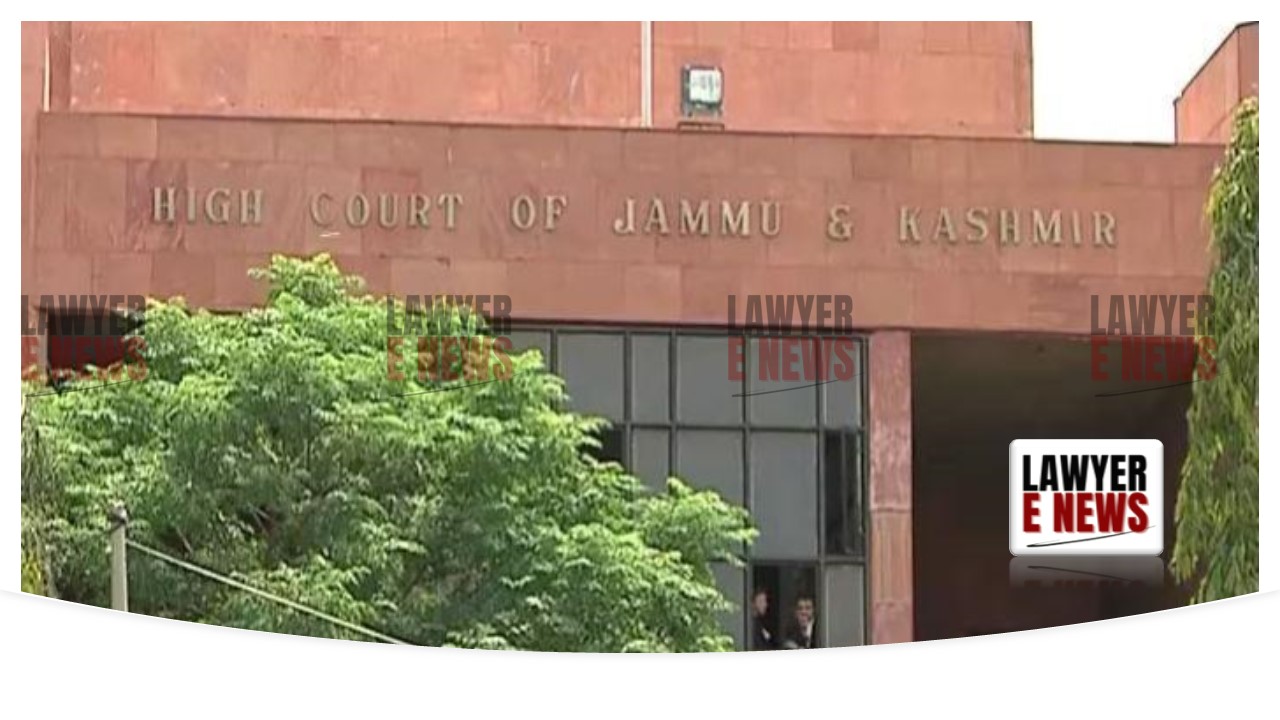
“No Person Shall Take Possession Unless Transfer is Valid Under Section 138 of the J&K Transfer of Property Act” – High Court of Jammu & Kashmir and Ladakh overturned the decision of the First Appellate Court and restored the decree of permanent prohibitory injunction granted by the Trial Court. Justice Vinod Chatterji Koul, while allowing the civil second appeal, delivered an emphatic interpretation of Section 138 of the J&K Transfer of Property Act, 1920, holding that “any possession derived without a valid, written, and registered transfer deed is unlawful and amounts to trespass.”
The judgment assumes substantial legal importance in the domain of property rights, statutory compliance under the Registration Act, 1977 (J&K), and the powers of an appellate court while dealing with findings of fact already adjudicated by a trial court.
Plaintiff’s Title Can’t Be Defeated By “Oral Consent” or Unregistered Transfer: High Court Reinstates Trial Court's Decree
In a suit filed by Mst. Khati, the plaintiff sought to restrain Abdul Rashid Salroo, the defendant, from interfering with her cultivating possession over 10 Marlas of land falling under Khasra No. 945 min in village Jablipora, Tehsil Bijbehara, District Anantnag. The Trial Court decreed in her favour in 2014, restraining the defendant from interference. However, in 2018, the Principal District Judge, Anantnag, acting as the First Appellate Court, reversed the decree and dismissed the suit, accepting the defendant's claim of possession based on an alleged oral transfer from the plaintiff’s daughters.
The High Court, however, restored the Trial Court’s findings, branding the First Appellate Court’s reversal as legally unsustainable and “a perverse interference with well-founded factual conclusions.”
"No Registered Deed, No Possession" – High Court Applies Strict Compliance Under Section 138 of J&K Transfer of Property Act
The core legal issue revolved around whether the defendant, who admittedly had no registered instrument of transfer in his favour, could claim valid possession over the land. Justice Koul decisively answered in the negative, ruling:
“Transfer of immovable property without complying with Section 138 is void and does not confer any lawful right to possess or claim ownership.”
Quoting Section 138(3) of the Act, the Court underscored:
“No person shall take possession of... any land... unless and until such transfer becomes valid under the provision of subsection (1).”
The Court went on to stress that: “The very object of this provision is to prevent unlawful occupation under the guise of oral transfers or informal arrangements.”
Suppression of Material Facts and Non-Specification of Suit Land Rejected As Frivolous Grounds
The Appellate Court had dismissed the plaintiff’s suit citing alleged suppression of material facts and failure to specify the suit land properly. This reasoning was categorically rejected by the High Court.
Justice Koul noted: “It is not the case of the defendant that the plaintiff sold her land; rather he claims transfer through her daughters. In such circumstances, the argument of suppression collapses entirely.”
On the issue of land identification, the Court observed: “Mere absence of boundary demarcation is not fatal when the land is clearly described by Khasra number, location, and has been consistently identified by witnesses on both sides. The parties were well aware of the land in question.”
The judgment reaffirmed the evidentiary sufficiency of revenue records and oral testimonies in establishing both ownership and possession in favour of the plaintiff.
Appellate Court “Failed to Apply Law and Rewarded Encroachment”: High Court Rebukes Findings
Perhaps the strongest portion of the judgment is the High Court’s stinging rebuke of the First Appellate Court’s approach. Justice Koul held that the lower appellate court:
“Miserably failed to go through the provisions of law governing the field, much less the provisions of Section 138... The impugned judgment has in essence showered the benefit of what the statute prohibits.”
It was further held that: “The First Appellate Court has, in gross violation of Section 138, tried to alter records by showing the defendant as owner and possessor against the recorded title of the plaintiff.”
Relying on multiple precedents, including Savitri Bai v. Savitri Bai (SC, 2024), Jana Begum v. Badir Khan (3 JKLR 226), and Ghulam Hussain v. Ghulam Qadir (AIR 1978 J&K 88), the High Court emphasized that "mere possession without registered title does not ripen into ownership."
“A Vendor Cannot Transfer a Better Title Than He Possesses”: Court Enforces Settled Legal Principle
Rejecting the defence that the plaintiff’s daughters could have conveyed title, the Court held: “Even assuming some sort of oral arrangement was made by plaintiff’s daughters, no person can convey a better title than what they possess. Since the plaintiff never executed any deed, the transfer to the defendant is invalid.”
The decision clarifies that in matters of inheritance, each co-sharer may alienate only their respective shares — and even such transfer must comply with registration requirements.
The High Court answered all three substantial questions of law in favour of the plaintiff and ruled that:
The suit was maintainable; there was no suppression of material facts.
The defendant’s possession, being unsupported by a registered transfer, was unlawful.
The First Appellate Court erred in reversing well-reasoned findings of the Trial Court.
Accordingly, the Court allowed the civil second appeal, set aside the impugned judgment of the First Appellate Court dated 24.08.2018, and restored the decree of the Trial Court.
“Registry is directed to accordingly prepare a decree sheet,” Justice Koul concluded.
Date of Decision: 21st November 2025