-
by sayum
27 July 2026 3:39 PM







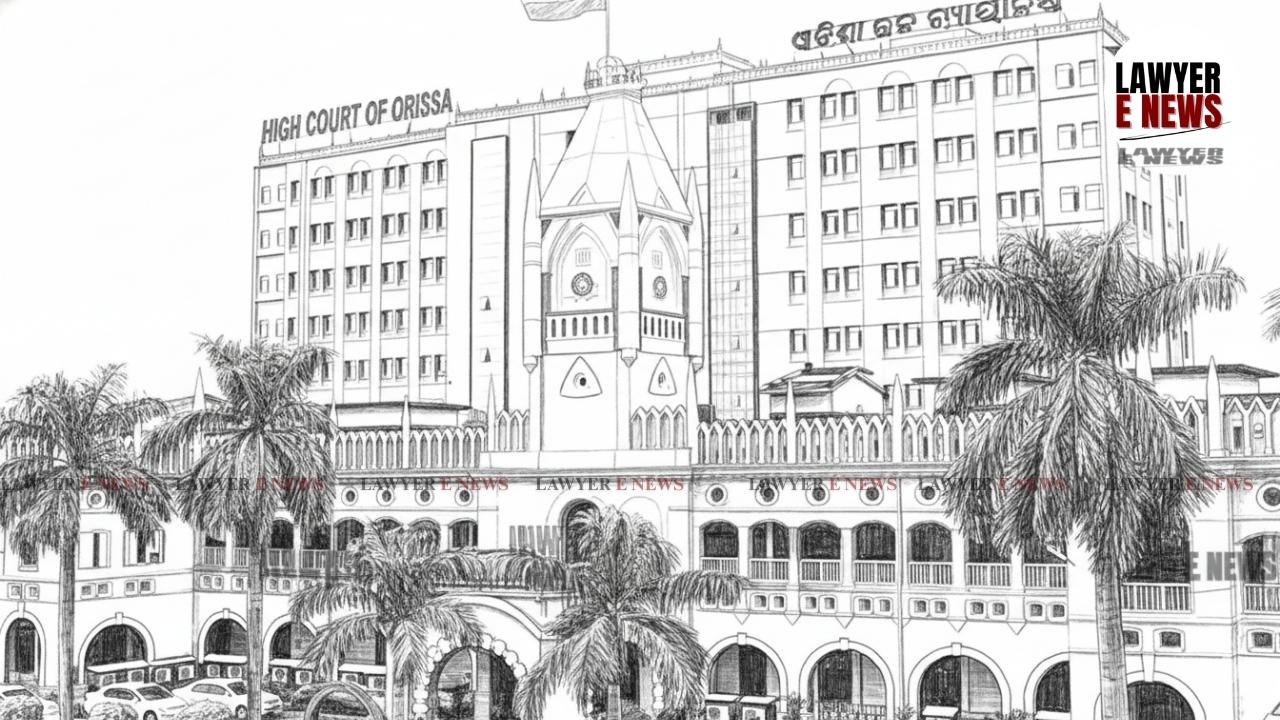
"Procedural laws of limitation apply to such a decree for being set aside and the perpetual minor doctrine does not bypass it," Orissa High Court, in a significant judgment, held that while a deity is considered a perpetual minor in the eyes of the law, it is not absolutely exempt from the procedural requirements of the Limitation Act.
A bench of Justice R.K. Pattanaik observed that while a deity’s property must be protected from unlawful disposal, any application to set aside an ex parte decree involving a deity must still satisfy the "sufficient cause" requirement under Section 5 of the Limitation Act.
The case arose from a long-standing title dispute where the petitioners claimed ownership over the properties of the deity, Kali Thakurani, through adverse possession. After the petitioners obtained ex parte decrees in 1997-2000, the deity, represented by the Sub-Collector, sought to set aside the decrees in 2017 after a delay of nearly 17 years. The lower courts condoned the delay, which was initially challenged and set aside by the High Court, leading to the current applications for recall.
The primary question before the court was whether the "perpetual minor" status of a deity grants it an absolute immunity from the law of limitation. The court was also called upon to determine whether the 17-year delay in filing applications under Order 9 Rule 13 of the CPC could be condoned in the interest of substantial justice.
Deity As A Juristic Person and Perpetual Minor
The Court emphasized that a deity is universally recognized as a juristic person and, due to its nature, is treated as a perpetual minor. Because a deity cannot act on its own, it remains dependent on managers such as Marfatdars or Sebayats to protect its interests. The bench noted that while a deity’s right to property is never technically extinguished by the mere passage of time, procedural laws still govern the enforcement of those rights in court.
Applicability Of Limitation Law To Deities
The Court clarified that the doctrine of perpetual minority does not serve as a total bypass of the Limitation Act. It held that when an ex parte decree is sought to be set aside under Order 9 Rule 13 CPC, the representatives of the deity must demonstrate "sufficient cause" for the non-appearance or delay. The bench remarked that the law of limitation is founded on public policy to ensure that litigation reaches a finality.
"The law of limitation is founded on public policy and a lethargic litigant cannot leisurely choose his own time in approaching the Court and therefore, the limitation is prescribed based on the maxim 'interest reipublicae ut sit finis litium'."
Liberal Approach To Condonation Of Delay
Relying on the Supreme Court's decision in Esha Bhattacharjee Vrs. Managing Committee of Raghunathpur Nafar Academy, the Court noted that a liberal, pragmatic, and justice-oriented approach should be adopted. It observed that courts are not supposed to legalize injustice but are obliged to remove it. The bench highlighted that inordinate delay warrants a strict approach, while shorter delays may be treated with more leniency, yet the ultimate goal is substantial justice.
Burden Of Proof On Deity's Representatives
The Court held that the burden of proof lies on the deity or its representatives to prove that they were prevented by sufficient cause from appearing in court. Such cause could include fraud or gross negligence by those entrusted with the deity's management. The bench underscored that any delay is condonable under Section 5 of the Limitation Act only if valid and justifiable reasons are pleaded on record.
"Whether, in a particular case, delay is to be condoned with the ex parte decree set aside depends on the facts pleaded on record."
Adverse Possession Claims Against Religious Deities
Regarding the petitioners' claim of adverse possession, the Court noted that such a plea generally cannot be set up against the property of a deity who is a perpetual minor. However, it clarified that the maintainability of a suit for adverse title is a matter for trial. The Court observed that the merits of the case—specifically whether the deity was served proper notice—cannot be ignored on purely technical grounds of limitation.
Restoration Of Revisions For Decision On Merits
The Court found that the previous orders disposing of the CMPs without the participation of the deity’s counsel (due to a missing name in the cause list) necessitated a recall. It held that the revisions should be heard afresh by the learned District Judge to determine if the deity had a reasonable excuse for the 17-year delay, especially considering the claim that notices were never properly served.
In its final order, the High Court allowed the applications for recall and directed the restoration of the Civil Revisions. The learned District Judge, Kalahandi, Bhawanipatna, was directed to rehear the parties and pass a fresh decision on the merits within four months. The Court emphasized that while limitation laws apply, the scales of justice must be balanced to ensure a fair opportunity for a deity's interest to be defended.
Date of Decision: 19 June 2026