-
by sayum
17 October 2026 12:47 PM







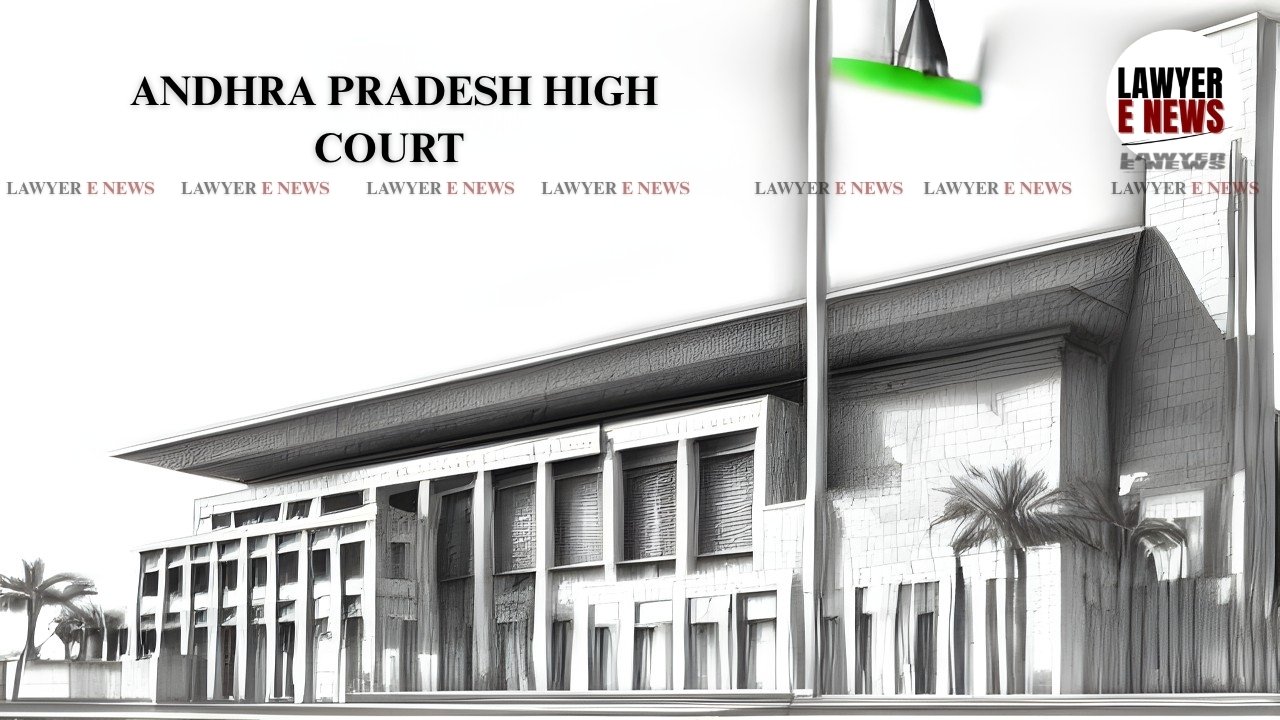
"The primary aim of the court is to try the case on its merits and ensure that the rule of justice prevails. For this the need is for the true facts of the case to be placed before the court so that the court has access to all the relevant information in coming to its decision." Andhra Pradesh High Court, in a significant ruling, held that trial courts should not adopt a hyper-technical approach while dealing with applications for the amendment of pleadings under Order VI Rule 17 of the CPC, particularly when the proposed changes are intended to rectify typographical errors rather than substitute a cause of action.
A bench of Justice K. Sreenivasa Reddy observed that such amendments are necessary for the purpose of determining the real questions in controversy between the parties and ensuring that the rule of justice prevails.
The petitioner had filed a Civil Revision Petition challenging an order of the Civil Judge (Senior Division), Narsapur, which had dismissed his application to amend his counter-affidavit in a suit for restitution of conjugal rights. The petitioner sought to correct several typographical errors where the labels "petitioner" and "respondent" had been inadvertently interchanged in his pleadings. The trial court had dismissed the application on the ground that it would cause prejudice to the respondent and that the petitioner had failed to satisfy the proviso to Order VI Rule 17 CPC regarding due diligence after the commencement of trial.
The primary question before the court was whether the proposed amendments, sought after the commencement of the trial, constituted a withdrawal of admissions or merely the correction of clerical mistakes. The court was also called upon to determine whether the trial court acted with material irregularity by adopting a hyper-technical view, thereby refusing to allow necessary pleadings that facilitate the determination of the real controversy.
Correction of Typographical Errors
The High Court meticulously examined the contents of the counter-affidavit, noting that the errors were contextual. The court observed that the pleadings contained references to previous matrimonial proceedings where the parties occupied specific roles, and the incorrect usage of terms was an obvious slip. The court held that when the counter-affidavit is read as a whole, it becomes clear that the usage of "respondent" instead of "petitioner" (and vice versa) was an inadvertent error that did not change the nature of the defence.
Proving the Contextual Reality
The bench found that the proposed amendments were not intended to create a new defence or withdraw any settled admission but were instead meant to align the pleadings with the factual reality already established in prior litigation. The Court noted that the trial court erred in failing to see that these corrections were essential for the court to have access to all relevant information.
Liberal Approach to Pleadings
The Court reiterated that the power to allow amendments under Order VI Rule 17 CPC is intended to ensure that justice is not defeated by technicalities. The court emphasized that the primary duty of the trial court is to determine the real questions in controversy, and if the amendments are essential to that end, they should be permitted provided they do not cause irreversible prejudice to the opposing party.
Courts Should Avoid Hyper-Technicality
The High Court held that the trial court's dismissal based on a rigid interpretation of the proviso to Order VI Rule 17 was unsustainable. By failing to discern that the amendments were meant to rectify patent clerical slips, the trial court had failed to exercise its jurisdiction correctly. The Court concluded that such amendments do not constitute an afterthought but are vital for a fair adjudication of the matrimonial dispute on its merits.
The High Court allowed the Civil Revision Petition and set aside the order of the trial court. The application for amendment of the counter-affidavit was allowed, enabling the petitioner to proceed with his corrected pleadings. The court clarified that such adjustments, when demonstrably typographical, do not cause legal prejudice to the other side and are vital for the administration of justice.
Date of Decision: 25 August 2026