-
by sayum
05 August 2026 6:43 AM







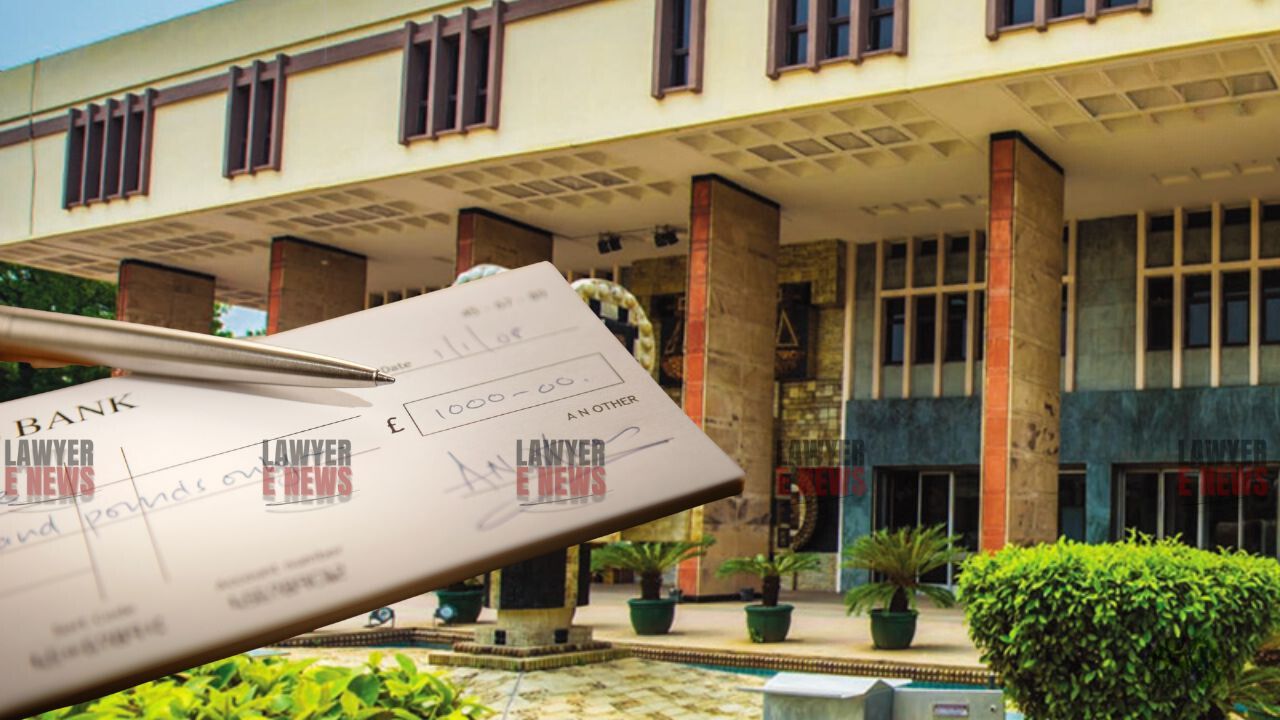
“Complainant Failed To Implead The Correct Person – Case Collapses On A Fundamental Legal Principle” – In a significant ruling Delhi High Court emphatically reaffirmed that a proprietorship concern has no separate legal existence from its proprietor, and therefore, only the proprietor can be held liable for the dishonour of a cheque under Section 138 of the Negotiable Instruments Act, 1881 (NI Act).
The Court, presided over by Justice Shalinder Kaur, dismissed the appeal filed by Noida Dhatu Pvt. Ltd., which sought to overturn the acquittal of D.P. Singh in a cheque dishonour complaint. The Court’s sharp observation was that the complainant had failed at the very threshold by not arraying the actual proprietor of the concern M/s Udai Continentals, which was in fact Ms. Sarika Singh Kuchhawaha, wife of D.P. Singh.
Justice Shalinder Kaur succinctly captured the core flaw in the appellant’s case, stating that, “A proprietorship concern stands on an absolutely different footing. A person being the proprietor thereof would be solely responsible for the affairs and the conduct of a proprietary concern.”
“Cheque Dishonour Complaint Against A Non-Proprietor Cannot Stand” – Rules Delhi High Court
The factual matrix of the case involved a cheque bearing number 040166, dated 15.12.2003, issued for a sum of ₹60,000, which was dishonoured with the endorsement “payment stopped by drawer”. The appellant, Noida Dhatu Pvt. Ltd., contended that this cheque was issued by D.P. Singh, who was allegedly the proprietor of M/s Udai Continentals, towards payment for canopies supplied to him. The appellant, after serving a demand notice for ₹62,200 (which included interest), initiated a complaint under Sections 138 and 141 of the NI Act, alongside Sections 420 and 406 IPC.
The complaint, however, suffered a crippling blow when during the trial it was revealed that the proprietor of M/s Udai Continentals was not D.P. Singh, but his wife, Ms. Sarika Singh Kuchhawaha. This fact was unequivocally established through the testimony of the bank manager, Mohd. Alam (DW-1), who confirmed that the current account in question was in the name of Ms. Sarika Singh Kuchhawaha as the sole proprietor.
The Court noted, “The testimony of DW-1 is unchallenged as the witness was not cross-examined by the appellant. Therefore, from the evidence on record, it is evident that the respondent no. 2 is not a signatory to the cheque.”
“Section 141 NI Act Does Not Apply To Proprietorships – No Vicarious Liability Possible” – Says Court
Relying on the Supreme Court’s judgment in Raghu Lakshminarayanan vs. Fine Tubes, (2007) 5 SCC 103, the Delhi High Court reaffirmed that the concept of vicarious liability under Section 141 applies only to juristic persons like companies or partnerships, not to proprietorships. Quoting the apex court, the judgment noted, “A proprietary concern is not a company... a person may carry on business in the name of a business concern, but he being proprietor thereof would be solely responsible for conduct of its affairs.”
Reinforcing the legal distinction between a proprietorship and other legal entities, the Court observed, “Section 141 of the NI Act does not cover within its ambit the proprietary concern as same is not a juristic person, so as to attract vicarious liability.” It further emphasized that “A proprietorship firm has no separate legal identity... it is in fact a business name of the sole proprietor.”
“Failure To Implead The Actual Proprietor Is Fatal – Foundation Of The Case Is Shaken” – Declares High Court
Addressing the core failure of the complainant, the Court remarked, “The appellant has miserably failed to establish that Respondent No. 2 was responsible, being the proprietor of Respondent No. 1 to make the payment under the cheque.”
The Court noted with gravity that although the complainant had belatedly attempted to summon Ms. Sarika Singh Kuchhawaha, this was done only at the stage of final arguments. The trial court had rightly dismissed that application on 5th February 2011, a decision that the appellant did not challenge, allowing it to attain finality.
Justice Shalinder Kaur’s verdict was categorical when she stated, “In the present case, the complaint appears to be suffering from fatal infirmities so much so, it goes directly to the root of the case and shakes the very foundation on which the appellant’s complaint had been registered.”
Demand Notice Irregularity Not Core, But Misidentification Remains Fatal
While the appellant had attempted to argue that the demand notice raised for ₹62,200 (on a dishonoured cheque of ₹60,000) was valid despite the slight discrepancy due to added interest, the Court clarified that this aspect was not decisive in the outcome. The judgment candidly pointed out that “The real and core reason for acquittal remained the appellant’s failure to establish that the respondent was the drawer or proprietor.”
Conclusion: No Cause Of Action Against D.P. Singh – Appeal Dismissed
Concluding the judgment, the Court upheld the trial court’s acquittal order dated 24.09.2011, noting, “No cause of action accrues in favour of the complainant against Respondent No. 2... this Court does not find any perversity in the impugned order.” The criminal appeal was accordingly dismissed.
This decision reinforces the legal principle that the liability under Section 138 NI Act strictly follows the drawer of the cheque, and where a proprietorship is involved, only the person who legally owns that proprietorship can be held accountable. The Court’s judgment sends a clear signal that misidentification of parties is a fatal defect that cannot be cured at a belated stage in cheque dishonour litigation.
Date of Decision: 01 July 2025