-
by sayum
26 August 2026 8:37 AM







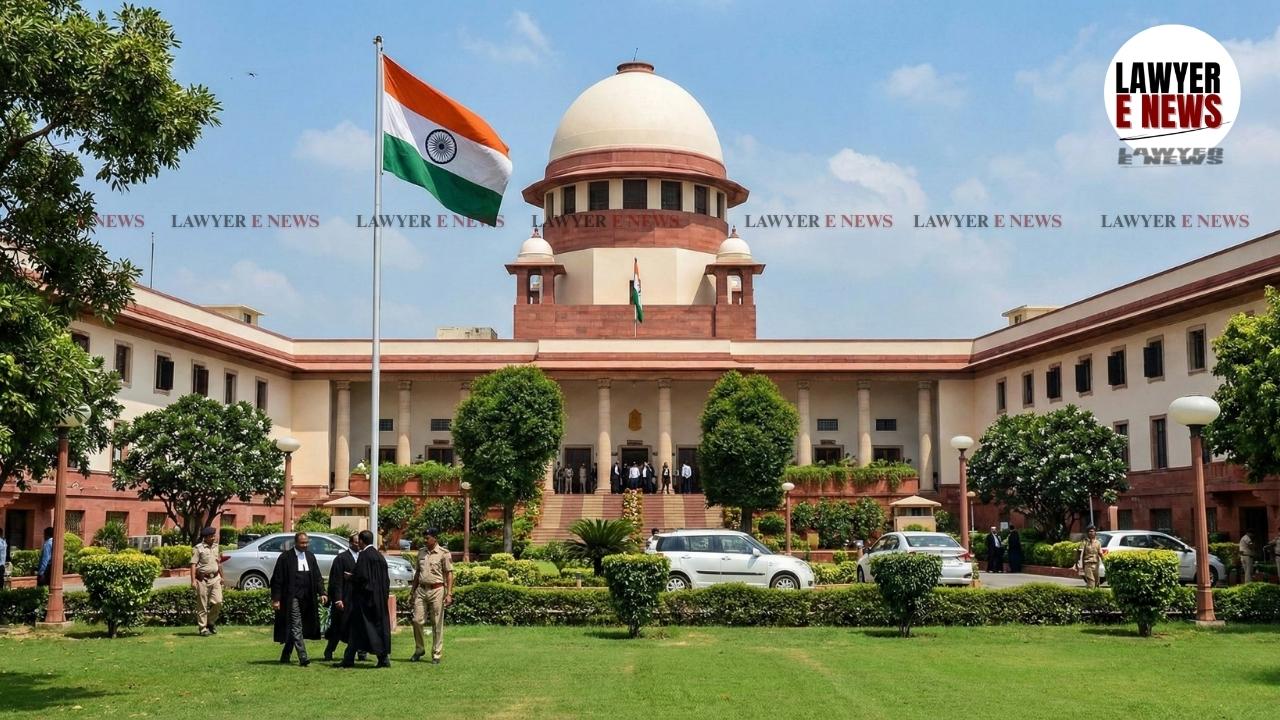
“The referral court is not a monotonous automation where absolute strangers can walk in and compel arbitration.”, In a landmark judgment that significantly clarifies the legal threshold for non-signatories attempting to enforce arbitration clauses, the Supreme Court held that a sub-contractor who is not a signatory to the main contract cannot compel arbitration with the principal employer in the absence of a “veritable” legal relationship.
The bench of Justice J.B. Pardiwala and Justice K.V. Viswanathan delivered this authoritative ruling in the case of Hindustan Petroleum Corporation Ltd. vs. BCL Secure Premises Pvt. Ltd. (Civil Appeal No. 14647 of 2025), arising from an appeal against the Bombay High Court's decision which had allowed a Section 11(4) petition under the Arbitration and Conciliation Act, 1996 filed by the sub-contractor BCL.
Setting aside the High Court’s order, the Supreme Court ruled that “even prima facie, the respondent has not been able to establish that it was a veritable party to the contract between HPCL and AGC.”
"Section 11 Inquiry Not a Rubber Stamp: Courts Must Scrutinize if Non-Signatory is Truly a Party to Arbitration"
The core issue before the Court was whether BCL—a sub-vendor to AGC, the main contractor—could invoke the arbitration clause in HPCL’s tender despite being a non-signatory to the main contract. HPCL had floated a tender for the supply and installation of Tank Truck Locking Systems (TTLS), which was awarded to AGC Networks Ltd. BCL later claimed to be entitled to HPCL’s payments, alleging it had performed the bulk of the contract under a back-to-back agreement with AGC.
However, the Supreme Court found no privity of contract, no express consent by HPCL, and an express prohibition in the tender against subletting or assigning without prior written permission.
The Court emphatically observed:
“This does not mean that where the Referral Court finds prima facie a party is not a veritable party, still the matter is left to the Arbitral Tribunal. To hold so would relegate the Referral Court to the status of a monotonous automation.”
The judgment sharply rebuked the High Court's decision to leave the matter to arbitration under Section 16 of the Act, ruling that such “hands-off” deference is inappropriate where the record fails even to establish a prima facie case of a veritable party relationship.
Background: Sub-Contractor BCL’s Claim Based on Assignment Rejected
BCL had entered into a back-to-back agreement with AGC and later obtained an Assignment-cum-Settlement Agreement dated 31.10.2023, under which AGC (now Black Box Ltd.) purportedly assigned its receivables from HPCL to BCL. BCL then issued a legal notice invoking arbitration under Section 21 of the Act, claiming over ₹3 crores in dues from HPCL. The High Court, in its April 2025 order, appointed an arbitrator but directed the arbitral tribunal to first decide its jurisdiction under Section 16.
However, the Supreme Court rejected this approach, stating:
“The referral court under Section 11 is not deprived of its jurisdiction from examining whether the non-signatory is in the real sense a party to the arbitration agreement. The answer thereof will depend on the facts and circumstances of each case.”
Doctrine of Veritable Party: No Shortcuts to Consent
The Court drew heavily from the five-judge Constitution Bench judgment in Cox & Kings Ltd. v. SAP India [(2024) 4 SCC 1], reiterating that “mere commercial connection” or the use of escrow accounts and group emails do not elevate a party to the status of a veritable party.
Justice Viswanathan, writing for the bench, explained:
“The respondent fails the prima facie test of being a veritable party to the arbitration agreement between HPCL and AGC... The parties operated on separate orbits.”
The judgment stressed that “assignment of obligations requires consent”, and the absence of written consent from HPCL to AGC’s purported assignment of receivables to BCL meant that no binding arbitration obligation could arise.
Supreme Court Emphasizes Need to Weed Out Vexatious Arbitration Claims
Referring to earlier rulings, including In Re: Interplay Between Arbitration Agreements & Stamp Act, SBI General Insurance v. Krish Spinning, and ASF Buildtech v. Shapoorji Pallonji, the Court clarified that Section 11(6-A) empowers the referral court to “inspect and scrutinize” the existence of a valid arbitration agreement rather than deferring all questions to the tribunal.
“The use of the term ‘examination’ under Section 11(6-A) implies that the scope of enquiry is limited to a prima facie scrutiny of the existence of the arbitration agreement.”
Significantly, the Court rejected the notion that mere assignment or commercial dealings automatically bind a third party to arbitrate:
“Mere legal or commercial connection is not sufficient for a non-signatory to claim through or under a signatory party.”
Arbitration Application Dismissed, BCL Left to Alternate Remedies
Having decisively held that BCL is not a veritable party and that no arbitration agreement exists between HPCL and BCL, the Supreme Court allowed the appeal and dismissed the arbitration application.
“If the respondent has any other remedy available in law, it is at liberty to pursue the same. If any such proceedings are resorted to, they have to be decided in accordance with law and on their own merits.”
With this verdict, the Court sends a strong signal that arbitration—while favoured in commercial disputes—cannot become an open arena for non-signatories seeking strategic claims without contractual legitimacy.
Date of Decision: 09 December 2025