-
by sayum
28 August 2026 2:11 PM







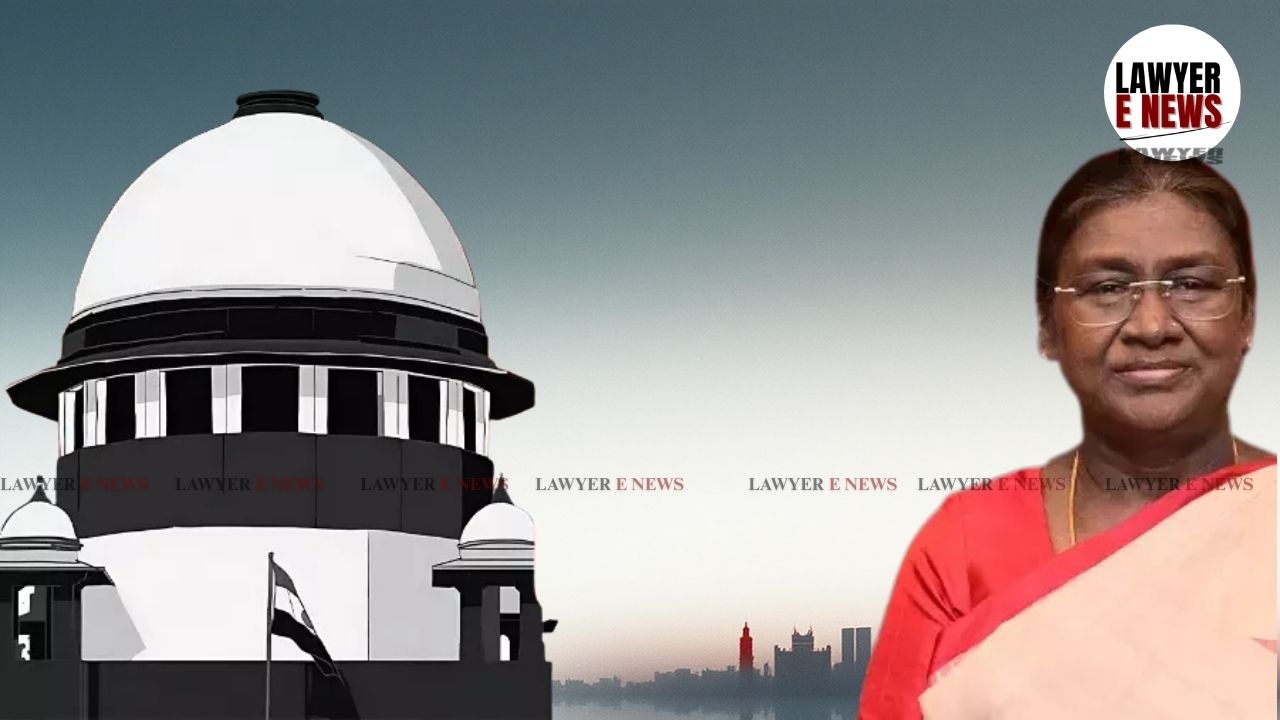
“Judiciary Cannot Rewrite the Constitution to Create Deemed Assent….No Fourth Option Under Article 200; Governor Cannot Sit Indefinitely Without Acting on a Bill” , In a landmark opinion delivered on November 20, 2025, the Supreme Court of India, responding to Special Reference No. 1 of 2025 under Article 143(1), firmly ruled that there is no constitutional doctrine of 'deemed assent' in the Indian legal framework. The Constitution Bench held that the judiciary cannot manufacture assent where none is granted, thereby partially overruling the controversial 2024 decision in State of Tamil Nadu v. Union of India.
The reference arose from growing constitutional friction between elected state governments and Governors, particularly where Bills passed by State Legislatures were left pending for indefinite periods. Amidst this, the Tamil Nadu ruling had created a judicially engineered mechanism whereby a Bill would be "deemed to have received assent" after an unspecified reasonable period, invoking Article 142 of the Constitution. The President of India referred fourteen constitutional questions to the Supreme Court, seeking clarity on the powers, responsibilities, and limits of Governors and the President under Articles 200 and 201.
The Court's advisory opinion reasserts the foundational principle that the judiciary cannot override express constitutional text in the name of expediency or public interest.
“Governor Has Only Three Constitutionally Permissible Options; The First Proviso to Article 200 Does Not Create a Fourth”
The Court held unequivocally that the Governor’s role under Article 200 is constitutionally limited to three specific courses of action: grant assent, withhold assent and return the Bill (if it is not a Money Bill), or reserve the Bill for the President. Any suggestion that the Governor could create a fourth option by indefinitely sitting on the Bill was categorically rejected.
Quoting the judgment, the Bench observed, “The first proviso to Article 200 restricts the Governor’s discretion, not expands it. It certainly does not authorise a refusal to act altogether.” The Court also clarified that the Governor is not bound by the advice of the Council of Ministers while exercising discretion under Article 200, as the nature of the function is constitutionally distinct from executive action under Article 163.
The judgment emphatically held, “No fourth option exists under Article 200. Any indefinite withholding of assent, without action, amounts to constitutional non-compliance.”
“Deemed Assent is a Judicial Fiction Without Constitutional Foundation”
Striking down the concept of deemed assent, the Court ruled that no deeming provision exists under Articles 200 or 201, and none can be created by judicial interpretation or through Article 142. The Bench noted that where the Constitution intended deemed assent, it has expressly said so — such as in Articles 109(5) and 198(5) dealing with Money Bills. The absence of such language in Articles 200 and 201 was declared to be deliberate and significant.
As the Court clarified, “Judiciary cannot invent a constitutional outcome that is textually absent. Deemed assent amounts to substituting the Governor’s role with judicial fiat, which would violate the separation of powers — a part of the basic structure of the Constitution.”
The judgment directly overruled the holding in the Tamil Nadu case to the extent that it allowed the legislature to presume assent after an undefined period. “The decision in State of Tamil Nadu was fundamentally flawed in prescribing deemed assent. It undermines constitutional architecture and collapses the delicate balance between the organs of the State,” the Court declared.
“Article 142 Cannot Be Used to Circumvent Constitutional Roles and Rewrite Processes”
In a forceful reaffirmation of constitutional limits on judicial power, the Court reiterated that Article 142 cannot be used to override express provisions of the Constitution or to create legal mechanisms not contemplated by it. Citing Prem Chand Garg, Supreme Court Bar Association, and Shilpa Sailesh, the Court reminded that Article 142 is meant to do “complete justice”, not to do injustice to the Constitution itself.
The Court held, “What cannot be done directly by the legislature or the executive, cannot be done indirectly by invoking Article 142. Judicial creation of deemed assent would amount to rewriting the Constitution, which the judiciary has no power to do.”
This interpretation aligns Article 142 with the basic structure doctrine, ensuring that the judiciary remains within its constitutional role as interpreter, not maker, of constitutional norms.
“Governor’s Decisions on Assent Not Subject to Judicial Review; Only Prolonged Inaction May Invite Limited Intervention”
The Court drew a crucial distinction between merits-based review and limited judicial oversight in cases of prolonged and unexplained inaction. It held that the decision to grant, withhold, or reserve assent is not justiciable and forms part of the legislative process, which is beyond judicial scrutiny.
However, the Court cautiously added that inaction for indefinite and unexplained periods could violate constitutional trust and therefore, warrant a limited mandamus — not to direct a particular outcome, but to direct the Governor to act.
As the Court observed, “Judicial review of a Bill, anterior to its enactment as law, is unheard of and unfathomable in our constitutional practice. However, where there is constitutional inaction, courts may issue a limited mandamus to prevent paralysis, without intruding on discretion.”
This compromise preserves institutional accountability while maintaining fidelity to the separation of powers.
“Governor Enjoys Personal Immunity Under Article 361, But Constitutional Office is Subject to Scrutiny”
The Court affirmed the personal immunity of the Governor under Article 361, noting that the Governor cannot be summoned, impleaded, or compelled to file an affidavit. However, it distinguished the Governor’s personal immunity from institutional accountability.
Citing Rameshwar Prasad (VI), the Court said, “Though the Governor cannot be personally proceeded against, the constitutional functioning of the office of the Governor can be examined to ensure compliance with the Constitution.”
This approach protects the dignity of the office while ensuring that the mechanism of constitutional governance is not shielded from judicial oversight in all circumstances.
“President Not Obligated to Refer Every Bill Under Article 143; Subjective Satisfaction Under Article 201 Prevails”
Addressing the role of the President when a Bill is reserved under Article 201, the Court clarified that the President is not constitutionally obligated to invoke Article 143 for every reserved Bill. The decision to seek the Supreme Court’s opinion is discretionary and not mandatory.
The Court noted, “The President’s action under Article 201 is based on subjective satisfaction and follows the same constraints applicable to the Governor under Article 200. Courts cannot mandate the invocation of Article 143.”
This reinforces the President’s discretion and prevents judicial entanglement in every legislative conflict between the Centre and States.
“Assent is a Constitutional Prerequisite; Article 142 Cannot Override Article 200”
The Court decisively ruled that no Bill becomes law unless the constitutional requirement of assent is fulfilled. There is no such thing as automatic or implied legislation, and the judicial branch cannot step in to declare a Bill to be law in the absence of assent.
“Article 142 cannot override Article 200. To allow such a substitution would amount to judicial legislation and a breach of constitutional discipline,” the Bench held.
This clear boundary ensures that judicial remedies do not disrupt the constitutionally mandated processes of lawmaking.
“Court Cannot Examine Bills Before They Become Law”
One of the most significant declarations was that Bills are not subject to judicial review unless and until they are enacted into law. The Court emphasized that the judicial role begins only when legislation becomes enforceable law and not during its legislative journey.
“Judicial examination of Bills prior to enactment would amount to the courts supplanting legislative or executive functions. That is neither permissible nor desirable in a constitutional democracy,” the judgment stated.
This position reaffirms earlier decisions in Kameshwar Singh, Hoechst Pharmaceuticals, and Bharat Sevashram Sangh, all of which recognized the sanctity of legislative procedure from judicial encroachment.
“Timelines Cannot Be Judicially Imposed on Constitutional Authorities”
The Court unequivocally rejected the idea that uniform judicial timelines can be imposed on the Governor or the President. The judgment stressed that constitutional silence on timeframes is deliberate, and that judicial imposition of timelines would amount to judicial legislation.
“Every Bill is different. Complexity, urgency, and public importance vary. A judicially prescribed deadline undermines the deliberative space that the Constitution affords to constitutional functionaries,” the Bench held.
The timeline-based reasoning in State of Tamil Nadu was, therefore, declared to be unconstitutional.
“Several Referred Questions Found Irrelevant and Returned Unanswered”
The Court declined to answer Questions 12, 13, and 14 concerning the composition of Constitution Benches under Article 145(3), broad powers under Article 142, and dispute resolution between Union and States outside Article 131. These were found to be outside the scope of the reference and were therefore returned unanswered.
“No Constitutional Shortcuts in a Democracy Governed by Rule of Law” – Supreme Court Preserves Institutional Integrity
Summing up, the Supreme Court’s opinion is a constitutional course correction that firmly reestablishes the limits of judicial power, the role of executive discretion, and the structural balance between the Union and the States. By rejecting deemed assent, denying judicial timelines, and reaffirming non-justiciability, the Court restores the integrity of the Constitution’s legislative procedure.
“We cannot permit institutional paralysis, but neither can we violate the Constitution to cure it,” the Court cautioned.
This judgment, in its sweeping clarity and disciplined restraint, restores federal comity, institutional accountability, and constitutional order.
Date of Decision: November 20, 2025
Case Title: In Re: Article 143(1) of the Constitution of India – Special Reference No. 1 of 2025