-
by sayum
14 August 2026 3:21 PM







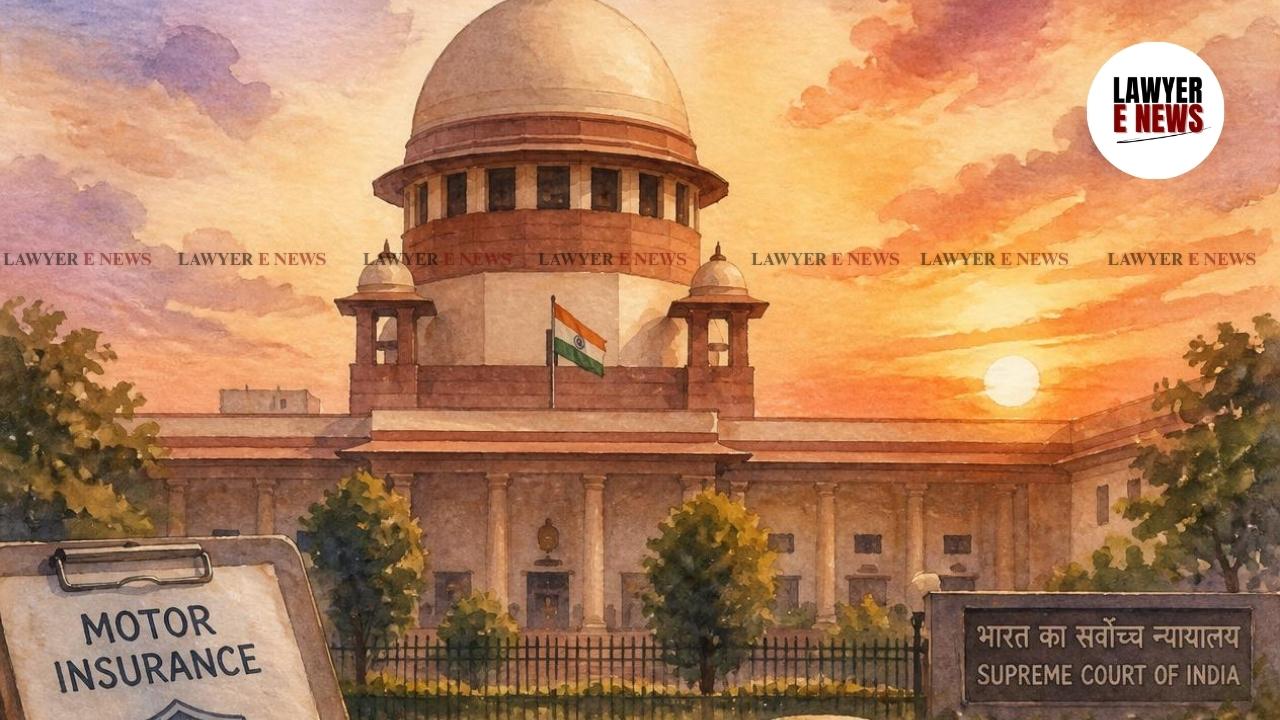
"When the party with all the drafting power writes an ambiguous policy, it is the ordinary policyholder who suffers. Insurers have, in many cases, exploited this ambiguity." Supreme Court, in a significant ruling dated July 20, 2026, held that an insurance company cannot repudiate a claim for a motor vehicle accident occurring outside India if the vehicle possessed a valid cross-border permit, even if no additional premium was paid by the insured.
A bench comprising Justices Sanjay Karol and Nongmeikpam Kotiswar Singh observed that standard-form insurance contracts must be read harmoniously and any ambiguity arising from "sloppy drafting" by the insurer must be interpreted in favour of the policyholder.
Background Of The Case
The dispute arose from an accident involving a passenger bus registered in Durg, Chhattisgarh, which suffered a fatal collision while travelling on a religious tour to Nepal. The Motor Accident Claims Tribunal initially fastened the compensation liability on the vehicle owner, which was later reversed by the Chhattisgarh High Court, making the appellant-insurer liable. The insurance company approached the Supreme Court arguing that its policy explicitly limited the "Geographical Area" to India and that the owner had failed to pay the extra premium required for foreign coverage under the India Motor Tariff (IMT) 2002.
Legal Issues
The primary question before the court was whether the accident occurring outside India would be covered by the motor insurance policy in the absence of an additional premium payment as required by General Regulation 4 of the IMT 2002. The court was also called upon to determine whether the driver’s Indian driving license was valid in Nepal at the time of the incident to satisfy the policy conditions.
Court's Observations and Judgment
Ambiguous Policy Clauses Must Favour The Insured
The bench heavily scrutinised the drafting of the standard insurance policy, noting that the insurer cherry-picked the "Geographical Area" clause while ignoring the "Limitation as to Use" clause. The court pointed out that the limitation clause broadly covered the vehicle's use under any permit within the meaning of the Motor Vehicles Act (MVA), 1988. Noting that the Additional Regional Transport Authority, Durg, had issued a special permit expressly authorising travel to Nepal, the court ruled that the insurer could not deny coverage.
Specific Permit Overrides General Geographical Exclusions
The court clarified that the presence of the geographical limitation clause is not entirely redundant, as it would apply to vehicles operating in foreign territories without a valid permit. However, where a specific statutory permit exists, the policy provides coverage. The bench strongly criticised the insurer's drafting practices, quoting the maxim that drafters must clearly exclude what they do not wish to cover.
"Cover what you want. Exclude what you want. But make sure you do it clearly. Sloppy drafting could cost you something."
Section 147(5) MVA Overrides Tariff Regulations
Addressing the insurer's core argument regarding the non-payment of extra premium under the IMT, the court relied on the non-obstante clause in Section 147(5) of the MVA. The bench held that this statutory provision imposes an absolute liability on the insurance company to indemnify the specified persons, irrespective of any other law or regulatory instrument in force. Consequently, the statutory requirement of Section 147(5) overrides the binding nature of the IMT regulations formulated by the Tariff Advisory Committee.
Extra-Territorial Operation Of MVA Is Valid
The Supreme Court also examined the extra-territorial applicability of the MVA, drawing power from Article 245(2) of the Constitution of India, which protects parliamentary laws from being invalidated on grounds of extra-territorial operation. By reading Sections 139 and 149 of the MVA together, the court concluded that the legislature explicitly intended the statute to apply to foreign jurisdictions and reciprocating countries, regardless of whether the accident took place in India or Nepal.
Indian Driving License Valid In Nepal Under 1950 Treaty
Rejecting the insurer's defense that the driver lacked a valid license for Nepal, the court referenced Article 7 of the Treaty of Peace and Friendship between India and Nepal, 1950. The bench observed that this treaty grants reciprocal privileges regarding movement and commerce. Since the Nepalese border authorities had verified the Indian driving license and issued a 'Bhansar Pragna Patra' without objection, the court found no breach of the policy's driving license conditions.
Supreme Court Issues Suggestions To IRDAI On Cross-Border Coverage
Taking note of recent regulatory changes, including the de-notification of IMT 2002 and the introduction of the Inter-Country Transport Vehicles Rules 2021, the court highlighted a persisting legislative vacuum regarding the extension of domestic policies. To cure this, the bench advised insurers to use clear and unambiguous language in their policies. The court further directed that if cross-border coverage is excluded, the policy must explicitly inform the insured of the need to obtain a separate endorsement before travelling.
IRDAI Directed To Issue Master Circular
In a crucial regulatory directive, the Supreme Court advised the Insurance Regulatory and Development Authority of India (IRDAI) to consider issuing a master circular to standardise cross-border coverage clauses across all motor insurance policies. The court noted that such standardisation is essential to prevent average consumers from falling foul of complex legal rigours while undertaking international travel.
Admonition To Tribunals On Clear Reasoning
Before parting with the judgment, the Supreme Court expressed considerable disturbance over the "tone tenor and extent" of orders passed by Motor Accident Claims Tribunals. The bench observed that while Tribunals elaborately record evidence, they frequently fail to correlate these facts with the final legal outcome. The court firmly reminded Tribunals that their conclusions must be supported by adequate and clear reasoning to reduce the large gap between the institution and disposal of claim petitions, and to curb unnecessary appeals.
The Supreme Court dismissed the appeal filed by the Oriental Insurance Co. Ltd., directing it to pay the compensation amount of Rs. 32,67,000 along with the stipulated 6% interest to the claimants. The insurer was ordered to deposit the amount directly into the claimants' bank accounts within a period of four weeks, definitively settling the legal position on cross-border motor insurance claims under the MVA.
Date of Decision: July 20, 2026