-
by sayum
09 October 2026 12:19 PM







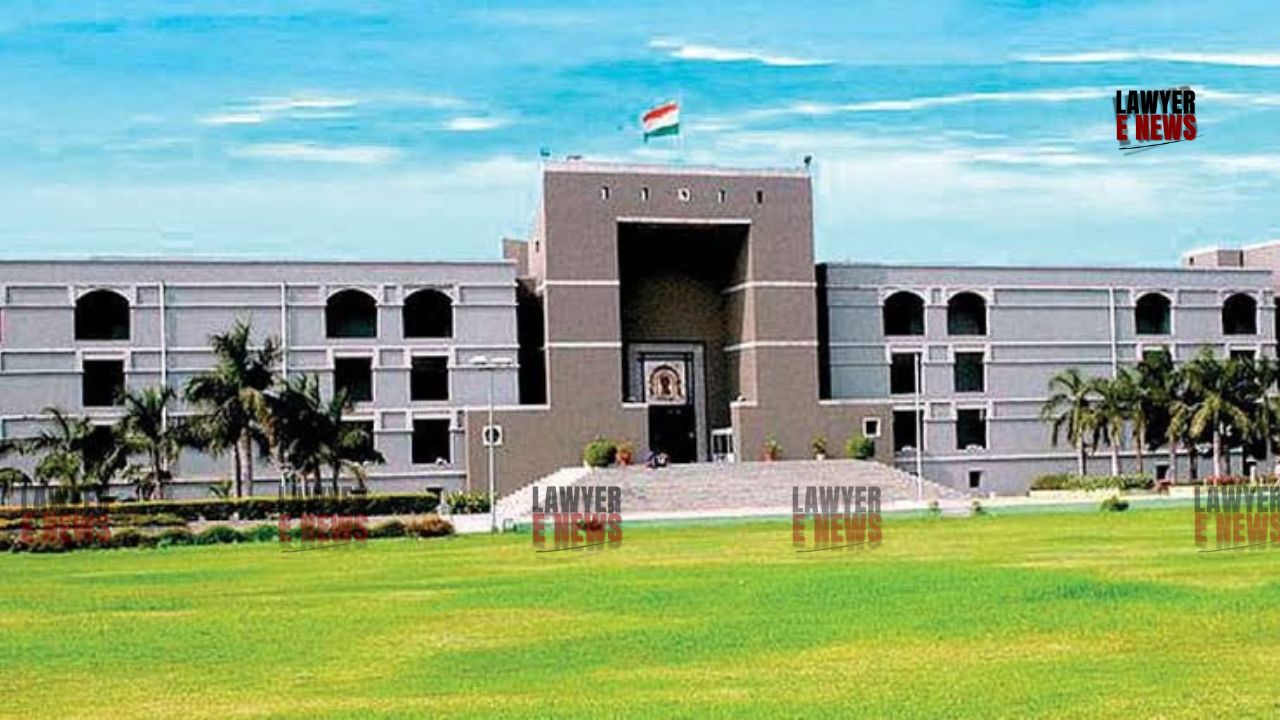
"It is a settled position of law that mere production and exhibition of the document would not, by itself, amount to proof of the document or its contents." Gujarat High Court, in a significant ruling dated 11 September 2026, held that the High Court, while exercising jurisdiction under Section 100 of the Code of Civil Procedure (CPC), cannot interfere with concurrent findings of fact unless they are shown to be perverse or contrary to settled law.
A bench of Justice Maulik J. Shelat observed that the mere exhibition of a document in court does not dispense with the requirement of proving its execution through appropriate evidence, noting that "the High Court cannot reappreciate the evidence and interfere with the findings of facts unless a substantial question of law... is to be decided."
The appellants, who were original plaintiffs, filed a suit seeking a declaration of their one-third share in a property, claiming it to be ancestral. Both the Trial Court and the First Appellate Court concurrently dismissed the suit, finding that the plaintiffs failed to prove the ancestral nature of the property and failed to prove the execution of the primary document (Exhibit 56) relied upon for their claim. The plaintiffs subsequently preferred a Second Appeal under Section 100 of the CPC.
The primary legal issue before the Court was whether the concurrent findings of fact regarding the ownership of the property and the failure to prove the evidentiary documents warranted interference under the scope of a Second Appeal. The Court was further required to determine whether the mere exhibition of a document suffices to prove its contents without examining witnesses to establish its execution.
Exhibition Versus Proof
The Court emphasized that the plaintiffs’ entire claim rested on an agreement marked as Exhibit 56. However, because the plaintiffs failed to examine any witnesses to prove the execution of this document, it remained unproved despite being exhibited. The bench reiterated that the judicial process requires strict adherence to the laws of evidence, and an exhibit mark does not substitute for the burden of proof required to establish a document’s authenticity and content in a court of law.
Adherence to Concurrent Findings
Addressing the scope of its power under Section 100 of the CPC, the Court relied on the Supreme Court’s ruling in Russi Fisheries (P) Ltd. vs. Bhavna Seth, affirming that findings of fact, even if they are perceived as erroneous, cannot be reopened or disturbed in a Second Appeal. The bench underscored that the High Court is not a third forum for factual appreciation and must limit its scrutiny to the presence of a substantial question of law.
"It is settled in law that the findings of fact howsoever erroneous, cannot be reopened and disturbed in second appeal which is required to be adjudicated only upon the substantial question of law."
Perversity as a Ground for Interference
The Court noted that there was no evidence of perversity in the findings recorded by the lower courts. The Trial Court had correctly noted that the suit property, post the Gujarat Devsthan Inams Abolition Act, 1969, was acquired by the defendants through legal tenancy rights and the deposit of necessary amounts. The plaintiffs’ reliance on reversed revenue entries was held to be insufficient for establishing title, especially when the substantive proof of an ancestral share was entirely lacking in the evidentiary record.
Conclusively, the High Court found that the appellant failed to present any substantial question of law necessary to invoke the Court's jurisdiction under Section 100 of the CPC. The appeal was found to be devoid of merit and was dismissed in limine, thereby confirming the concurrent decrees passed by the Trial Court and the First Appellate Court.
Date of Decision: 11 September 2026