-
by sayum
05 August 2026 6:43 AM







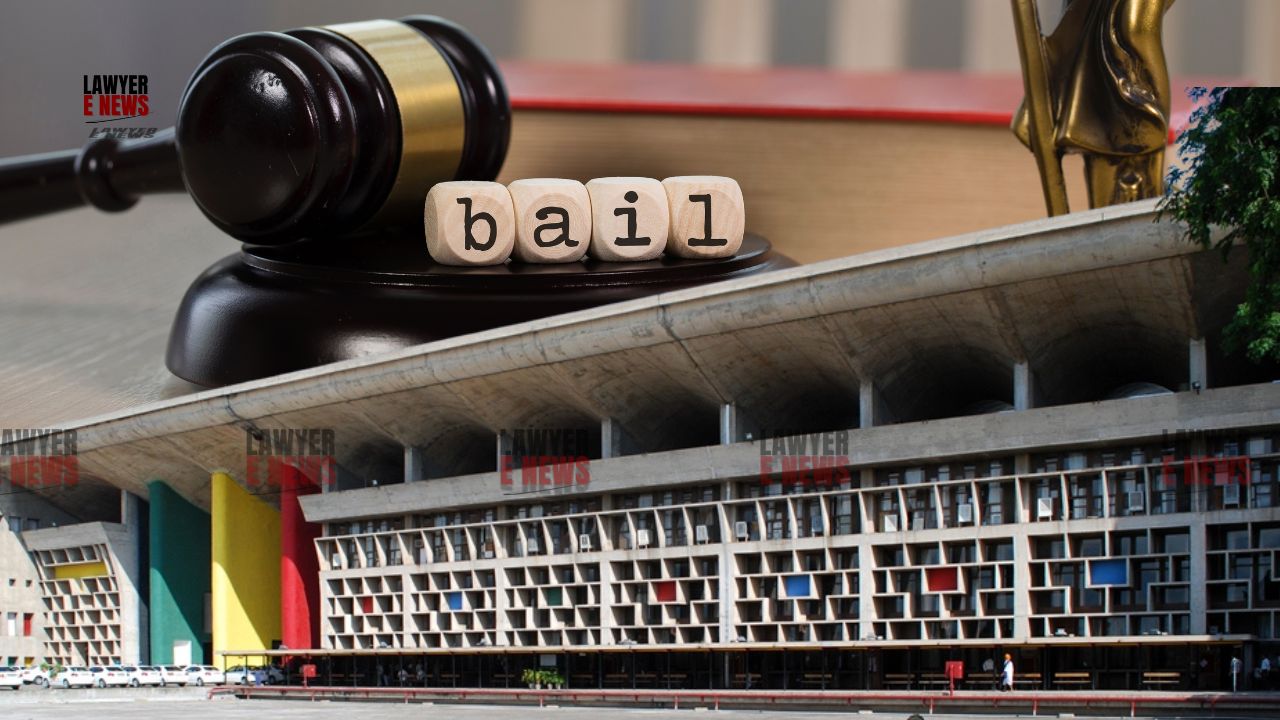
“Criminal Procedure Must Align with Article 21 — It Cannot Be Arbitrary,” In a significant ruling balancing personal liberty with procedural fairness, the Punjab and Haryana High Court on 1st July 2025 set aside the order cancelling bail and forfeiting surety bonds against a man who missed a court appearance due to mistakenly noting the wrong date.
While delivering the judgment in CRM-M-31534-2025 (O&M), Justice Harpreet Singh Brar strongly observed, “Many a times, the accused can be prevented by sufficient reasons to put an appearance before the Court on a given date and, therefore, it necessarily cannot be construed as a deliberate and wilful absence.”
The Court also reminded that the issuance of non-bailable warrants is a means to secure presence, not a punishment. The order dated 08.07.2024, passed by the Additional Sessions Judge, Rohtak, which cancelled the petitioner’s bail and issued non-bailable warrants, was consequently quashed.
“Criminal Procedure Cannot Be Unjust or Arbitrary — It Must Uphold Article 21”: Court Emphasizes Right to Personal Liberty
The petitioner, Hari Om, had been granted regular bail in connection with an FIR registered under Sections 401, 398 of IPC and Section 25 of the Arms Act, 1959 at Police Station City Lakhan Majra, District Rohtak. His bail was abruptly cancelled after he failed to appear in court on 08.07.2024—a date he reportedly noted incorrectly.
The High Court, taking serious note of this, held, “While the scheme of criminal justice necessitates curtailment of personal liberty to some extent, it is of utmost importance that the same is done in line with the procedure established by law to maintain a healthy balance between personal liberty of the accused and the interest of society in promoting law and order.”
Justice Brar further emphasized, “Such procedure must be compatible with Article 21 of the Constitution i.e., it must be fair, just and not suffer from the vice of arbitrariness or unreasonableness.”
“Presence, Not Punishment, Is the Purpose of Non-Bailable Warrants”: Court Restores Bail With Costs
Advocate Mr. Ravi Kumar Girdhwal, appearing for the petitioner, argued that his client's absence was entirely inadvertent and unintentional. The Court accepted this explanation and noted that there was no allegation of the petitioner attempting to abscond or evade proceedings.
The Court reasoned,
“The sole purpose of issuance of non-bailable warrants is to secure presence of the accused before the learned trial Court. The petitioner in the present case has himself come forward and has undertaken to appear before the learned trial Court on each and every date.”
Accordingly, the Court ordered that the bail cancellation order, forfeiture of bonds, and issuance of non-bailable warrants stand set aside.
Conditional Restoration: Court Imposes Rs.10,000 Cost for Wasting Judicial Time
While showing leniency, the Court did not let the lapse go entirely without consequence. It directed that:
“The petitioner shall be admitted to bail on furnishing bail bonds and surety bonds to the satisfaction of the learned trial Court, along with costs of Rs.10,000/- to be deposited with PGIMER Poor Patient Welfare Fund, Chandigarh, for wasting precious time of the Court.”
Additionally, the Court ordered that the receipt of the payment of the costs must be presented before the Trial Court, failing which the bail would not be granted.
The judgment further stipulated: “In case, the petitioner fails to surrender before the learned trial Court within the stipulated time period, the interim protection granted by this Court shall be deemed to be vacated.”
This judgment serves as an important reiteration of a long-standing principle in criminal jurisprudence — liberty is not to be curtailed mechanically or punitively merely for a lapse of presence unless deliberate non-cooperation is established.
Date of Decision: 01.07.2025