-
by sayum
24 August 2026 3:22 PM







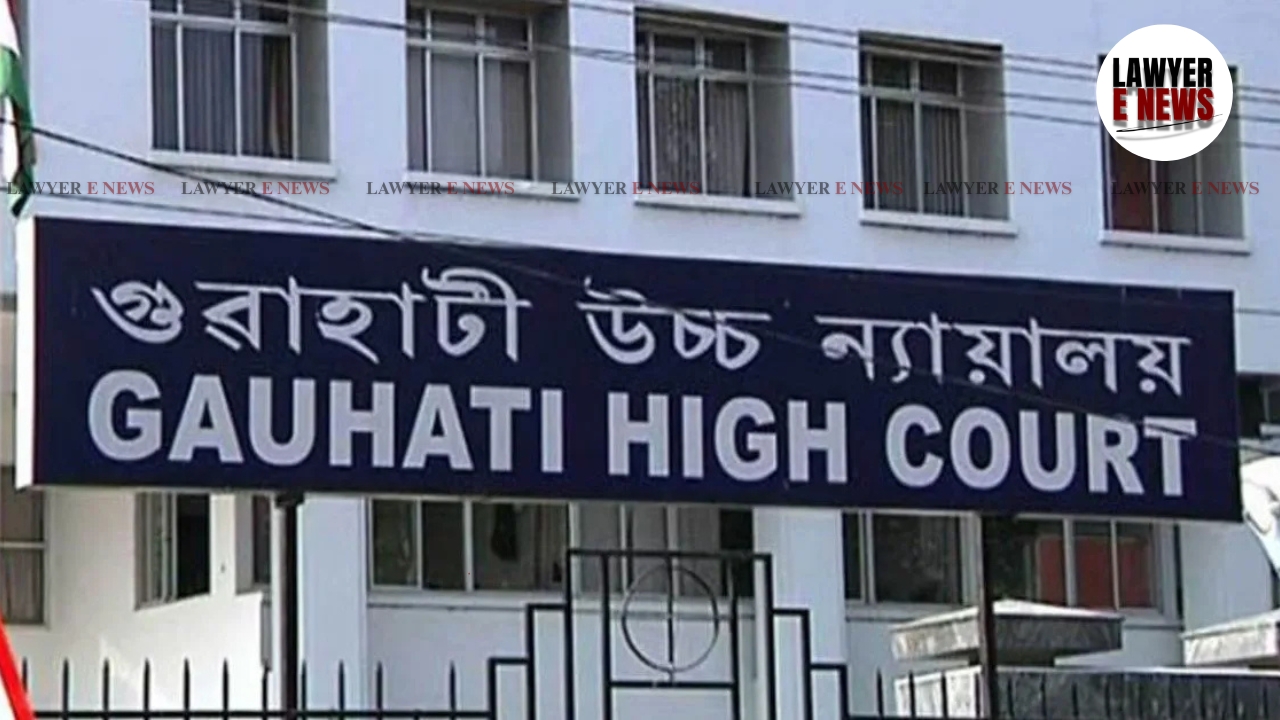
“An affidavit is no substitute for lawful divorce under personal law” — In a pivotal ruling Gauhati High Court set aside a maintenance order passed by the Family Court, Barpeta, on the ground that the respondent, who claimed to be the petitioner’s wife, had failed to prove the lawful dissolution of her previous marriage. Justice Pranjal Das held that “a marriage cannot be dissolved by way of an affidavit made before a Notary”, and that failure to prove a valid divorce from her first husband rendered the respondent ineligible to claim maintenance from the petitioner under Section 125 of the CrPC.
This decision reaffirms that while proceedings under Section 125 CrPC (now Section 144 of the Bharatiya Nagarik Suraksha Sanhita, 2023) are summary in nature and do not require strict proof of marriage, the burden to establish the end of a prior valid marriage falls squarely on the claimant when such previous marriage is admitted.
Maintenance Sought as “Second Wife” While Prior Marriage Undissolved
The case arose from a criminal revision filed by Tufazzul Hussain, challenging the order dated March 17, 2025, passed by the Principal Judge, Family Court, Barpeta, in F.C. (Crl.) Case No. 356/2020. The Family Court had directed him to pay ₹3,000 per month as maintenance to Fulmala Khatun, who claimed to be his lawfully wedded wife.
In her application under Section 125 CrPC, Fulmala Khatun contended that she had been married to the petitioner under Islamic law and was later abandoned and subjected to cruelty by him and his first wife. She claimed she was unable to maintain herself and thus entitled to maintenance. The petitioner denied any marital relationship, stating that Fulmala was an advocate’s clerk whom he knew professionally but never married. He also raised a serious legal objection — that Fulmala was already married to one Manik Ali, with whom she had three children, and had not proved any lawful dissolution of that earlier marriage.
Can an Affidavit Dissolve a Marriage Under Muslim Law?
At the heart of the case was the respondent’s admitted previous marriage. In her deposition, Fulmala Khatun herself acknowledged that she married Manik Ali in 2000 and had three children from that marriage. She asserted that she had “divorced” Manik Ali in 2017 by executing an affidavit and submitted only a photocopy of the same in court proceedings.
The High Court strongly rejected the sufficiency of such a process, stating:
“Needless to say that a marriage cannot be dissolved by way of an affidavit made before the Notary. There is also no material to indicate that the respondent invoked the provisions of the Dissolution of Muslim Marriages Act, 1939.” [Para 25]
Justice Pranjal Das further observed that the document was not even exhibited properly during the Family Court proceedings and noted:
“Reference to the affidavit in her cross-examination and about submitting a copy of the affidavit in the maintenance proceeding would not constitute sufficient proof of dissolution of her earlier marriage.” [Para 27]
Status of ‘Wife’ Not Established, Maintenance Unsustainable
The Court highlighted the settled legal position that strict proof of marriage is not necessary in proceedings under Section 125 CrPC, as held in Dwarika Prasad Satpathy v. Bidyut Prava Dixit (1999) and Rohtash Singh v. Ramendri (2000). However, those principles apply when the claim of marriage is not vitiated by a pre-existing, undissolved marriage.
In the present case, Fulmala Khatun had not only admitted her earlier marriage but had failed to produce any legally recognized proof of its dissolution. The Court concluded:
“Without rendering reasonable proof about dissolution of her earlier marriage, the woman will not be able to seek maintenance as a wife of the person from whom she is seeking maintenance.” [Para 18]
As a result, Justice Das found that the Family Court had erred in presuming her to be the wife of the petitioner, and ruled:
“She could not have claimed maintenance from the petitioner as his legally wedded wife and therefore, she cannot be granted maintenance from the side of the petitioner.” [Para 30]
Impact and Interpretation: A Caution Against Informal Divorce Declarations
This judgment serves as a significant reminder that under personal law, especially for Muslims, marriage and divorce must follow a recognized legal process. The Dissolution of Muslim Marriages Act, 1939 provides a statutory framework for Muslim women to seek dissolution through courts. An affidavit — even if notarized — does not substitute this process, and parties cannot bypass legal mechanisms to alter marital status.
By invalidating the Family Court's maintenance order, the Gauhati High Court has reinforced a key evidentiary requirement: when a claimant admits to a previous marriage, the burden is on them to prove that it was lawfully terminated before claiming spousal rights from another.
The Gauhati High Court’s judgment in Tufazzul Hussain v. Fulmala Khatun stands as a careful balancing of procedural fairness and legal substance in matrimonial claims under Section 125 CrPC. While upholding the social welfare objective of maintenance laws, the Court drew a clear line that such protection cannot extend to individuals who fail to establish the legal basis of their claimed spousal relationship.
The decision also implicitly cautions subordinate courts to be vigilant in assessing marital status where previous marriages are admitted, ensuring that substantive law is not overridden by unverified claims or informal practices.
Date of Decision: January 20, 2026