
-
by sayum
28 August 2026 2:11 PM







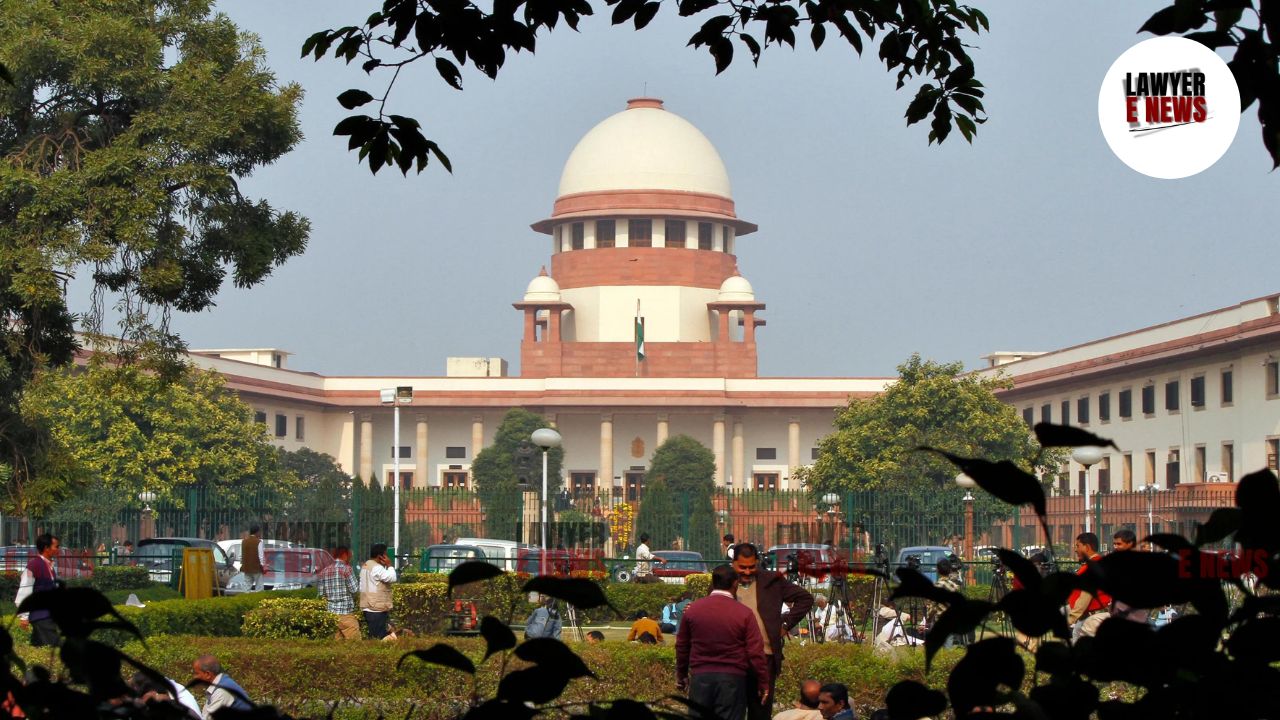
“When One Duty Bearer Speaks, Time Starts Ticking for All” – In a significant ruling that tightens the timeline for environmental litigation, the Supreme Court of India dismissed an appeal, holding that the period of limitation for such appeals begins from the earliest date on which any one of the responsible authorities communicates the EC, not when the party claims personal knowledge of it.
Delivering the judgment in Talli Gram Panchayat v. Union of India & Ors., Civil Appeal No. 731 of 2023, a Bench of Justice Pamidighantam Sri Narasimha and Justice Atul S. Chandurkar affirmed the decision of the National Green Tribunal (NGT), which had dismissed the Panchayat’s appeal as time-barred. The Court held that once the EC was uploaded on the Ministry of Environment, Forest and Climate Change (MoEF&CC) website on 05.01.2017, that constituted a valid and complete communication, triggering the 30-day limitation under Section 16(h) of the National Green Tribunal Act, 2010.
“Limitation will commence from the earliest of the date on which the communication is carried out by any of the duty bearers.” — observed the Court while rejecting the Panchayat’s attempt to rely on a later RTI response to revive its time-barred appeal.
“Communication Is in Rem, Not in Personam” — Supreme Court Declares Environmental Orders Are Public Law Instruments
At the heart of the judgment lies a crucial principle: environmental decisions are not private litigations, but concern the public at large. Hence, their communication does not require personal service but must be understood in the context of public accessibility.
“Environmental issues are not always adversarial, rather they operate as public law concerns. The expression ‘any person aggrieved’ must receive a liberal construction as communication under Section 16(h) is intended to be in rem and not in personam,” declared the Bench, firmly placing ECs in the category of public law instruments.
Thus, when the MoEF&CC uploaded the EC on its official website on 5 January 2017, that act itself constituted communication to all stakeholders. The Panchayat’s claim that it only came to know of the clearance via RTI on 14 February 2017 was categorically rejected by the Court as a pretext to bring the appeal within limitation.
“First Communication Is Enough—You Can’t Wait for the Last Bell to Ring”
The Court invoked the principle of first accrual, holding that when multiple duty bearers such as the Ministry, the Project Proponent, Pollution Control Boards, and Local Authorities are required to communicate the grant of EC, the limitation period starts with the earliest effective communication.
“It is the first accrual that would trigger the period of limitation prescribed under Section 16(h) of the Act,” ruled the Court.
Citing Khatri Hotels v. Union of India and landmark NGT decisions like Save Mon Region Federation v. Union of India and Medha Patkar v. Ministry of Environment, the Court reinforced that once one legally bound authority effectively communicates the EC, the 30-day limitation clock starts ticking.
“The limitation shall start running and shall be computed from the date when complete communication is carried out by any of the stakeholders. Successive communications by others do not reset the clock,” emphasized the Court.
“You Don’t Need to Print the Whole Book in the Newspaper”—Court Rejects Demand for Full EC in Ads
The Panchayat argued that the project proponent failed to publish the full text of the EC in newspapers, and therefore the obligation to communicate was not properly discharged. But the Court firmly dismissed this argument as hyper-technical.
“Interpreting Clause 10 to require publication of the entirety of the EC in newspapers would be pedantic,” the Court held, clarifying that it is sufficient if the factum of the grant, substance of the conditions, and where to access the full EC are provided.
The Court quoted its approval of the NGT’s earlier interpretation in V. Sundar Proprietor v. Union of India, stating:
“The size of the advertisement is immaterial but what it conveys is material… There were clear notices to the public at large… complete and comprehensive information was available on the website.”
“Law Can’t Wait for You to Open Your Eyes—It Starts When the Record Is Public”
The factual matrix left little room for doubt. The MoEF&CC’s own digital records showed that the EC was uploaded on 05.01.2017, and that it remained accessible and downloadable. The project proponent had also published newspaper advertisements on 11.01.2017, and submitted the EC to local panchayat authorities on 09.01.2017.
Still, the Panchayat waited until 19.04.2017 to file its appeal—well beyond the statutory 30-day period and the maximum permissible extension of 60 days.
“The Tribunal found that the EC was placed in public domain and was accessible. The RTI-based knowledge claimed by the appellant was just a ruse,” noted the Supreme Court.
The Court also cautioned that if every party were allowed to calculate limitation based on the last communication received by any authority, "it would frustrate the very object of the Act and cause serious prejudice to all concerned."
“Limitation would never begin to run… and the project proponent would be exposed to uncertainty and unnecessary litigation even after years had lapsed,” the Bench warned.
"You Can't Sleep on Public Information and Wake Up in Court" — Apex Court Dismisses Appeal
The Supreme Court concluded that the appeal was clearly barred by limitation, as it was filed beyond the maximum 90-day window contemplated under the Act.
“Once the period of limitation starts running, then it does not stop... such an approach would be opposed to the basic principle of limitation,” the Court said in no uncertain terms.
Accordingly, the Civil Appeal was dismissed, and the judgment of the NGT was affirmed in full.
Date of Decision: 19 November 2025





