-
by kapil
15 October 2026 12:52 PM







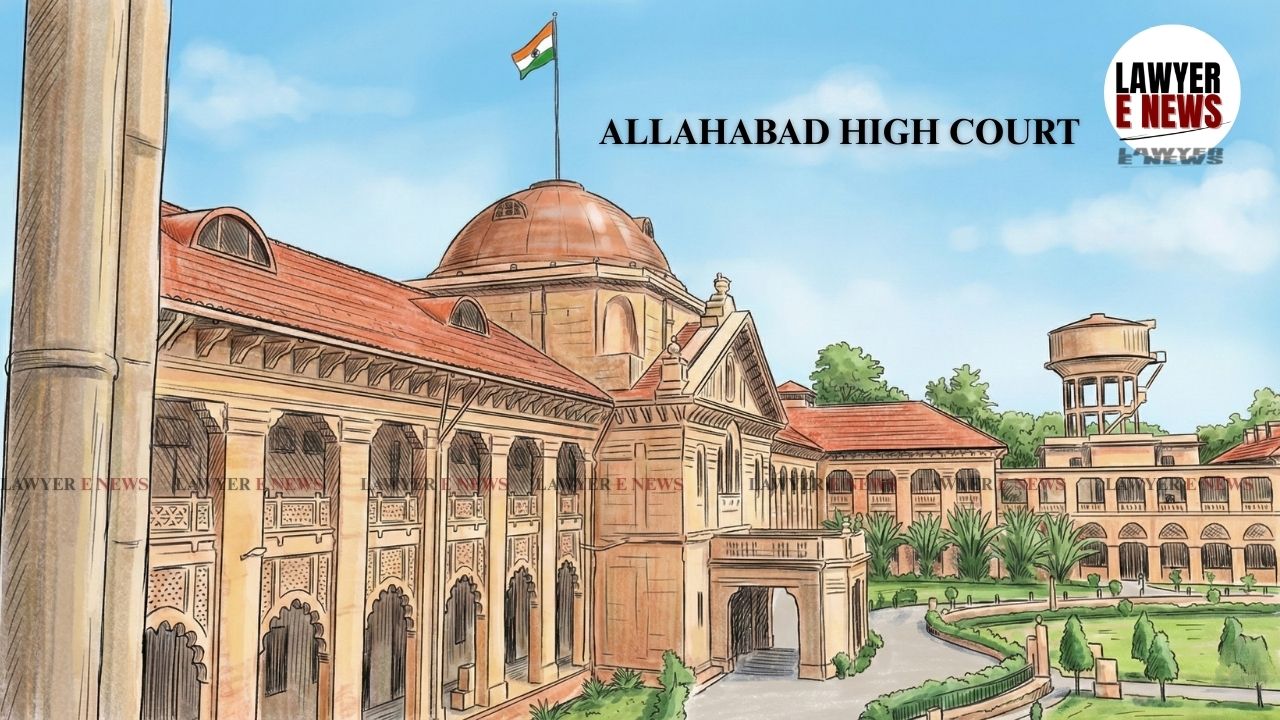
"The procedure undertaken by Labour Court concerned, being contrary and in the teeth of judgments passed by Supreme Court, cannot be sustainable." Allahabad High Court, in a significant judgment dated July 15, 2026, has held that a Labour Court cannot simultaneously decide the fairness of a domestic inquiry and the merits of a termination without first giving the employer an opportunity to lead fresh evidence.
A bench of Hon’ble Saurabh Shyam Shamshery, J., observed that once a domestic inquiry is found to be unfair or improper, the employer has a procedural right to justify the dismissal by adducing evidence before the court.
The petitioner, M/s Shahi Export House (now Shahi Export Pvt. Ltd.), terminated the services of a workman (Respondent-2) in 2001 following a domestic inquiry into alleged misconduct. The workman raised an industrial dispute before the Labour Court, Noida. The Labour Court framed an additional issue regarding the fairness of the domestic inquiry. However, instead of deciding this as a preliminary point, it recorded evidence from the employer and eventually held that the inquiry was unfair and the charges were unproven, setting aside the termination in a single consolidated order.
The primary question before the court was whether the Labour Court is legally mandated to decide the fairness of a domestic inquiry as a preliminary issue. The court was also called upon to determine if the failure to grant an employer the opportunity to lead fresh evidence after an inquiry is held unfair constitutes a procedural illegality that vitiates the award.
Procedural Mandate In Industrial Disputes
The court emphasized that the legal position regarding domestic inquiries is well-settled through various Supreme Court precedents. It noted that if an industrial dispute is raised against an order passed on the basis of a domestic inquiry, the Labour Court must first decide whether the inquiry was fair and proper. This procedural step is critical because it determines the subsequent course of the adjudication.
If the inquiry is found to be fair, the Labour Court’s jurisdiction is limited to reviewing the punishment. However, if the inquiry is found to be defective, the employer must be granted a specific opportunity to prove the charges on merit before the court. The bench reiterated that this sequence of adjudication is a settled principle of industrial law.
"The Labour Court at first instance will decide an issue, whether domestic inquiry was fair or not. In case answer remain in negative, the Employer shall be granted an opportunity to present evidence to prove the charge."
The Firestone Tyre Principle Reiterated
Relying heavily on the landmark judgment in Workmen of M/s Firestone Tyre & Rubber Co. of India (P) Ltd. vs. Firestone Tyre & Rubber Company (1973), the court noted that the right to take disciplinary action is a managerial function. The court observed that even if no inquiry was held or if the inquiry was found to be defective, the Tribunal is bound to give the employer and employee an opportunity to adduce evidence.
The bench highlighted that the Tribunal derives jurisdiction to deal with the merits of the dispute only after it holds that the inquiry proceedings were not properly conducted. By deciding both the fairness of the inquiry and the merits of the termination simultaneously, the Labour Court effectively bypassed this mandatory jurisdictional stage.
"A defective enquiry in our opinion stands on the same footing as no enquiry and in either case the tribunal would have jurisdiction to go into the facts and the employer would have to satisfy the tribunal that on facts the order of dismissal or discharge was proper."
Distinguishing Conflicting Coordinate Bench Rulings
The respondent-workman had placed reliance on a previous decision by a Coordinate Bench of the High Court in a similar case involving the same petitioner. However, Justice Shamshery noted that the previous bench had not considered the specific procedural requirements and the catena of Supreme Court judgments on the employer's right to lead evidence.
The court observed that the earlier ruling focused on the legal consequences of an ex-parte inquiry rather than the procedural steps prescribed for the Labour Court. Consequently, the Court held that it was bound to follow the Supreme Court's directives over the Coordinate Bench's limited view, ensuring that the process remains consistent with the principles of natural justice for both parties.
"This Bench can still follow the judgment passed in M/s Dwarikesh Sugar Industries Ltd. wherein several judgments passed by Supreme Court on the issue was considered... which has prescribed specifically the process to be adopted by Labour Court."
Remedy For Procedural Illegality
The Court concluded that the Labour Court’s approach of deciding the "additional issue" and the final merits together was a clear "procedural illegality." While the Court did not interfere with the finding that the domestic inquiry was unfair, it held that the denial of an opportunity to the employer to lead fresh evidence was unsustainable.
The bench clarified that under Section 11-A of the Industrial Disputes Act, the Tribunal has the power to satisfy itself on the evidence adduced before it. However, this power must be exercised within the framework of a fair hearing, which includes the employer’s right to justify their action after the initial inquiry report is discarded.
The High Court partly allowed the writ petition, setting aside the Labour Court's award dated January 7, 2026, to the extent that it denied the employer the chance to prove the charges. The matter has been remitted back to the Labour Court, Noida, with a direction to allow the employer to produce fresh evidence and provide the workman an opportunity for cross-examination. The court ordered that the proceedings be concluded within three months.
Date of Decision: July 15, 2026