
-
by sayum
28 August 2026 2:11 PM







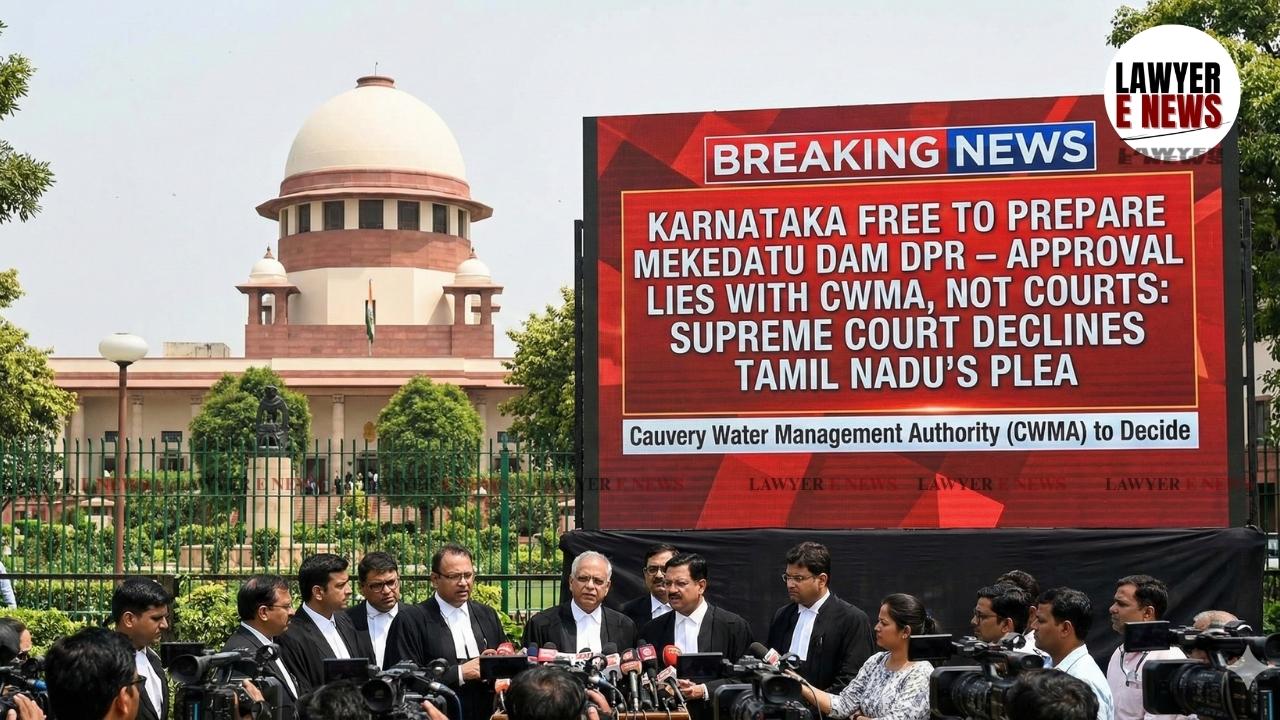
“This Court does not possess the expertise in the said matter… Courts must refrain from interfering in technical issues best left to expert bodies” — In a ruling of critical importance for inter-State water governance, the Supreme Court of India declined to restrain the State of Karnataka from preparing a Detailed Project Report (DPR) for its Mekedatu Balancing Reservoir cum Drinking Water Project, firmly holding that preparation of a DPR, by itself, does not amount to a violation of the final Cauvery Water Disputes Tribunal Award, as modified by its earlier judgment in (2018) 4 SCC 1.
Delivering judgment in Miscellaneous Application No. 3127 of 2018 in Civil Appeal No. 2453 of 2007, a Bench comprising Chief Justice B.R. Gavai, Justice K. Vinod Chandran, and Justice Vipul M. Pancholi dismissed multiple connected applications filed by the State of Tamil Nadu seeking to stop Karnataka from proceeding with the Mekedatu project.
“Preparation of DPR Does Not Mean Execution; No Interference Warranted Until Expert Bodies Decide”
Rejecting Tamil Nadu’s contention that Karnataka’s DPR preparation infringes its right to “uncontrolled flow of water”, the Court noted that permission granted by the Central Water Commission (CWC) on 22nd November 2018 was strictly limited to preparation of the DPR, not for construction or execution.
“We find that the present application has been filed at a premature stage as the final decision by the CWC with respect to the Mekedatu Dam would be taken only after consideration of the DPR as well as the opinions of CWMA and CWRC,” the Court clarified.
It further observed that Karnataka’s right to utilize its allocated share of water is constitutionally protected, provided it does not impinge on the quota reserved for Tamil Nadu.
“CWMA Is the Competent Authority to Examine Grievances; Courts Must Defer to Expert Bodies”
Relying heavily on the doctrine of judicial deference to technical expert bodies, the Court reminded both States that disputes over technical matters such as release schedules, water flow measurement, or environmental treatment standards must be left to bodies like the Cauvery Water Management Authority (CWMA) and Cauvery Water Regulation Committee (CWRC).
Citing its own orders from 25th August 2023 and 21st September 2023, the Court stated:
“This Court time and again has observed that the courts should refrain from entering into the areas which can be best looked after by the experts in that field.”
Consequently, the Bench declined to entertain Tamil Nadu’s prayers to stay the CWC's letter or restrain Karnataka from moving forward with the DPR.
Tamil Nadu's Fear of Water Diversion Is Premature: DPR Subject to CWMA Approval
Tamil Nadu had alleged that Karnataka’s intent behind the Mekedatu project was to construct a dam that would unlawfully regulate or reduce water flow to the lower riparian State, violating the principle of “uncontrolled flow” guaranteed by the CWDT Award.
But the Court held:
“What Karnataka is doing is only preparing a DPR… The CWC letter itself mandates that the prior approval of the CWMA would be a prerequisite for consideration of the DPR.”
This meant that Tamil Nadu’s objections must be routed through CWMA and addressed during the expert scrutiny phase — not preemptively before the DPR is even reviewed.
“Karnataka Is Bound to Comply with CWMA’s Directives – Or Face Contempt”
Addressing the concerns of non-compliance with water release orders, the Court sternly reminded Karnataka that:
“If the State of Karnataka fails in complying with the directions issued by this Court, then it faces the risk of committing the Contempt of this Court.”
However, since no willful disobedience had been proven at this stage, the pending contempt petition (Contempt Petition (Civil) No. 2210/2018) was also disposed of.
No Blanket Ban on Intra-State Infrastructure for Using Allocated Share
In a clear assertion of cooperative federalism, the Court reemphasized that every State has the right to manage its own water usage, provided it stays within its allocated share.
“No other State has a right to interfere with the decision regarding the management and use of water allotted to a particular State unless by such act the water allotted to that State is reduced,” the Court noted.
Karnataka, therefore, is free to construct infrastructure like Mekedatu, if it is for the purpose of better managing its allocated share — subject to final approval by CWMA.
Environmental Concerns Must Be Raised Before CWC/CWMA – Not Through PILs
Tamil Nadu had also filed Miscellaneous Application No. 1869/2023, alleging that treated water from Bengaluru’s domestic use was being diverted to the Pennaiyar basin, in violation of the CWDT Award.
Tamil Nadu sought directions that:
The Court declined to entertain this application directly, stating:
“The applicant/State is always at liberty to approach the CWC, CWMA or CWRC. If approached, these authorities would take a decision in accordance with law as expeditiously as possible.”
Thus, environmental and basin diversion issues are also to be addressed through technical mechanisms, not judicial fiat.
Writ Petition and Other Connected Applications Also Dismissed
A Public Interest Litigation (W.P.(C) No. 914/2023), seeking general directions for enforcement of the CWDT Award, was also dismissed, with the Court noting that:
“No orders are necessary… CWMA and CWRC are competent statutory bodies for implementation of the judgment.”
Likewise, Miscellaneous Applications No. 93 of 2022 and 1020 of 2024, which raised related procedural and compliance questions, were also disposed of in light of the present judgment.
Key Takeaways from the Supreme Court's Ruling
With this judgment, the Supreme Court has reemphasized its 2018 precedent — that water sharing under the Cauvery Award must now be managed institutionally rather than through litigation. The creation of CWMA and CWRC was not symbolic but intended to shift dispute resolution from courtrooms to expert panels.
As of now, Karnataka may proceed with preparation of the DPR for the Mekedatu project, but cannot commence execution without CWMA’s approval. Tamil Nadu retains its full right to raise objections — but only in the designated fora, not through speculative judicial intervention.
Date of Decision: 13th November 2025





