-
by sayum
19 August 2026 10:42 AM







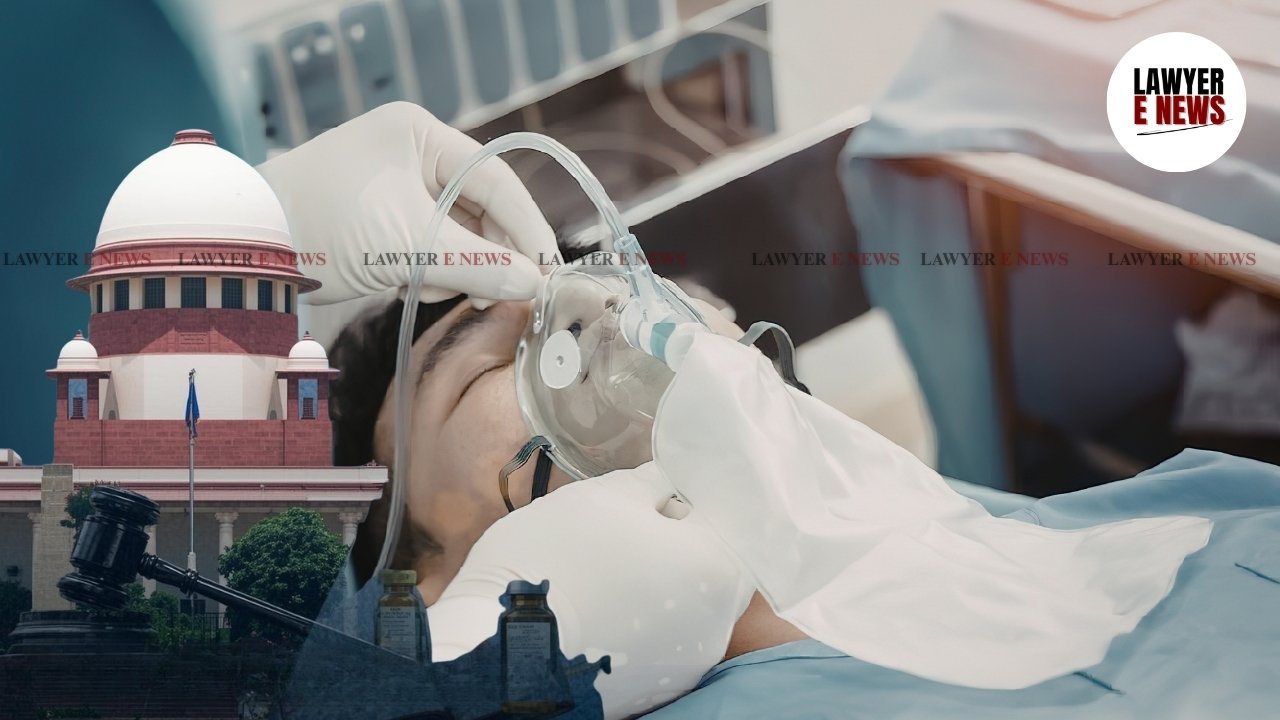
“Indefinite continuation of futile physical life is regarded as undignified”, In a significant constitutional ruling clarifying the legal framework governing end-of-life decisions, the Supreme Court of India has held that Clinically Assisted Nutrition and Hydration (CANH) constitutes “medical treatment” and may lawfully be withdrawn where continuation of such treatment does not serve the patient’s best interests.
The judgment has been delivered on March 11, 2026 by a Bench of Justice J.B. Pardiwala and Justice K.V. Viswanathan in Harish Rana v. Union of India & Ors. (2026 INSC 222). The Court reiterated that the right to live with dignity under Article 21 of the Constitution also includes the right to die with dignity and streamlined the procedural safeguards governing withdrawal or withholding of life-sustaining treatment.
Delivering a detailed 286-page judgment, the Court observed that indefinite continuation of medically futile treatment undermines human dignity and that the law must provide a practical framework enabling doctors and families to make ethically responsible end-of-life decisions without fear of legal consequences.
Background of the Case
The case arose from the tragic circumstances of Harish Rana, a 32-year-old man who had remained in a Persistent Vegetative State (PVS) for more than thirteen years following a traumatic brain injury. Multiple medical boards had consistently confirmed that his neurological condition was irreversible and that there was no realistic possibility of recovery.
Despite the medical consensus, the existing procedural framework evolved through earlier judgments—particularly the guidelines issued in Common Cause v. Union of India (2018)—created uncertainty in practice. Hospitals and medical practitioners often hesitated to initiate withdrawal of life-sustaining treatment due to apprehensions of criminal liability and procedural complications.
The patient’s family approached the Supreme Court seeking permission to withdraw life-support measures, arguing that the prolonged continuation of treatment had no therapeutic benefit and merely prolonged biological existence without dignity.
Legal Issues Before The Court
The Supreme Court examined several critical constitutional and medical-legal questions:
Whether the withdrawal of Clinically Assisted Nutrition and Hydration (CANH) amounts to permissible withdrawal of medical treatment.
How the “best interest” principle should be applied for patients who lack decision-making capacity.
Whether the procedural safeguards laid down in earlier judgments required simplification to avoid delays.
How doctors can be protected from criminal liability when discontinuing medically futile treatment.
The Court noted that the legal discourse around euthanasia often suffers from conceptual confusion and that clarity in terminology is essential to ensure lawful medical decision-making.
Court’s Observations On Passive Euthanasia And Medical Treatment
The Bench clarified that the expression “passive euthanasia” is conceptually imprecise and instead adopted the formulation “withdrawing or withholding of medical treatment.”
The Court observed that the legality of a doctor’s action frequently depends on whether a particular intervention is classified as medical treatment or merely basic care. In this context, the Court ruled that Clinically Assisted Nutrition and Hydration administered through medical devices such as PEG tubes constitutes medical treatment rather than ordinary nourishment.
Rejecting the argument that artificial feeding is equivalent to routine care, the Court held that such interventions are technological medical procedures requiring professional evaluation.
The Bench observed that recognizing CANH as medical treatment ensures that physicians retain the professional discretion necessary to assess whether the intervention continues to provide therapeutic benefit.
Best Interest Principle And Substituted Judgment
The Court emphasized that decisions regarding withdrawal of treatment must be guided by the “best interest” principle.
However, the Court clarified that the inquiry is not whether it is in the best interests of the patient that the patient should die, but whether it is in the best interests of the patient that life should be prolonged through continuation of a particular medical intervention.
In determining this question, the Court directed that medical boards must also apply the “substituted judgment” standard, which requires reconstruction of what the patient would likely have chosen if competent.
Thus, factors such as the patient’s prior values, beliefs, expressed wishes, and personal autonomy must be considered while evaluating end-of-life decisions.
Streamlining The Procedural Framework
A major concern addressed by the Court was the delay in constituting medical boards required to examine cases involving withdrawal of treatment.
To address this problem, the Court directed that Chief Medical Officers (CMOs) across districts must maintain permanent panels of medical experts. These panels would facilitate the prompt constitution of Secondary Medical Boards whenever a request for withdrawal of life-sustaining treatment is made.
The Court stressed that judicial intervention should remain a minimal safeguard rather than a routine step in medical decision-making.
The Bench further clarified that families of patients receiving treatment at home may admit the patient to any hospital of their choice or approach a hospital to designate a treating physician who can initiate the evaluation process.
Protection Of Doctors From Criminal Liability
The Supreme Court acknowledged that doctors frequently hesitate to initiate withdrawal of futile treatment due to the “chilling effect” of potential criminal prosecution.
Addressing this concern, the Court held that an omission to continue treatment does not constitute an illegal omission under criminal law when the treatment in question is medically futile and detrimental to the dignity of the patient.
The judgment emphasized that once the medical and factual circumstances indicate that withdrawal of treatment may serve the patient’s best interests, the process must commence without unnecessary delay.
Court’s Disapproval Of “Discharge Against Medical Advice”
The Bench strongly criticized the practice of hospitals discharging terminal patients against medical advice merely to avoid legal complications.
The Court described this practice as an abdication of medical responsibility and directed that hospitals must instead transition such patients to structured palliative care and end-of-life (EOL) care plans.
The judgment emphasized that compassionate end-of-life care is a necessary component of the constitutional commitment to dignity.
Supreme Court Calls For Comprehensive Legislation
Recognizing the absence of a comprehensive statutory framework governing end-of-life decisions in India, the Supreme Court urged the Union Government to enact appropriate legislation.
The Court clarified that judicial guidelines in this field have always been intended as temporary constitutional safeguards until Parliament formulates a comprehensive law.
Allowing the application in the present case, the Supreme Court waived the thirty-day reconsideration period prescribed under earlier guidelines in view of the unanimous consent of the patient’s parents and the medical boards.
The Court permitted withdrawal of Harish Rana’s treatment so that he may “leave with dignity,” marking a significant development in India’s constitutional jurisprudence on the right to die with dignity and the legal regulation of end-of-life medical decisions.
Date of Decision: 11 March 2026