-
by sayum
19 August 2026 10:42 AM







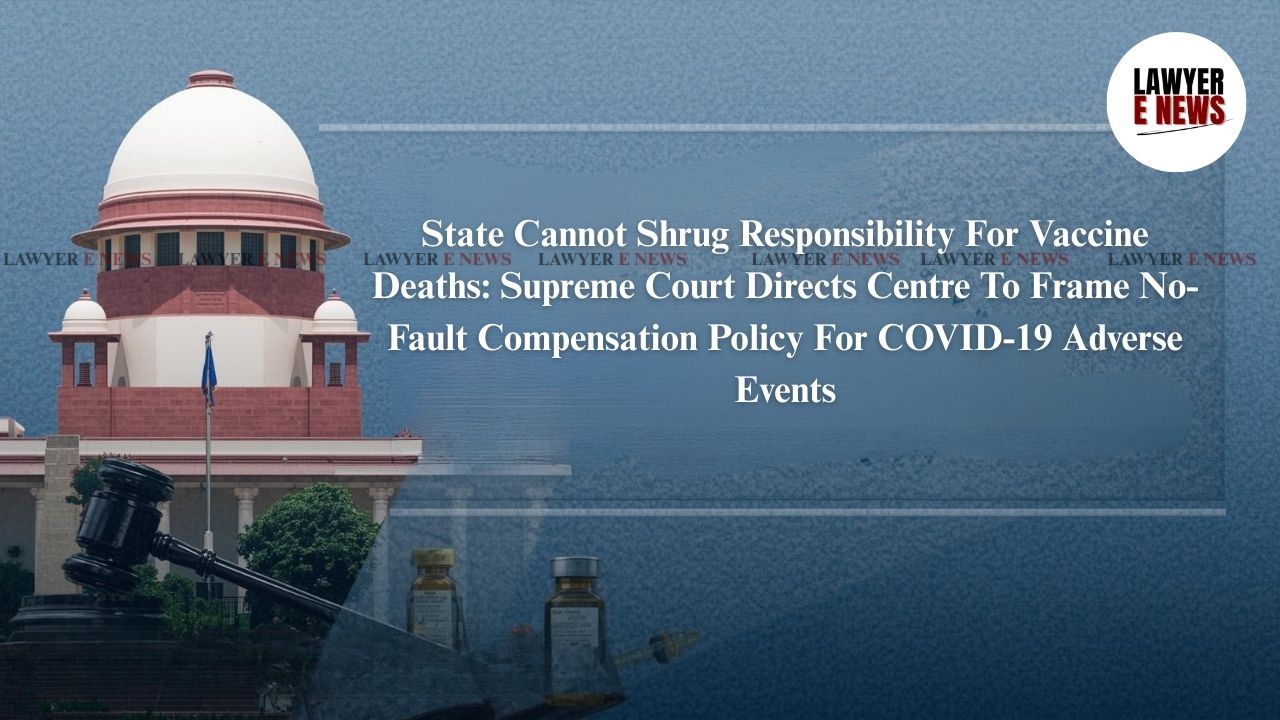
"State cannot be heard to say that those who experience serious adverse consequences must fend for themselves, without any clear or accessible avenue of relief", In a landmark ruling touching the intersection of public health, constitutional rights, and State accountability, the Supreme Court of India on March 10, 2026, directed the Union of India to expeditiously frame a no-fault compensation framework for serious adverse events following COVID-19 vaccination.
A bench of Justices Vikram Nath and Sandeep Mehta, in a judgment authored by Justice Vikram Nath, held that the State's obligation under Article 21 of the Constitution does not end at vaccine surveillance alone but must extend to providing fair and accessible redress to families who suffered grave harm during the course of a State-led mass immunisation programme.
Background of the Case
The proceedings arose from multiple petitions filed by families who lost their loved ones or suffered serious injuries following COVID-19 vaccination. The lead petition, Rachana Gangu v. Union of India (W.P.(C) No. 1220 of 2021), was filed before the Supreme Court under Article 32 by parents whose two daughters — aged 18 and 20 — died in June and July 2021 respectively, having been diagnosed with Cerebral Venous Sinus Thrombosis (CVST) and Multisystem Inflammatory Syndrome following their first doses. Several connected writ petitions pending before the Kerala High Court raised identical grievances, including deaths from intracranial bleeding, Thrombocytopenia, Thrombosis with Thrombocytopenia Syndrome (a known rare complication of Covishield), auto-immune encephalitis, and paralysis — all alleged to be adverse events following immunisation. The Kerala High Court had by an interim order directed the Ministry of Health and Family Welfare and the National Disaster Management Authority to formulate a policy for compensating such families. Aggrieved by this direction, the Union approached the Supreme Court, and all connected matters were transferred and heard together with the Article 32 petition as the lead case.
Legal Issues
The two central questions framed by the Court were: whether the absence of a uniform compensation policy for deaths and injuries following COVID-19 vaccination constitutes a violation of the right to life under Article 21 of the Constitution, and if so, whether the Court could direct the executive to frame such a policy.
Court's Observations and Judgment
The Court commenced by acknowledging the human dimension of the tragedy before it. "The COVID-19 pandemic was an unprecedented period of suffering and disruption, which brought grief and hardship to countless families across the country," it observed, adding that it approached the issues "with a deep sense of empathy for the human loss endured during the pandemic."
On the Right to Health Under Article 21
The Court reaffirmed the well-settled constitutional position that Article 21 is not limited to protection against unlawful deprivation of life but extends to the right to health and bodily integrity as a positive obligation of the State. Tracing the evolution of this jurisprudence from Parmanand Katara v. Union of India (1995) through State of Punjab v. Ram Lubhaya Bagga (1998), the Court reiterated that the State can neither urge nor say that it has no obligation to provide health facilities, as that would be "ex facie violative of Article 21."
Crucially, the Court clarified the precise scope of its inquiry: "We are neither adjudicating upon vaccine efficacy nor sitting in scientific review over the regulatory approval process." The Court expressly accepted the Union's submission — reinforced by its earlier ruling in Jacob Puliyel v. Union of India (2022) — that COVID-19 vaccines had undergone a rigorous multi-layered regulatory approval process involving CDSCO, NTAGI, and NEGVAC, and that emergency approvals were not granted in haste. Studies by ICMR and AIIMS had also conclusively established no direct linkage between the vaccines and sudden deaths. The question, the Court emphasised, was therefore not one of fault or illegality of the vaccination programme, but of the constitutional adequacy of the State's welfare response.
On the Inadequacy of Existing Civil Remedies
The Union argued that affected families could approach consumer fora or civil courts on the basis of negligence, and that unlike many other countries, vaccine manufacturers in India enjoy no legal immunity from such claims. The Court was unpersuaded. It held that fault-based civil remedies are "ill-suited as the only pathway of redress in the context of a mass immunization program." Vaccine injury claims involve complex questions of scientific attribution, and to insist on proof of negligence in each individual case "would impose an onerous burden upon affected families." Further, a multiplicity of individual proceedings risks inconsistent outcomes and unequal access to relief, "thereby undermining the guarantee of equality under Article 14."
"The Constitution does not conceive of the State as a distant spectator to human suffering, but as an active guardian of welfare and dignity"
On the Principle of No-Fault Compensation
The Court invoked the principle of no-fault liability — not alien to Indian law, as seen in Section 164 of the Motor Vehicles Act, 1988 — and surveyed no-fault vaccine compensation frameworks across Australia, the United Kingdom, Japan, and the WHO's COVAX initiative. It found that "Governments have acknowledged the need to address vaccine-related injuries through dedicated compensation mechanisms" as an expeditious and fair avenue of relief, obviating the need to relegate affected persons to "labyrinthine processes."
Turning to the constitutional dimension, the Court held that "where the State undertakes an intervention of this scale in discharging of its duty to protect public health, the right to health under Article 21 would automatically extend to a corresponding obligation of institutional support in cases of grave outcomes, no matter how rare they are." Articles 41 and 47 of the Directive Principles, the Court noted, further illuminate the State's vision as an active guardian of welfare. "The vaccination program undertaken during the pandemic was itself an expression of these constitutional commitments," the Court observed, but added that "it cannot be brushed aside that the same vaccines also led to loss of life. In such a situation, it is not appropriate that the State shrugs its responsibility in coming to aid to those affected families who have lost their near and dear ones."
On Independent Expert Board and AEFI Surveillance
The Court declined to constitute an independent expert body to investigate individual deaths, holding that the existing National and State AEFI Committees constitute an adequate mechanism. It observed that in the absence of any material showing these mechanisms are non-functional, it would not be appropriate for the Court to constitute a parallel body to undertake individual medical determinations. On AEFI surveillance, the Court reiterated the direction in Jacob Puliyel — that the Union must continue to ensure efficient monitoring and that relevant data is periodically placed in the public domain in a transparent and timely manner, including through an accessible virtual platform for reporting by individuals and private doctors.
Disposing of the writ petition and all connected matters, the Supreme Court issued four directions: first, the Union of India through the Ministry of Health and Family Welfare shall frame a no-fault compensation policy for serious adverse events following COVID-19 vaccination; second, existing AEFI monitoring mechanisms shall continue with periodic public disclosure of data; third, no separate court-appointed expert body is necessary; and fourth, the judgment shall not preclude any person from pursuing other available legal remedies, nor shall the no-fault framework be construed as an admission of liability or fault on the part of the Union or any authority.
Date of Decision: March 10, 2026