-
by sayum
25 August 2026 6:19 AM







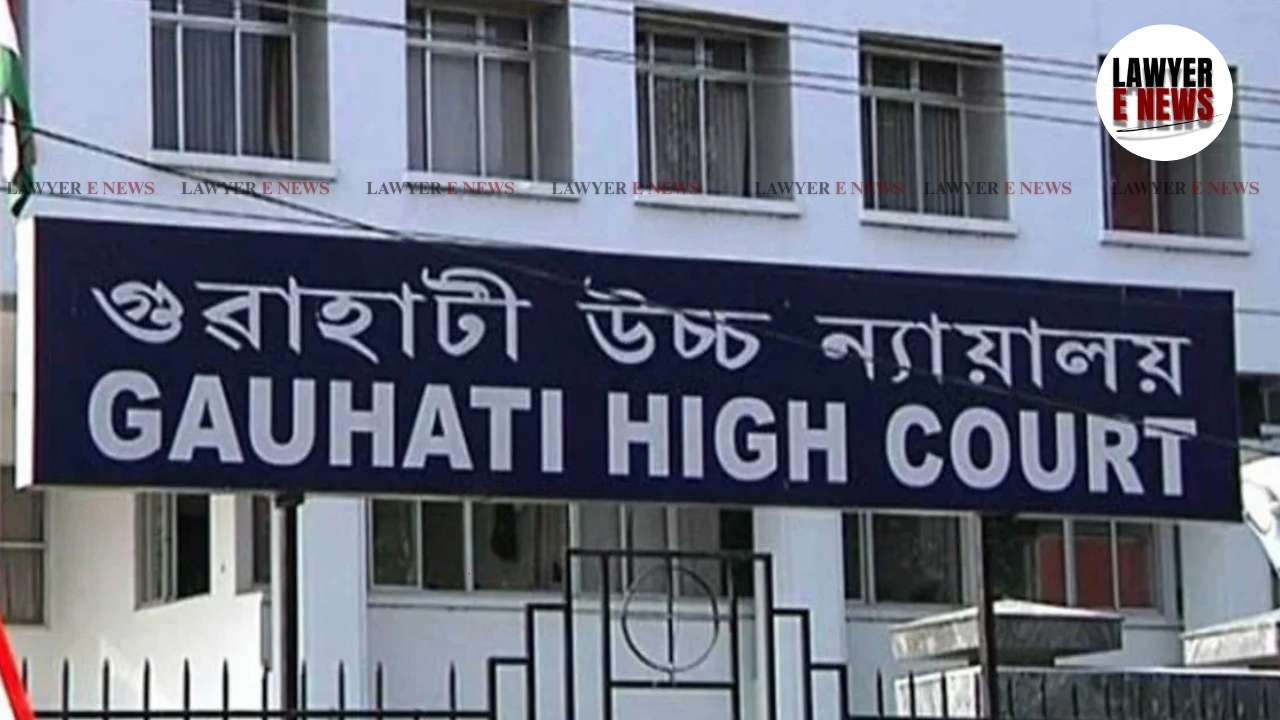
“The Court cannot sidestep a full trial when material propositions of fact and law are in controversy. An evasive written statement does not justify denying the defendants a chance to be heard through evidence.” — held the Gauhati High Court, while setting aside a decree for specific performance that was passed solely on the basis of alleged admissions in pleadings, without trial, issues, or evidence.
Justice Susmita Phukan Khaund allowed the appeal filed by Madhuri Goswami Sarma and others, setting aside the judgment and decree dated 06.03.2024 passed by the Civil Judge, Kamrup (M), in TS No. 690/2022, and remanding the matter back to trial.
The Court held that the Trial Court erred in invoking Order XII Rule 6 CPC (judgment on admission) and denying the parties their right to lead evidence, especially when factual disputes were evident on record and a compromise deed executed during the suit’s pendency had not been considered.
“An Evasive Written Statement Does Not Mean No Trial — It Requires Issues, Not Assumptions”
The High Court expressed strong disapproval of the Trial Court’s reliance on the “evasive and subtle” nature of the written statement to pass a decree without evidence. The Trial Court had held that the failure of the defendants to specifically deny key facts amounted to admission under Order VIII Rule 5 CPC, and hence, it was competent to pass a decree on admission under Order XII Rule 6.
However, the High Court rejected this reasoning, observing:
“The Trial Court abruptly truncated the proceedings without framing issues, even though the pleadings clearly disclosed contested facts... This is in direct violation of the mandate under Order XIV Rule 1, 2 & 3 CPC.”
Citing the Supreme Court’s decision in Balraj Taneja & Anr. v. Sunil Madan & Anr., AIR 1999 SC 3381, the High Court emphasized that “serious disputed questions of fact cannot be resolved merely on the basis of pleadings”. The apex court had categorically held that “a vague or evasive denial does not dispense with the necessity of a full-fledged trial.”
“Existence of a Compromise Deed Points to Disputed Facts — Plaintiff’s Claims Must Be Tested Through Evidence”
The appellants had argued that during the pendency of the suit, a deed of compromise dated 17.10.2023 was executed between the parties, under which the plaintiff agreed to receive ₹40 lakhs in full settlement, out of which ₹4 lakhs was paid at the time of execution, and the rest was to be paid within three months.
Though the plaintiff later withdrew from the settlement, citing financial pressure and coercion, the High Court held that this compromise deed was a critical material fact, and even if it could not be admitted under Order XLI Rule 27 CPC (for additional evidence at the appellate stage), its mere existence indicated disputed facts requiring a trial.
“The deed of compromise cannot be brushed aside merely because it was executed under pressure or was not formally brought on record. Its existence shows that the factual matrix was evolving and should have been tested through trial,” the Court observed.
“Limitation Is a Mixed Question of Law and Fact — Cannot Be Decided Without Evidence”
Another key contention raised by the defendants was that the suit was barred under Article 54 of the Limitation Act, 1963, as the agreement for sale was executed on 01.05.2013, and the suit was filed only on 18.11.2022 — well beyond the three-year limitation period for specific performance.
The plaintiff claimed that the cause of action arose only in 2022, when the defendant refused to execute the sale deed. But the High Court clarified that limitation is a mixed question of law and fact, and its determination requires evidence, not summary disposal.
“Whether the plaintiff’s cause of action was triggered in 2022 or earlier is not a question that can be settled at the admission stage. It demands factual findings through trial,” the Court ruled.
“Admissions Must Be Clear and Unequivocal — Not Constructed Through Legal Inference Alone”
The High Court acknowledged that while admissions were made by the defendant regarding the execution of the agreement and receipt of payments, the broader context — including the delay in obtaining NOC, the attempt to cancel the contract, and the execution of a second agreement with third parties — indicated that the suit could not have been disposed of without evidence.
“An admission must be unambiguous, unconditional, and complete — not something drawn from silence or presumed through inference,” the Court warned, citing the definitions of admission under Sections 17 and 18 of the Indian Evidence Act, 1872 and Sections 15 and 53 of the Bharatiya Saksha Adhiniyam, 2023.
“The Entire Decree Rests on a Faulty Foundation — Matter Must Go to Trial”
Summing up, the Court held:
“The impugned judgment and decree is based solely on pleadings and alleged admissions, without a proper adjudication of issues or recording of evidence. Such a decree is legally untenable and contrary to settled principles of civil procedure.”
Accordingly, the Court allowed the appeal, set aside the decree of specific performance, and directed the Trial Court to frame issues and proceed with the trial on merits, affording both parties the opportunity to lead evidence.
Trial Court Overstepped; Suit Must Proceed on Merits
This ruling is a firm reminder that civil suits, especially those involving specific performance, cannot be disposed of summarily when serious factual controversies exist. Procedural rules such as Order XIV CPC (framing of issues) and Order X CPC (admissions and denials) are not empty formalities — they are essential to ensuring fair adjudication.
Date of Decision: 11 November 2025