-
by sayum
26 August 2026 8:37 AM







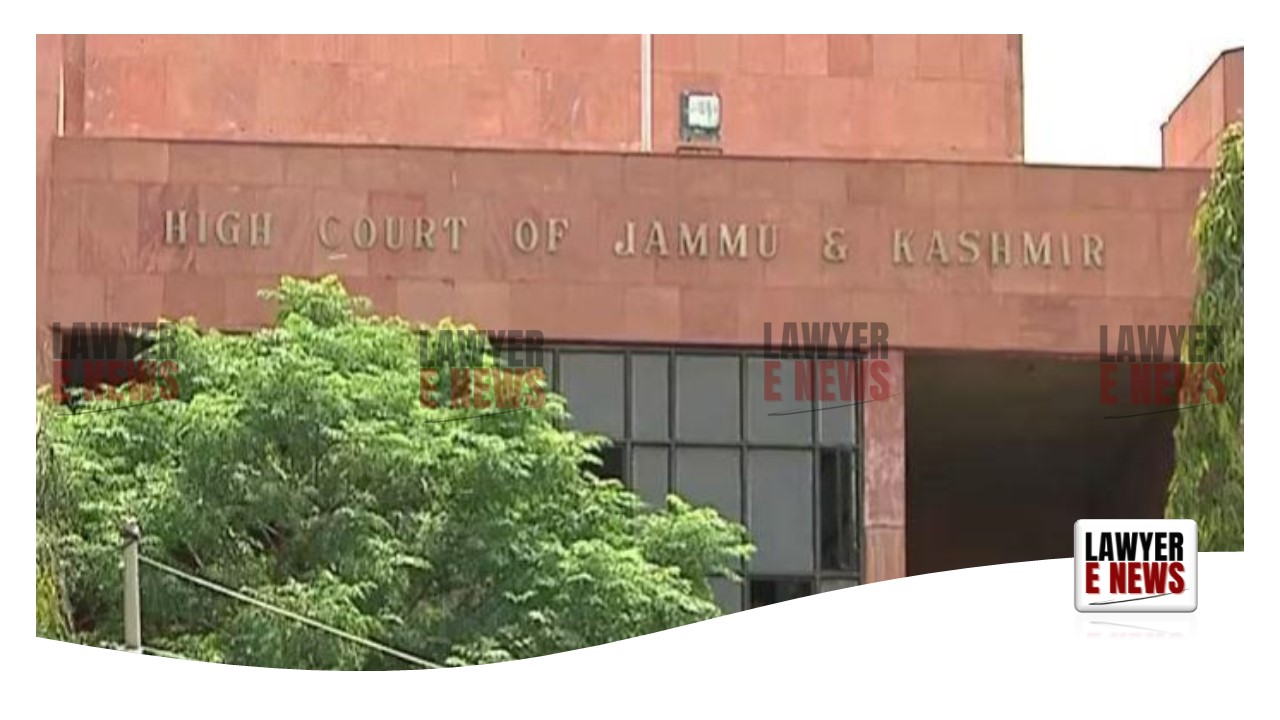
Each Day Beyond the Limitation Period Must Be Explained With Sufficient Cause - Jammu & Kashmir and Ladakh High Court, in a significant ruling, dismissed a writ petition filed by Mohd Bashir, who sought to challenge a mutation order passed in 1984 under the J&K Agrarian Reforms Act, 1976. The Court refused to condone a 39-year delay, observing that limitation laws are fundamental to preventing uncertainty and unending litigation.
The dispute concerned Survey No. 1842, measuring 4 kanals, in Village Fazlabad, Tehsil Surankote, District Poonch. The land had been mutated in favor of Mohd Rafiq on April 25, 1984, as per the J&K Agrarian Reforms Act, 1976. Mohd Bashir, the petitioner, contended that he was in continuous cultivating possession of the land and that his stepfather, Qadara, had executed a Will in his favor. He alleged that the mutation was carried out behind his back, depriving him of his rightful ownership.
Bashir filed an appeal before the Additional Deputy Commissioner (Commissioner Agrarian Reforms), Poonch, in 2023, seeking cancellation of the mutation. Along with his appeal, he filed an application for condonation of delay under Section 5 of the Limitation Act. The appellate authority rejected his plea, stating that he had failed to provide any sufficient cause for the extraordinary delay. Aggrieved by this decision, Bashir approached the High Court.
Ignorance of Law is No Excuse, and 39 Years of Silence Cannot Be Justified
Bashir argued that he was illiterate and had no knowledge of the mutation until recently, when Mohd Rafiq allegedly attempted to take possession of the land. He claimed that the mutation had been fraudulently executed and that the court must take a liberal approach while considering delay in cases affecting substantive rights.
Rejecting these arguments, the High Court observed that the petitioner had failed to establish even the basic details required to justify condonation of delay. The Court noted that his application did not specify:
• The exact date when he gained knowledge of the mutation.
• The source from which he learned about it.
• Any efforts taken earlier to challenge the mutation.
• A legitimate reason why he remained silent for nearly four decades.
Referring to the Supreme Court’s judgment in Ram Nath Sao alias Ram Nath Sahu & Ors vs Gobardhan Sao & Ors (2002 Legal Eagle SC 239), the Court reiterated that "limitation laws are founded on public policy to prevent uncertainty and unending litigation. A bad cause does not transform into a good cause merely because time has passed."
The Court further emphasized that "each day beyond the limitation period must be explained with sufficient cause. The petitioner’s delay of 39 years, one month, and 20 days is neither excusable nor justifiable."
"Litigation Cannot Be Allowed to Drag Indefinitely": High Court Upholds Rejection of Appeal
Dismissing the writ petition, the High Court upheld the order of the Additional Deputy Commissioner, Poonch, and ruled that the petitioner’s delay was wholly unjustified and that condoning it would set a dangerous precedent.
"The law of limitation is not a mere formality but a fundamental principle of justice to prevent stale claims. If such extraordinary delays are condoned without valid reasons, it would lead to legal chaos and uncertainty in property rights," the Court observed.
Holding that "there is no presumption that delay in approaching the court is always deliberate, but it must be backed by reasonable and sufficient cause," the Court reaffirmed the principle that limitation laws are necessary to prevent unending disputes and safeguard the legal system from anarchy.
The ruling by the Jammu & Kashmir and Ladakh High Court underscores the importance of adhering to statutory limitation periods. By refusing to condone the 39-year delay, the Court has reinforced the principle that litigation must have finality, and endless delays cannot be permitted under the garb of ignorance or illiteracy.
Date of Decision: 10 March 2025