-
by sayum
14 August 2026 3:21 PM







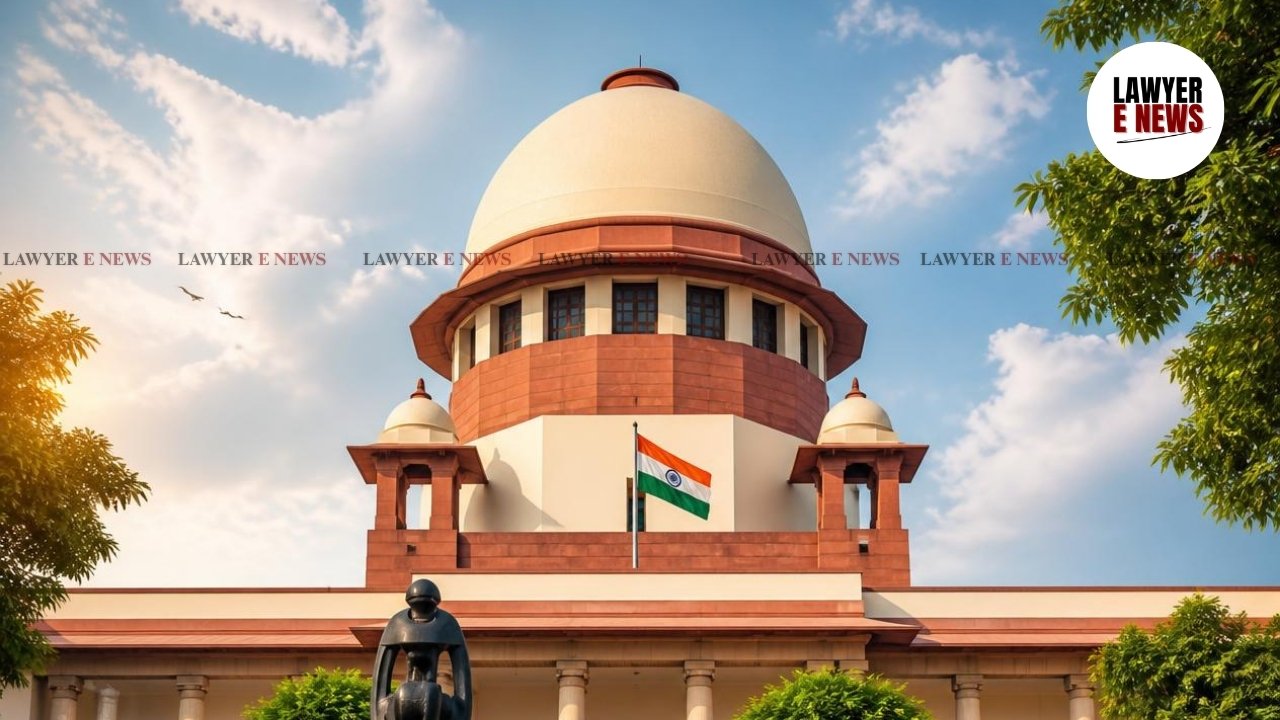
"A combined reading of Clauses 8, 9 and 10 discloses a single interlocking arrangement and not three independent obligations." Supreme Court, in a significant ruling dated July 21, 2026, held that multiple maintenance clauses in a divorce settlement must be interpreted harmoniously as an interlocking arrangement rather than independent, perpetual obligations.
A bench comprising Justice Sanjay Karol and Justice Augustine George Masih observed that where a settlement explicitly stipulates a discharge condition upon payment of a specific lump sum, an interim income-linked maintenance clause ceases to operate once that condition is fulfilled.
The parties dissolved their marriage by mutual consent in 2015 under Section 13B of the Hindu Marriage Act, 1955, filing a settlement petition containing specific maintenance clauses. The husband agreed to pay a total lump sum of Rs. 2.20 crore (Clause 8), 20% of his annual income (Clause 9), and a discharge provision stating that after payment of the first Rs. 1 crore, no further maintenance would be payable (Clause 10). In 2022, nearly five years after the lump sum was paid, the wife filed an execution petition under Section 36 read with Order XXI Rule 10 of the Code of Civil Procedure, 1908, claiming the income obligation was perpetual, which was dismissed by the courts below.
The primary question before the court was whether Clause 9 of the settlement constituted an independent and continuing obligation that survived the lump sum payments made under the settlement. The court was also called upon to determine whether the general obligation of a father to maintain a dependent child could be invoked during execution proceedings to revive a discharged term of a consent decree.
Clauses Form A Single Interlocking Arrangement
The Supreme Court rejected the appellant-wife's contention that the income-linked maintenance under Clause 9 was a standalone, perpetual obligation. The Court noted that Clause 8 fixed the total quantum of maintenance at Rs. 2.20 crore, while Clause 9 provided an interim mechanism to secure the child's maintenance while the husband liquidated properties to pay the lump sum. The bench reasoned that the agreement must be read holistically to understand the true commercial and legal logic intended by the parties.
"Clause 10 identifies the point of discharge, namely, once Rs. 1,00,00,000/- stood paid, the interim mechanism came to an end and only the balance under Clause 8 remained payable."
Express Clauses Cannot Be Rendered Otiose
Addressing the argument that reading Clause 10 as a discharge would render Clause 9 redundant, the Court emphasized the established canon of construction that an interpretation rendering an express clause otiose must be eschewed. The bench highlighted that accepting the wife's interpretation would denude Clause 10 of all its content, leaving its explicit words of discharge with nothing to operate upon. The Court found that the parties consciously moved from an open-ended structure to a time-bound capital settlement designed to achieve finality.
No Repugnancy Between The Clauses
The appellant relied on the precedents in Ramkishorelal v. Kamal Narayan and Radha Sundar Dutta v. Mohd. Jahadur Rahim to argue that when clauses conflict, the earlier clause prevails. The Court distinguished these rulings, noting that this rule of construction is attracted only where two clauses are so repugnant to each other that they cannot possibly be reconciled. The bench held that Clause 10 merely marks the point at which the interim obligation concludes, without contradicting the preceding clause.
"Clauses 8, 9 and 10 stand together as a coherent whole and admit of a harmonious reading."
General Duty Cannot Rewrite Concluded Settlements
The Court also examined the invocation of the father's general duty to maintain a dependent child, citing Kirti Malhotra v. M.K. Malhotra and Jayvardhan Sinh Chapotkat v. Ajayveer Chapotkat. The bench firmly held that an execution petition seeks only the enforcement of a specific covenant of a concluded consent decree. The executing court cannot utilize general principles of maintenance to substitute a fresh and larger provision when the agreed covenant already stands fully satisfied.
"The general principle, whatever be its content, cannot be made a vehicle for rewriting the terms of a settlement which the parties themselves arrived at and acted upon."
Executing Court Cannot Go Behind The Decree
Highlighting the limited scope of execution proceedings, the Court observed that an executing court cannot embark upon a fresh adjudication of the rights of the parties. The bench ruled that the enquiry remains confined to whether, on a true construction of the settlement, the obligation remains enforceable. Furthermore, the Court noted that the wife's conduct, having remained silent for nearly five years after the final payment without demanding the annual income, fortified the finding that she understood the settlement exactly as constructed by the courts.
Limits of Article 142 Powers In Execution Appeals
The Court declined the appellant's alternative prayer to create a one-time corpus of Rs. 6 crore for the son's higher education abroad under Article 142 of the Constitution of India. The bench observed that issuing such a direction would amount to recasting a settlement which stands performed and discharged. The Court clarified that its extraordinary jurisdiction cannot be employed to supplant the concluded and acted-upon terms of a consensual arrangement by undertaking a fresh determination of maintenance.
The Supreme Court ultimately dismissed the appeal, affirming the concurrent findings of the Family Court and the High Court that the husband's maintenance obligations under the settlement stood completely satisfied. However, noting the husband's voluntary transfer of Rs. 1 crore during the pendency of the appeal to secure the son's foreign admission, the Court directed that this amount be utilized solely towards the child's educational expenses without any right of reimbursement.
Date of Decision: 21 July 2026