-
by sayum
27 August 2026 7:40 AM







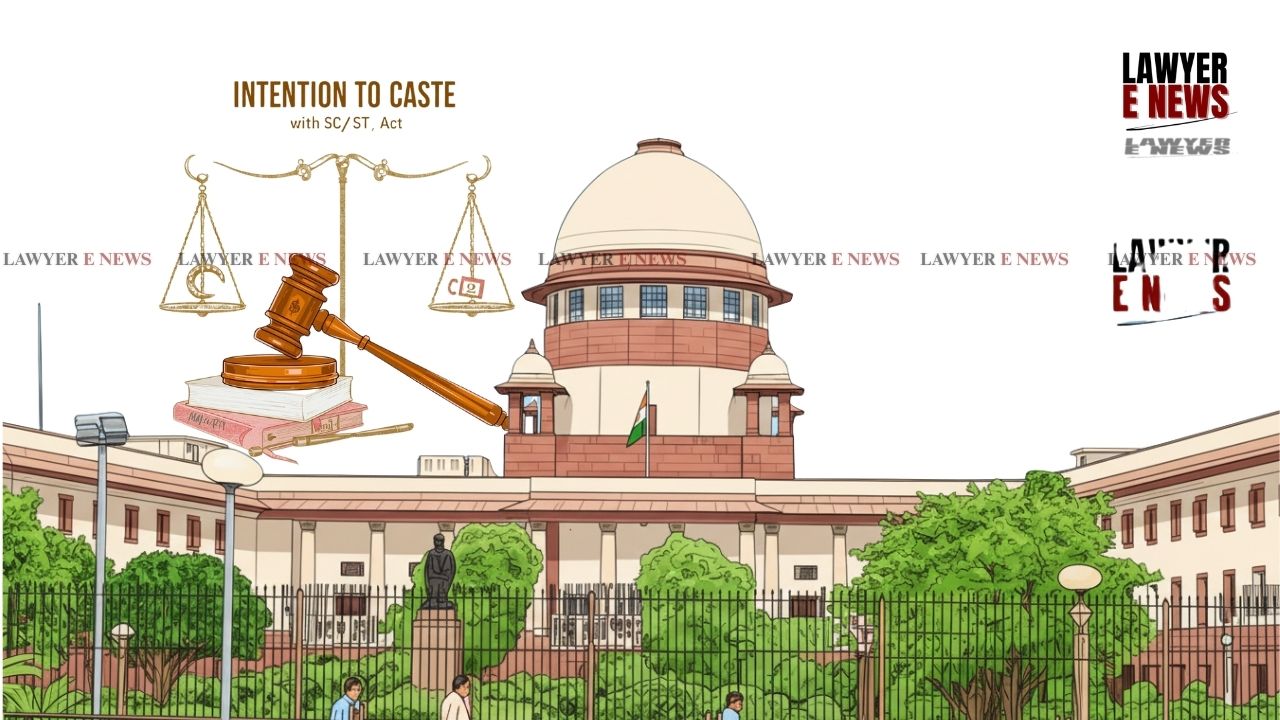
“Mere Presence Not Enough to Face Trial…Putting the appellant into trial along with co-accused would be a travesty of justice” – In a significant judgment reaffirming the need for strict adherence to statutory ingredients under the Scheduled Castes and Scheduled Tribes (Prevention of Atrocities) Act, 1989, the Supreme Court on January 12, 2026, quashed criminal proceedings against a man accused under the SC/ST Act and the Indian Penal Code (IPC), holding that mere presence at the scene without any specific overt act or caste-based abuse cannot justify prosecution.
The bench of Justice J.B. Pardiwala and Justice Alok Aradhe set aside the order of the Patna High Court dated February 15, 2025, which had upheld the trial court's decision to take cognizance of offences under Sections 341, 323, 379, 504, 506, and 34 of the IPC, along with Sections 3(1)(r) and 3(1)(s) of the SC/ST Act.
“Intention to Humiliate on Account of Caste Is Essential Under Sections 3(1)(r) and 3(1)(s)”: Supreme Court Clarifies
The Supreme Court critically examined the FIR, chargesheet, and materials placed on record to determine whether the statutory ingredients of the offences under the SC/ST Act were satisfied. The bench observed:
“It does not seem to be the case of the prosecution that the appellant herein uttered any word from his own mouth.”
Further analyzing Section 3(1)(r) and Section 3(1)(s) of the SC/ST Act, the Court emphasized that the intent to humiliate a person on the ground of caste is essential to attract the penal provisions. Citing the precedent in Shajan Skaria v. State of Kerala, 2024 SCC OnLine SC 2249, the Court reiterated that:
“The offence under Section 3(1)(r) cannot stand merely on the fact that the complainant is a member of a Scheduled Caste or a Scheduled Tribe, unless the insult or intimidation is with the intention to humiliate such a member of the community.”
Similarly, for Section 3(1)(s), the Court explained that mere abusive language or reference to a caste is not sufficient. The abuse must be specifically by caste name and must be intended to humiliate in public view.
In the present case, the bench found no such allegation or content either in the FIR or the chargesheet that would suggest the appellant engaged in any caste-based abuse or intimidation.
“Criminal Trial Cannot Be Based on Vague and Omnibus Allegations”: No Vicarious Liability in Absence of Overt Act
The FIR alleged that the informant was sitting with his friend at a local Anganwadi Centre when multiple accused, including the appellant, abused him. However, no specific act or utterance was attributed to the appellant in the entire narrative. The prosecution admitted during arguments that the only allegation was the appellant’s presence at the scene, with no claim that he personally hurled any caste-based abuse.
The Court observed:
“Mere presence of the appellant does not establish his participation in the alleged offence.”
The bench reaffirmed that vicarious liability cannot be fastened in criminal law without specific material connecting an accused to the alleged crime. General allegations or mere proximity to co-accused do not suffice to proceed with prosecution.
“Putting the Appellant on Trial Would Be Travesty of Justice”: SC Quashes Cognizance and Summoning Order
Holding that continuation of the criminal proceedings would amount to abuse of the process of law, the Court noted:
“In such circumstances… putting the appellant into trial… will be a travesty of justice.”
The bench accordingly quashed the cognizance and summoning order dated October 9, 2020, issued by the Special Judge, SC/ST Court, Bhagalpur, and set aside the Patna High Court’s refusal to interfere.
The Court allowed the appeal and concluded:
“This appeal succeeds and is hereby allowed. The criminal prosecution against the appellant is hereby quashed.”
Conclusion: Supreme Court Emphasizes the Need for Precision in Allegations Under SC/ST Act
This judgment is a resounding reaffirmation of the principle that penal statutes—especially those under the SC/ST Act—must be construed strictly, and criminal trials cannot be permitted to proceed without foundational facts satisfying the statutory elements. The decision also reinforces that mere presence or association with co-accused is not enough to put a person through the rigors of criminal prosecution.
Date of Decision: 12 January 2026