-
by sayum
27 July 2026 3:39 PM







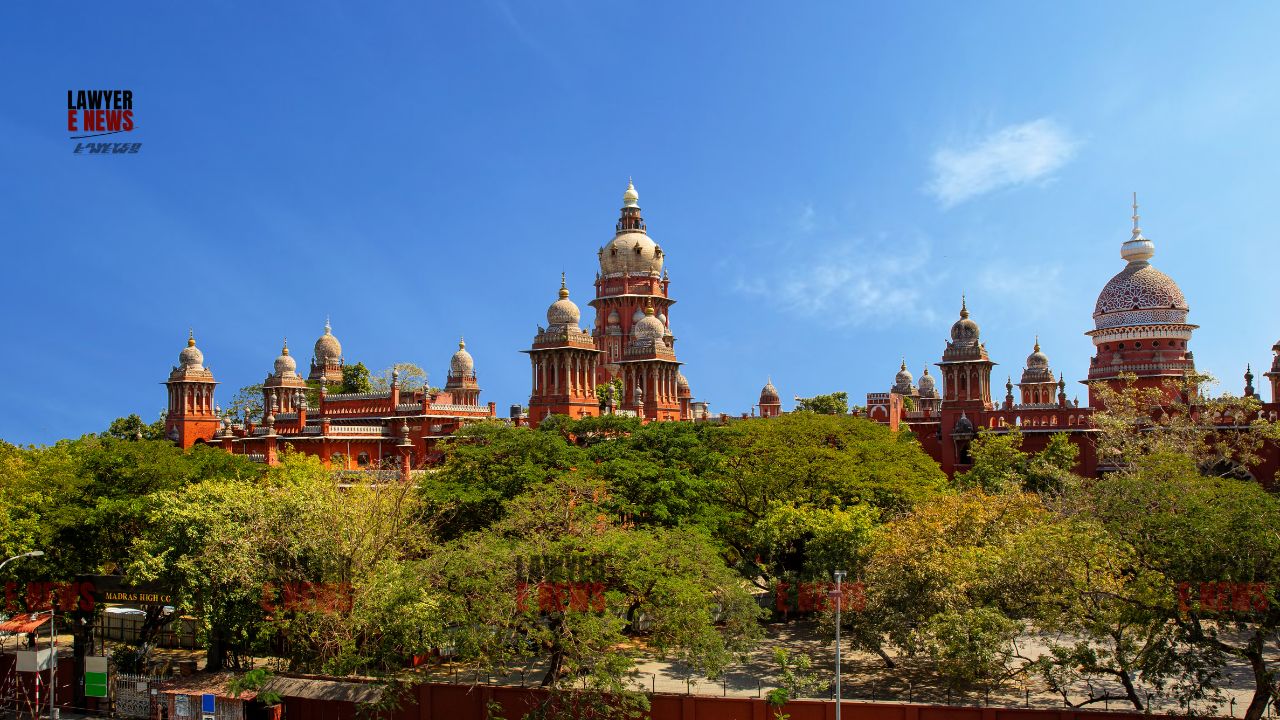
"It is well settled that the Indian Trust Act is inapplicable to public or even private religious or charitable endowments. The Act relates only to private trusts and trustees. The case on hand pertains to a public religious charity. Section 108 of the HR&CE Act will also kick in," Madras High Court (Madurai Bench), in a significant ruling, held that properties dedicated to public religious charities constitute "specific endowments" under the Tamil Nadu Hindu Religious and Charitable Endowments (HR&CE) Act and cannot be alienated without the express permission of the HR&CE Commissioner.
A bench of Justice G.R. Swaminathan and Justice R. Poornima observed that the Indian Trust Act, 1882, has no application to such endowments, rendering any sale permitted by a civil court under the Trust Act as coram non judice (without jurisdiction).
The dispute involved a property set apart for religious charities in a 1960 partition deed among the descendants of one Vada Venkada Konar. Although the Principal Sub-Court at Trichy had granted permission to sell the property in 2003 under the Indian Trust Act, the appellants challenged the subsequent 2010 sale to the 19th defendant, alleging that it was fraudulent and violated the court's directions. The trial court had dismissed the suit, leading to the present appeal.
The primary questions before the court were whether the auction sale was in conformity with the directions of the Sub-Court and whether the Indian Trust Act applies to public religious charities. The court also determined if a suit to set aside the sale of an endowment is maintainable without a prayer for recovery of possession and whether it was barred by limitation.
Property Dedicated To Charity Constitutes A 'Specific Endowment'
The court began by analyzing the 1960 partition deed, which had set aside "M" schedule properties for performing various religious charities, including feeding pilgrims and contributing to temple festivals. The bench noted that these activities clearly attract the definition of "religious charity" and "specific endowment" under Sections 6(16) and 6(19) of the HR&CE Act, 1959.
Referencing the Supreme Court's decision in Sri Renganathaswamy Vs. Ramanuja Koodam Anandhana Trust (2020), the bench emphasized that a charity associated with a Hindu festival or observance of a religious character is a public charity. The court concluded that once a property is designated as a specific endowment, it falls squarely within the regulatory framework of the HR&CE Act.
Civil Courts Lack Jurisdiction To Permit Sale Under Indian Trust Act
The bench observed that the Principal Sub-Court had erroneously assumed jurisdiction by entertaining a petition under Section 34 of the Indian Trust Act, 1882. The court clarified that the Trust Act relates only to private trusts and is expressly inapplicable to public or private religious and charitable endowments.
"When the field is occupied by the provisions of the HR&CE Act, the issues will have to be adjudicated only within its four corners. The order dated 16.09.2003 made in O.S.No.382 of 2002 on the file of the Principal Sub-Court, Trichy appears to be without jurisdiction."
All Trustees Must Jointly Execute Sale Deeds For Trust Property
A critical legal infirmity identified by the High Court was the non-joining of all trustees in the sale transaction. The court noted that while there were 22 descendants who were essentially joint trustees, only four of them (Defendants 15 to 18) had authorized the sale. The bench cited the precedent in Janakirama Iyer v. Nilakanta Iyer (1962) to reiterate that all trustees must join in a transaction unless the power is specifically delegated.
The court held that the absence of the plaintiffs from the sale transaction rendered the 2010 sale deed void. The bench remarked that the performance of religious charities requires the court to assume the role of parens patriae to protect the endowment's interests, regardless of the previous litigation history between the parties.
Auction Process Vitiated By Fraud And Irregularities
The bench expressed deep concern over the manner in which the auction was conducted. It found that the advocate-auctioneer failed to follow the Sub-Court's directions, such as publishing notices in two newspapers and ensuring a transparent bidding process. Furthermore, while the auction notice required immediate deposit of the sale price, the 19th defendant paid the amount nearly two years later.
"The answers given by the 19th defendant also throw considerable doubt on whether the auction itself was actually conducted. The whole thing appears to be a stage-managed affair and reeks of fraud. Fraud unravels everything."
Suit To Set Aside Endowment Transfer Governed By 12-Year Limitation
On the issue of limitation, the court set aside the trial court's finding that the suit was time-barred. It held that Article 94 of the Limitation Act is the appropriate provision, which allows a period of 12 years to set aside a transfer of immovable property comprised in a religious or charitable endowment made by a manager for valuable consideration. Since the sale took place in 2010 and the suit was filed in 2015, it was well within time.
Possession Follows Title For Vacant Lands
Addressing the 19th defendant's contention that the suit was not maintainable without a prayer for recovery of possession, the court held that for vacant sites, possession follows title. Citing Indore Development Authority vs. Manoharlal (2020), the bench reasoned that since the sale process was fraudulent and void, the defendant acquired no title and thus could not be in legal possession.
The court allowed the appeal, setting aside the trial court's judgment and decreeing the suit as prayed for. It declared the sale deed dated June 28, 2010, as null and void. However, in the interest of equity, the 19th defendant was permitted to withdraw the sale consideration of Rs. 25,20,518/- along with any accrued interest from the bank deposit.
Date of Decision: 04 June 2026