-
by sayum
14 August 2026 3:21 PM







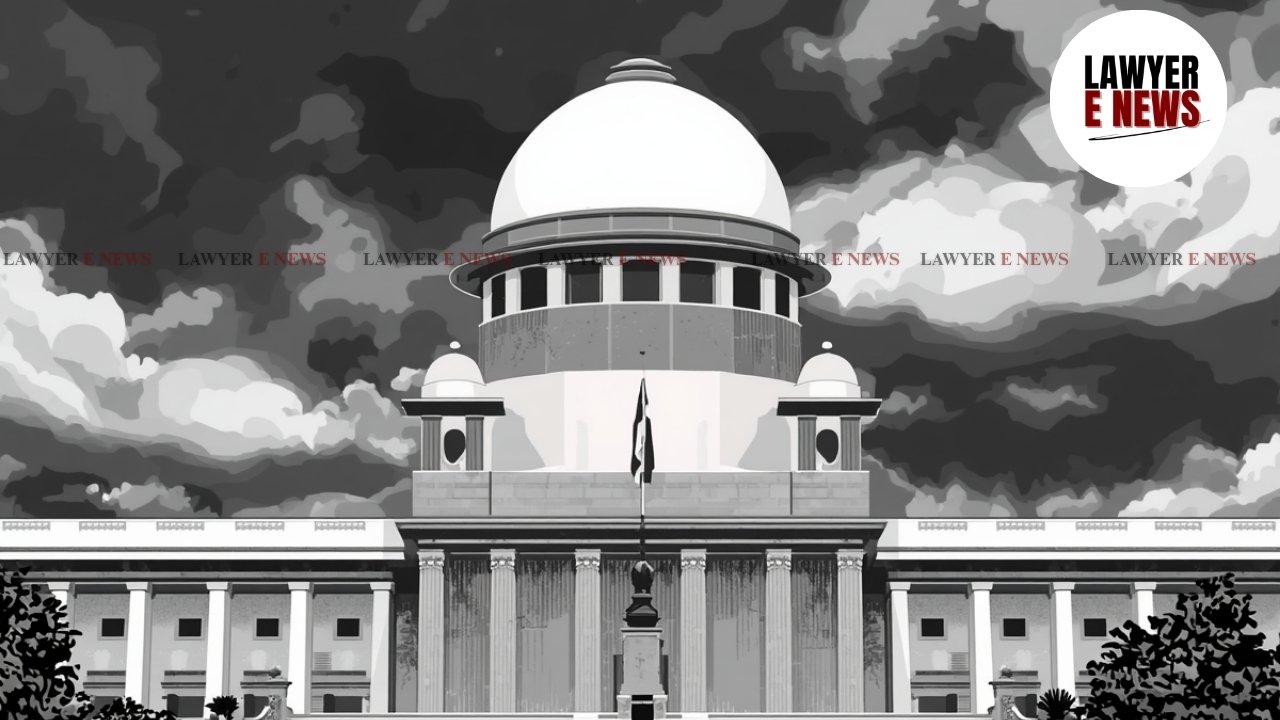
"As a means to check evasion, a measure has been prescribed under which ad valorem will be arrived at to check manipulation and to strike at evasion, certain factors have been loaded on to the sale value and we find nothing illegal in the same." Supreme Court, in a significant ruling dated July 13, 2026, held that the inclusion of royalty and other statutory contributions in the 'sale value' for determining the Average Sale Price (ASP) of minerals is constitutionally valid.
A bench of Justice J.B. Pardiwala and Justice K.V. Viswanathan observed that such a mechanism serves as a regulatory measure to prevent the evasion of state revenue through price manipulation. The Court emphasized that the "measure of a levy" is a matter of legislative policy and does not necessarily need to be contoured along the lines of the "nature of the levy."
The petitioners, including Kirloskar Ferrous Industries Ltd., challenged the validity of Explanations appended to Rule 38 of the Mineral Concession Rules, 2016, and Rule 45 of the Mineral Conservation and Development Rules, 2017. They argued that including royalty, District Mineral Foundation (DMF), and National Mineral Exploration Trust (NMET) payments in the "sale value" created a cascading effect. This, according to the petitioners, resulted in a "royalty on royalty" computation that was ultra vires Section 9 of the Mines and Minerals (Development and Regulation) Act, 1957.
The primary question before the Court was whether the non-deduction of royalty, DMF, and NMET from the gross amount for computing "sale value" violates the concept of ad valorem under the MMDR Act. The Court was also called upon to determine if this mechanism was manifestly arbitrary under Article 14 or an unreasonable restriction on the right to carry on business under Article 19(1)(g) of the Constitution of India.
Presumption Of Constitutionality Of Subordinate Legislation
The Court began by reiterating the fundamental principle that there is a strong presumption in favour of the constitutionality of not just plenary legislation, but also subordinate legislation. Citing State of Tamil Nadu v. P. Krishnamurthy, the bench noted that the burden lies heavily on the petitioner to displace this presumption. The Court observed that a rule can only be struck down if it is manifestly arbitrary or directly inconsistent with the mandatory provisions of the parent statute.
Distinction Between Nature Of Levy and Measure Of Levy
Addressing the core contention regarding the "cascading effect," the Court highlighted the well-settled distinction between the subject matter of a levy and the standard by which the amount of levy is measured. The bench noted that the measure of the levy is not the true test of the nature of the levy. In fiscal matters, the legislature possesses a broad discretion to design the measure of a tax or royalty to suit policy objectives and administrative convenience.
"The measure of the levy is not the true test of the nature of the levy."
The Court relied on the Federal Court's decision in Ralla Ram v. Province of East Punjab and the Supreme Court's ruling in Bombay Tyre International Ltd. to explain that a broad-based standard can be adopted for determining the measure of a levy. The bench held that as long as the standard maintains a reasonable nexus with the essential character of the levy, it cannot be deemed invalid.
Measure As An Antidote To Check Evasion
A significant portion of the judgment focused on the Union of India’s justification that the impugned mechanism was an "antidote to check evasion." The Union demonstrated through data that miners often reported lower ex-mine prices for higher quantities of despatches to depress the ASP, thereby reducing their liability for royalty and auction premiums. The Court accepted this reasoning, noting that regulatory interventions are necessary to suppress such mischief and arrive at the fair value of the mineral.
"Regulatory interventions are needed to suppress the mischief and advance the remedy and to arrive at the fair value of the mineral."
Comparison With Coal Industry Held Unjustified
The petitioners had argued that the government had already remedied this anomaly for the coal sector by allowing deductions of statutory dues. However, the Supreme Court rejected this comparison, terming it as "comparing apples and oranges." The bench noted that while coal production is largely a monopoly of Public Sector Undertakings like Coal India Limited, the iron ore sector involves numerous private players. This difference in market structure necessitates a different mechanism, such as the ASP-based system, to curb under-invoicing.
Public Interest Overrides Individual Hardship
On the aspect of "royalty on royalty" causing financial hardship, the Court invoked the legal maxim "Salus populi suprema lex", stating that the welfare of the public is the highest law. The bench observed that even if a fiscal measure causes hardship to some individuals, it cannot be a ground for unconstitutionality if it serves the larger public interest of protecting state revenue.
"Private rights will have to cede to public interest. A Constitutional Court should be loath to interfere in the absence of legitimate grounds."
Committee Reports Not Binding For Judicial Review
The Court also addressed the petitioners' reliance on the Praveen Kumar and Dr. Aruna Sharma Committee reports, which had recommended removing the cascading effect. The bench held that such reports are purely recommendatory in nature. The government’s decision not to accept these recommendations is a policy choice that does not render the existing rules illegal or arbitrary.
Concluding the analysis, the Court found no infirmity in the impugned Explanations. It held that the rules comport with the parent MMDR Act and do not violate Articles 14 or 19(1)(g) of the Constitution. Consequently, the Court dismissed the writ petition, validating the inclusion of royalty, DMF, and NMET in the calculation of sale value for determining the Average Sale Price.
Date of Decision: July 13, 2026