-
by sayum
26 August 2026 10:38 AM







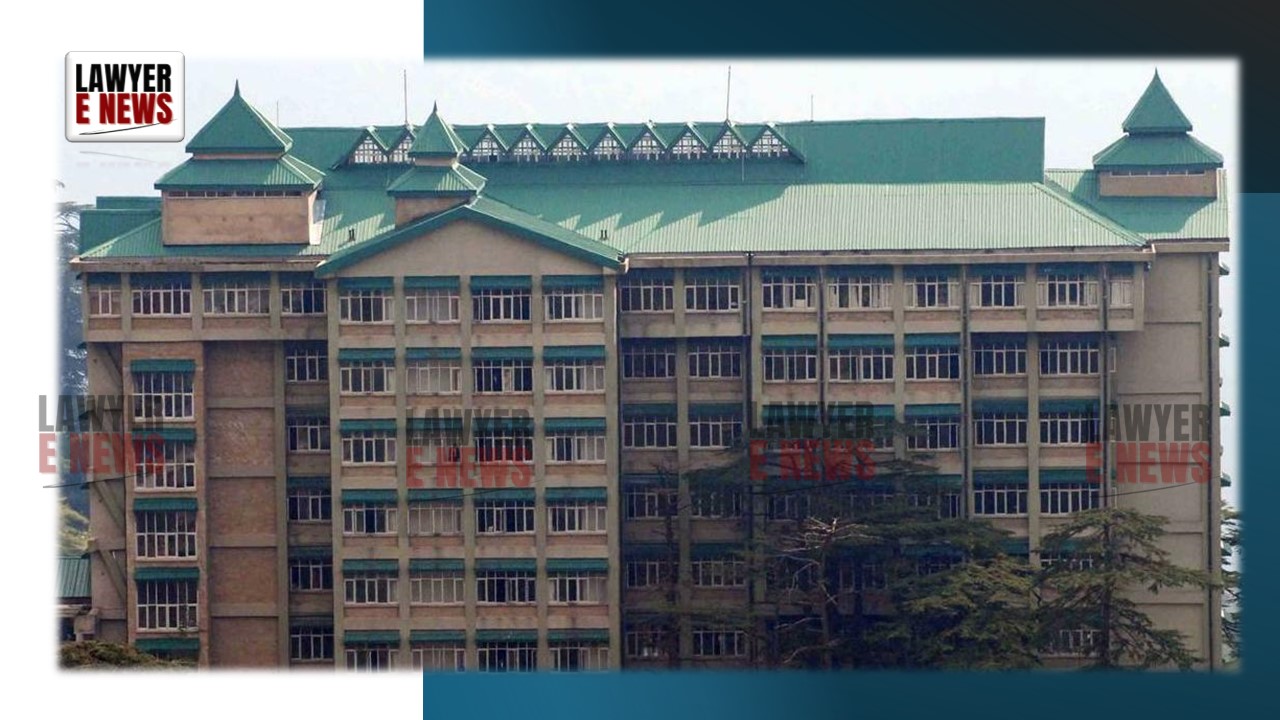
Himachal Pradesh High Court upheld the convictions of Kamal Singh, Kuldeep Singh, Bhagat Ram, and Rakesh Kumar in a 1997 assault case arising from a land dispute. The court reaffirmed the decision of the Sessions Court, which sentenced Kamal Singh and Kuldeep Singh to two years of rigorous imprisonment, and imposed fines on Bhagat Ram and Rakesh Kumar. The court relied heavily on eyewitness accounts and medical evidence to support the convictions, rejecting the defense's claim of a land ownership dispute.
The altercation occurred on September 27, 1997, when Satish Kumar, the informant, was driving a tractor near his home in Haroli village, Himachal Pradesh. The accused—Kamal Singh and Kuldeep Singh, armed with pickaxes, along with Bhagat Ram and Rakesh Kumar—blocked his path. The dispute allegedly stemmed from Bhagat Ram encroaching on government land adjacent to the informant’s property.
As Satish attempted to pass through what he described as a common passage, the accused threatened him. Kamal Singh and Kuldeep Singh struck Satish on the head with pickaxes, causing severe injuries. Bhagat Ram and Rakesh Kumar further assaulted him with kicks and fists. His parents, alerted by his cries, intervened and rescued him. A police report was filed immediately, and medical examinations confirmed that Satish had sustained grievous injuries to the head, including a palpable skull fracture.
The trial court had initially acquitted the accused, citing insufficient evidence. However, the Sessions Court overturned the acquittal in 2009, based on the credibility of eyewitness testimonies and the medical reports indicating injuries caused by sharp-edged weapons.
The key legal question was whether the evidence—particularly the testimonies of eyewitnesses and the medical reports—was sufficient to prove beyond reasonable doubt that the accused were guilty of assault. The defense claimed that the injuries were caused by an unrelated tractor accident and argued that the land in question belonged to Bhagat Ram, making Satish the aggressor.
The Himachal Pradesh High Court, however, found these arguments unconvincing. It ruled that the injuries were consistent with the use of sharp weapons, as confirmed by medical experts. The court also dismissed the claim that Satish was trespassing, affirming that the incident occurred on a public path regularly used by villagers. The High Court emphasized that the minor contradictions in the testimonies of witnesses did not undermine their overall credibility.
Justice Rakesh Kainthla, delivering the judgment, highlighted the importance of medical evidence in corroborating the severity of the injuries inflicted on Satish. The court noted that the presence of blood-stained leaves at the scene, along with pickaxes recovered by the police, further supported the prosecution's case.
The court found that the injuries on Satish’s head could not have been caused by a mere fall from a tractor, as the defense argued, but were the result of deliberate blows with sharp weapons. The medical expert testified that the wounds were deep, with brain tissue exposed, consistent with the use of pickaxes.
The court also reaffirmed that revisional jurisdiction is not a re-evaluation of evidence but is meant to address legal errors or jurisdictional defects. It upheld the appellate court's decision to convict the accused, noting that the trial court had erred in dismissing the medical evidence and eyewitness accounts.
The Himachal Pradesh High Court upheld the convictions of Kamal Singh, Kuldeep Singh, Bhagat Ram, and Rakesh Kumar for their roles in the violent assault. The court ruled that the defense failed to provide sufficient grounds for overturning the convictions, citing the consistency of the prosecution's evidence. The accused were ordered to serve their sentences, with Kamal Singh and Kuldeep Singh receiving two years of rigorous imprisonment, while Bhagat Ram and Rakesh Kumar were fined.
Date of decision: 26/09/2024
Kamal Singh & Ors. vs. State of H.P..