
-
by sayum
26 August 2026 8:37 AM







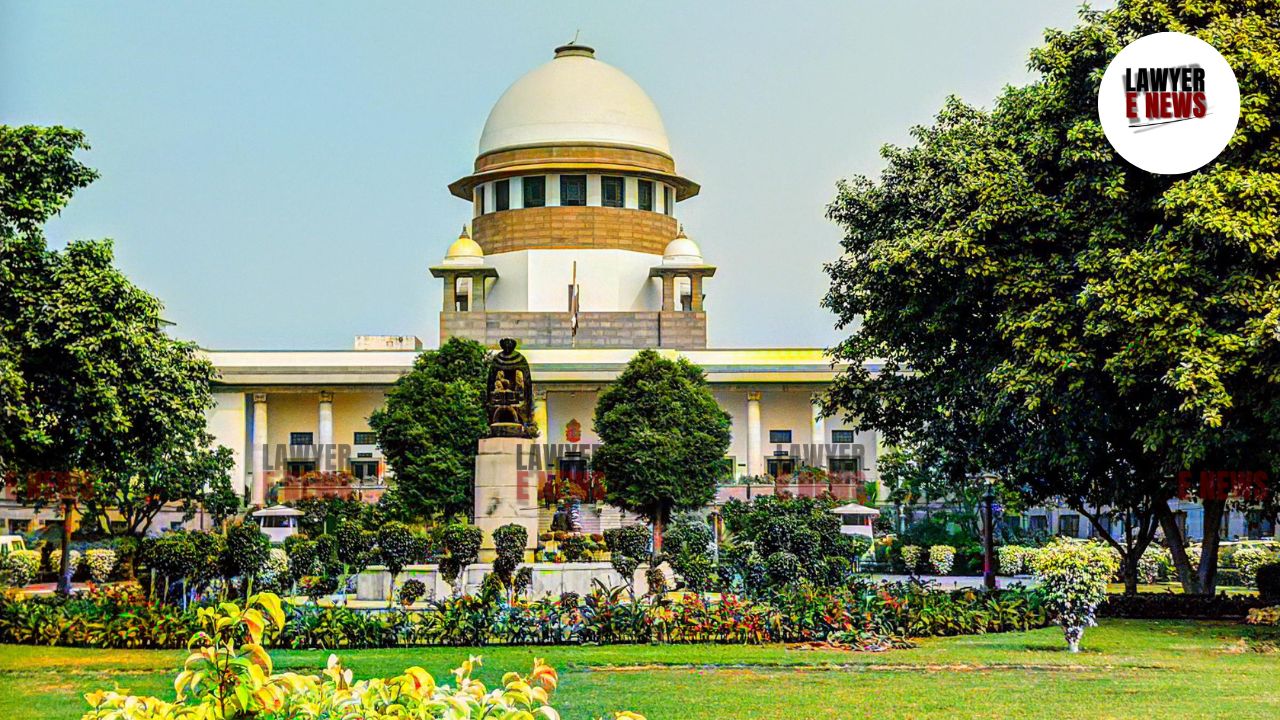
“Protection from Arrest Cannot Be a Substitute for Bail , which the law does not permit” – In a judgment that strikes at the heart of judicial discipline in criminal proceedings, the Supreme Court of India unequivocally held that High Courts cannot extend protection from arrest or impose arbitrary timelines for investigation when petitions seeking quashing of FIRs are dismissed on merits. The decision came in a batch of appeals where challenging orders of the Allahabad High Court which, while refusing to quash FIRs in a serious arms license forgery case, granted the accused interim protection and directed the investigation to conclude within 90 days.
Declaring such directions impermissible and legally unsustainable, the Bench of Justices Sanjay Karol and Nongmeikapam Kotiswar Singh ruled that the High Court had committed a manifest error in bypassing settled law and granting unauthorised judicial shelter from arrest, despite declining to interfere with the criminal proceedings.
The Court minced no words:
“Protection from arrest, while declining to interfere with the FIR, amounts to an indirect grant of anticipatory bail without judicial satisfaction under Section 438 CrPC. This is a practice that has no sanction in law.”
“Imposing Time Limits on Investigation Must Be a Response to Delay, Not a Pre-emptive Direction” – SC Cautions Against Arbitrary Deadlines
The background of the case involved the filing of FIR No. 33/2025 dated 24.05.2025 at Nai Ki Mandi Police Station, Agra, alleging procurement of arms licences through forged documents and false affidavits. The allegations were grave, implicating private individuals Mohd. Arshad Khan, Sanjay Kapoor (a former arms clerk), and Muhammad Zaid Khan, as well as officials complicit in the forgery.
While refusing to quash the FIRs, the Allahabad High Court directed that the accused should not be arrested until cognizance was taken by the Magistrate, and also ordered the police to complete the investigation within 90 days.
The Supreme Court came down heavily on this, observing that such judicial micromanagement of criminal investigations violates the constitutional balance between liberty and investigation. Justice Sanjay Karol, speaking for the Bench, observed:
“Timelines must be imposed reactively, not prophylactically. Investigations are inherently complex and unpredictable. Unless there is clear evidence of stagnation, delay, or prejudice to Article 21 rights, the imposition of deadlines is unwarranted.”
The Court further clarified that while the right to a speedy trial is part of the fundamental right to life and liberty, “judicial intervention to impose timelines cannot be used as a routine device to accelerate proceedings when no delay exists.”
“The Law Laid Down in Neeharika Must Be Followed, Not Circumvented” – Supreme Court Reiterates Binding Precedent
The High Court had relied on its earlier ruling in Shobhit Nehra v. State of U.P., where interim protection from arrest was granted in the context of a long-standing civil and familial dispute. The Supreme Court held that such reliance, without any application of mind to the facts of the present case, was wholly unjustified.
Quoting the classic principle from Quinn v. Leathem, the Court stated:
“Every judgment must be read as applicable to the particular facts proved or assumed to be proved… not as an exposition of law irrespective of the facts.”
Emphasising the danger of misapplying precedent, the Court held:
“It is ex facie evident that the impugned orders failed to conduct any factual comparison or demonstrate how the directions in Shobhit Nehra apply to the present matter. This amounts to judicial indolence and results in perverse orders.”
Turning to the binding precedent of Neeharika Infrastructure Pvt. Ltd. v. State of Maharashtra, the Supreme Court noted that the law was absolutely clear:
“Directions not to arrest during investigation, while refusing to quash an FIR, amounts to backdoor anticipatory bail without statutory compliance. Such orders must be deprecated.”
The Bench observed with concern that despite repeated clarifications from the top court, several High Courts continue to pass such orders:
“We caution the High Courts again against passing such orders of ‘not to arrest’ or ‘no coercive steps’ after declining to quash the FIR. This practice must end. The law declared by this Court is binding and must be scrupulously followed.”
“Liberty Cannot Become a Shield Against Investigation” – SC Restores Rule of Law in Forgery Case Involving Public Functionaries
The FIR against the accused alleged that arms licenses were obtained using false PAN and Aadhaar cards, and that official records were manipulated to present applicants as younger or more eligible than they were. One of the accused, Sanjay Kapoor, a former clerk in the Arms Department of Agra, was alleged to have facilitated this illegal process, in concert with private individuals.
In this context, the Supreme Court found no justification for judicial protection being extended under Article 226 of the Constitution or Section 482 CrPC.
Refusing to allow the High Court’s order to stand, the Bench held:
“Interim protection cannot be granted without satisfying the twin conditions under Section 438 CrPC. Courts must not permit circumvention of the criminal process through ad hoc judicial indulgence.”
Accordingly, the impugned orders were set aside in full, but the Court granted two weeks' interim protection to the accused to allow them to seek appropriate remedies under the law.
Date of Decision: December 19, 2025