
-
by sayum
25 August 2026 12:32 PM







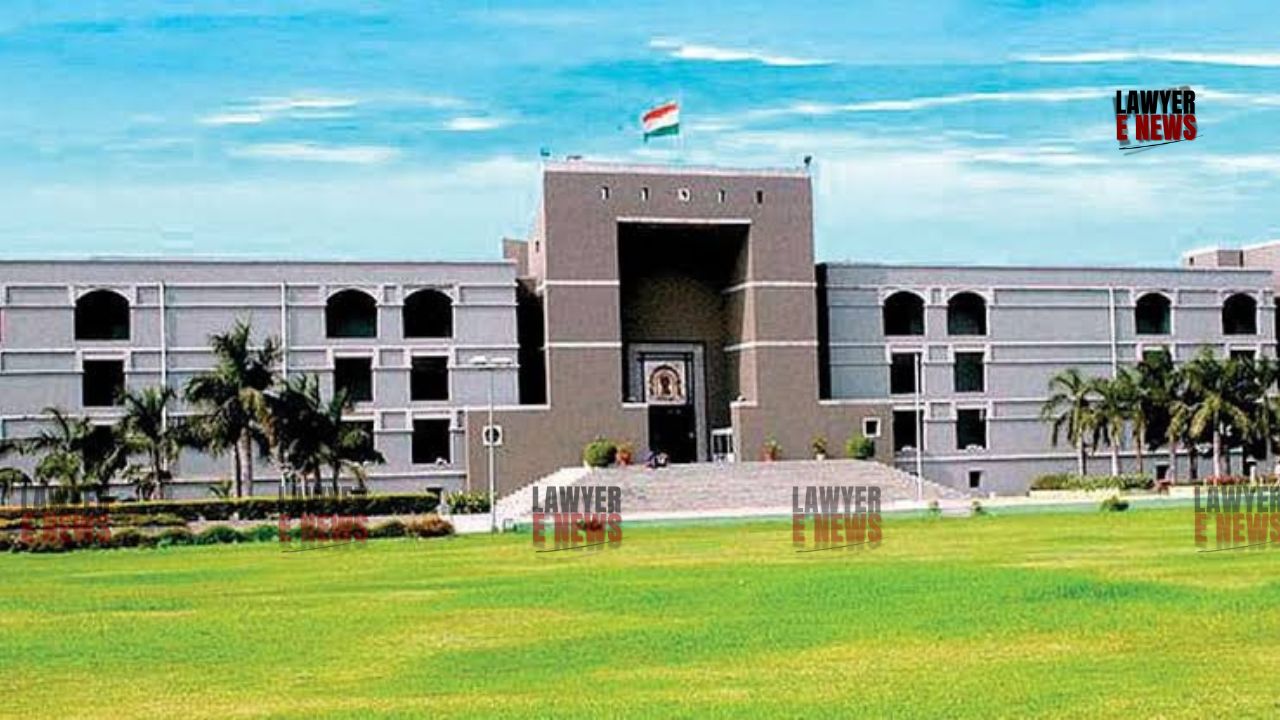
“Revisional Jurisdiction Cannot Be Used To Reassess Discretionary Bail Orders — Interlocutory Orders Bar Challenge Under Section 438 BNSS,” In a detailed and legally consequential ruling delivered on 27 January 2026, the High Court of Gujarat dismissed a batch of Criminal Revision Applications filed by nine accused individuals challenging the cancellation of their bail in an alleged ₹7.3 crore scam under the MGNREGA scheme. The Court, while refraining from examining the merits of the underlying allegations, held that orders granting, refusing or cancelling bail are purely interlocutory in nature and hence, cannot be challenged through a revision under Section 438 read with Section 442 of the Bharatiya Nagarik Suraksha Sanhita, 2023.
Justice P. M. Raval, speaking for the Court, observed:
“It is manifestly clear that the orders granting, rejecting and cancelling bail are interlocutory orders against which revision cannot lie as there is no finality to such orders, for an application for bail can always be renewed from time to time.”
The ruling carries significant implications for how accused persons must navigate bail cancellations in serious economic offences, especially under the newly enacted BNSS — the successor to the CrPC.
“Interlocutory Orders Cannot Be Invoked to Trigger Revisional Powers” — Court Relies on Settled Law from Madhu Limaye and Amar Nath
The batch of revision applications arose from an FIR registered at City A-Division Police Station, Bharuch, for serious economic offences under Sections 409, 406, 465, 467, 468, 471, 120B, and 114 of the Indian Penal Code, alleging massive embezzlement of government funds meant for rural employment under MGNREGA.
Applicants, including government officials and private contractors, had initially secured bail from the Chief Judicial Magistrate, Bharuch. However, on the State’s plea, the Sessions Court cancelled their bail, citing non-speaking bail orders, the scale of the fraud, and ongoing investigation into remaining parts of the scam.
The applicants approached the High Court under Section 438 r/w Section 442 of the BNSS challenging the cancellation. But the Court declined to entertain their applications altogether — not on merits, but solely on the ground of maintainability, invoking a well-settled principle:
“Law is settled that orders granting bail are interlocutory orders... and therefore, no revision lies under Section 438 BNSS (analogous to Section 397 CrPC).”
Justice Raval extensively cited Amar Nath v. State of Haryana [(1977) 4 SCC 137], Madhu Limaye v. State of Maharashtra [AIR 1978 SC 47], and Usmanbhai Dawoodbhai Memon v. State of Gujarat [(1988) 2 SCC 271], reinforcing the proposition that bail orders do not attain finality and are inherently renewable.
“Sessions Judge May Cancel Bail Granted by Magistrate — But Revision Against Such Orders Is Statutorily Barred”
Challenging the Sessions Court’s jurisdiction, the applicants argued that cancellation of bail, in absence of supervening circumstances like tampering of evidence or threat to witnesses, was illegal. They submitted that the Magistrate was competent to grant bail since the alleged offences were triable by Magistrate and did not carry a mandatory minimum sentence.
However, the High Court sidestepped all such contentions, noting that revisional jurisdiction is not a forum for re-evaluation of bail discretion, especially where no gross illegality is evident.
Citing Amit Kapoor v. Ramesh Chander [(2012) 9 SCC 460], the Court reiterated:
“Revisional jurisdiction is to be exercised only for correcting manifest error of law, patent jurisdictional defects, or perversity — not to reassess discretionary orders.”
Justice Raval emphasized that a bail order may be ill-reasoned, but unless it is perverse or illegal in a manner that infringes jurisdiction, it does not warrant interference in revision.
“Statutory Bar Under Section 438 BNSS Cannot Be Circumvented By Framing the Challenge as One Against Cancellation”
In what may serve as a guiding precedent under the BNSS regime, the Court clarified that the statutory bar against revising interlocutory orders under Section 438 BNSS is absolute. Whether the applicant frames the challenge as one against "grant", "refusal", or "cancellation" — the underlying nature of the order remains interlocutory.
The Court declared:
“There is no finality to such orders for an application for bail can always be renewed from time to time.”
Relying on coordinate bench decisions in Aarif Mohammadsharif Pipadwala v. State of Gujarat (2018) and Vithalbhai Talsibhai Parmar v. State of Gujarat (2000), the Court reinforced that no revision lies even where Magistrate grants bail in offences punishable with life imprisonment, provided the offence is triable by Magistrate.
“Maintainability Fails, Not Merits”: Court Extends Surrender Deadline for Applicants Till 16 February 2026
Importantly, the Court acknowledged that its refusal to entertain the revisions was not based on merits of the applicants' case. In view of this, Justice Raval showed leniency and extended the time to surrender by the applicants till 16 February 2026, to enable them to pursue alternative remedies under law.
“The request is found to be genuine and hence, acceded to... Registry to communicate this order to the trial Court concerned, forthwith.”
Thus, while the applicants' hope of getting bail reinstated through revision stands quashed, the door remains open for them to seek redress via other procedural channels — potentially before the appellate forum or in fresh bail proceedings before competent courts.
“High Stakes Don't Trump Procedural Barriers — Revisional Power Not A Substitute For Appeal”
This judgment marks a significant affirmation of procedural discipline under the new BNSS framework, making it clear that bail-related orders are off-limits for revision, regardless of the severity of the alleged crime.
By refusing to entertain the matter on merits despite the gravity of allegations involving MGNREGA funds misappropriation across 56 villages and ₹7.3 crore loss to the exchequer, the Court upheld the principle that legal remedies must align with statutory architecture — not with the scale of public outrage or administrative suspicion.
Date of Decision: 27 January 2026





