-
by sayum
24 August 2026 3:22 PM







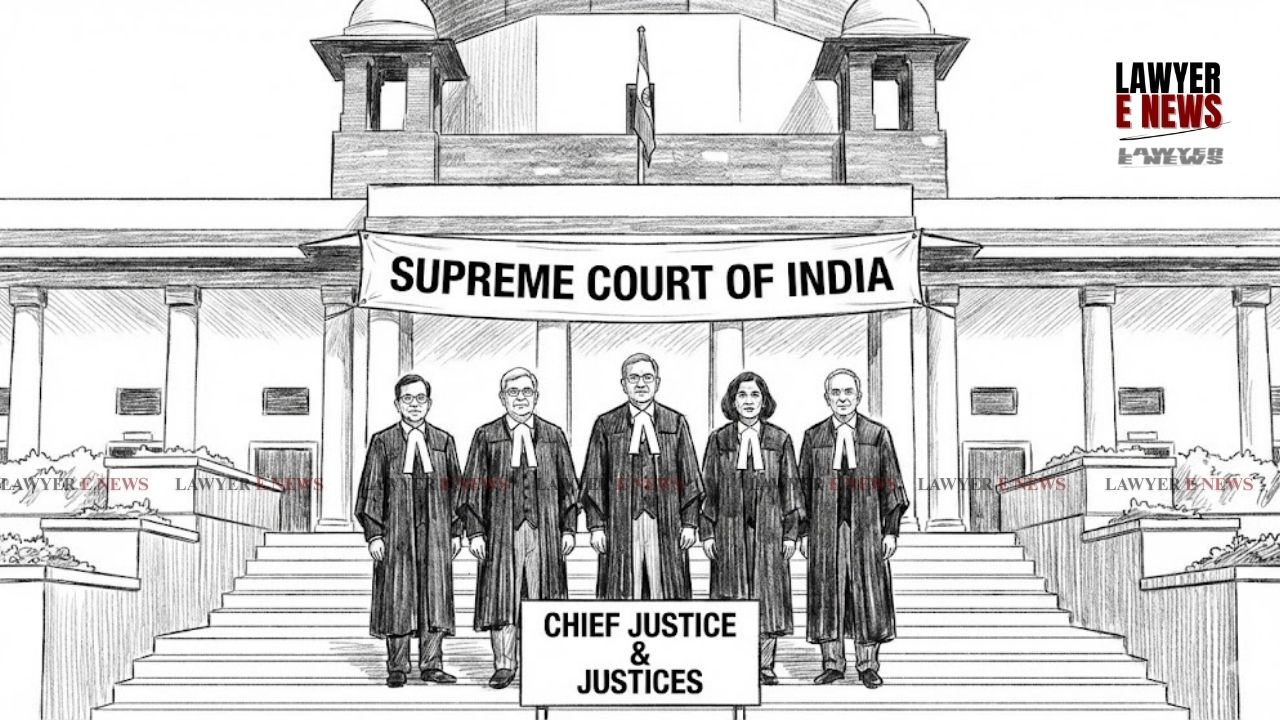
"Inaction Cannot Be Infinite – Governor Has No Veto Power, But Limited Judicial Nudging Is Permissible," In a landmark constitutional clarification , a Five-Judge Constitution Bench of the Supreme Court of India, headed by Chief Justice D.Y. Chandrachud (Justice B.R. Gavai presiding in his place), answered critical questions relating to the powers of the Governor and the President under Articles 200 and 201 of the Constitution, specifically concerning assent, withholding or reservation of State Bills.
The opinion was delivered in response to Special Reference No. 1 of 2025 made under Article 143 of the Constitution, seeking clarity on the extent, manner, and judicial review of executive discretion exercised by the Governor and the President when a State Bill is presented for assent.
The Bench, comprising Justices B.R. Gavai, Surya Kant, Vikram Nath, P.S. Narasimha and Atul S. Chandurkar, clarified that while the Governor enjoys discretion, that discretion is not absolute, not indefinite, and certainly not immune to judicial prodding in cases of unexplained inaction.
“Constitution Does Not Contemplate 'Deemed Assent' – But Courts Can Intervene to End Indefinite Silence”: Supreme Court Draws the Line Between Power and Paralysis
Introduction:
The apex court held that the Governor has only three constitutionally recognized options when a Bill is presented under Article 200 – assent, withhold and return with comments, or reserve for the President. Crucially, the Court rejected the notion of ‘deemed assent’ or a fourth implied option, declaring:
“The first proviso to Article 200 is bound to the substantive part of the provision and restricts the existing options, rather than offering a fourth option.”
At the same time, the Court acknowledged the growing concern over Governors stalling Bills for indefinite periods, and held that though the Governor’s decision is not justiciable on merits, judicial review is permissible in cases of prolonged and unexplained delay.
“In glaring circumstances of inaction that is prolonged, unexplained, and indefinite – the Court can issue a limited mandamus for the Governor to discharge his function under Article 200 within a reasonable time period.”
This nuanced interpretation strikes a careful balance between constitutional discretion and accountability.
“The Governor Is Immune, But the Office Is Not Above Scrutiny” – Court Declares That Article 361 Does Not Create a Constitutional Vacuum
The Court emphasized that Article 361, which provides immunity to the Governor and the President from being personally answerable to courts, does not bar judicial review of the constitutional office:
“The Governor continues to enjoy personal immunity, but the constitutional office of the Governor is subject to the jurisdiction of this Court.”
This observation opens the door for limited judicial directions where constitutional duties are evaded or indefinitely delayed, without violating the dignity or immunity of the officeholder.
“Courts Cannot Set Timers for Constitutional Authorities, But Can Prevent Constitutional Freeze”: No Judicial Timelines, But No Infinite Delay Either
Rejecting the idea of prescribing specific time limits within which the Governor or President must act on a Bill, the Court clarified:
“In the absence of constitutionally prescribed time limits… it would not be appropriate for this Court to judicially prescribe timelines for the exercise of powers under Article 200.”
However, it made it clear that this does not translate into limitless inaction:
“The Constitution does not contemplate a situation where a Bill passed by an elected legislature can be held in abeyance without any constitutional consequence or remedy.”
The President’s role under Article 201 was similarly treated, with the Court holding that decisions of the President are not justiciable, but again emphasizing constitutional accountability in principle.
“No Judicial Substitution for the President or the Governor – Article 142 Cannot Create Deemed Assent”
Another important issue addressed was whether the Supreme Court could use its extraordinary powers under Article 142 to treat a Bill as passed in the event of inaction by the Governor or President.
The answer was emphatically no:
“The exercise of constitutional powers and the orders of the President/Governor cannot be substituted in any manner under Article 142.”
“We clarify that the Constitution, specifically Article 142 even, does not allow for the concept of ‘deemed assent’ of Bills.”
This clarification closes the door on judicial attempts to override non-assent by creating legal fictions, and reinforces that assent is a substantive constitutional act, not a procedural formality.
“Article 143 Is Not a Precondition for Presidential Decision” – Subjective Satisfaction of the President Is Sufficient
The Bench also dealt with a procedural question – whether the President must seek advice from the Supreme Court every time a Bill is reserved by a Governor under Article 201.
The Court held:
“The President is not required to seek advice of this Court under Article 143 every time a Governor reserves a Bill… The subjective satisfaction of the President is sufficient.”
However, it clarified that if the President or the Union Government desires legal clarity, they may seek advisory opinion, as has been done in the past.
"Legislative Vacuum Cannot Be Judicially Filled" – On Whether a Bill Can Become Law Without Governor's Assent
In response to whether a State Law can come into effect without express assent, the Court answered with finality:
“There is no question of a law made by the State Legislature coming into force without assent of the Governor under Article 200.”
“The Governor’s legislative role under Article 200 cannot be supplanted by another constitutional authority.”
This ruling reaffirms the centrality of the Governor's constitutional assent, even as it recognizes the need for time-bound constitutional responsibility.
The opinion delivered by the Constitution Bench is not a verdict in litigation, but a binding advisory opinion under Article 143, which will now guide the interaction between State Governments, Governors, and the Union on contentious legislative processes. It clarifies that while discretion exists, it is not unaccountable, and while personal immunity is guaranteed, the constitutional role is not immune to scrutiny.
This judgment strikes a critical constitutional balance – rejecting judicial overreach, but asserting judicial oversight, especially to prevent executive indifference from choking legislative will.
The Court has now firmly stated that “assent cannot be assumed, but silence cannot be eternal” – a principle that will likely resonate in every future confrontation between Raj Bhavan and the State Assembly.
Date of Decision: 20 November 2025